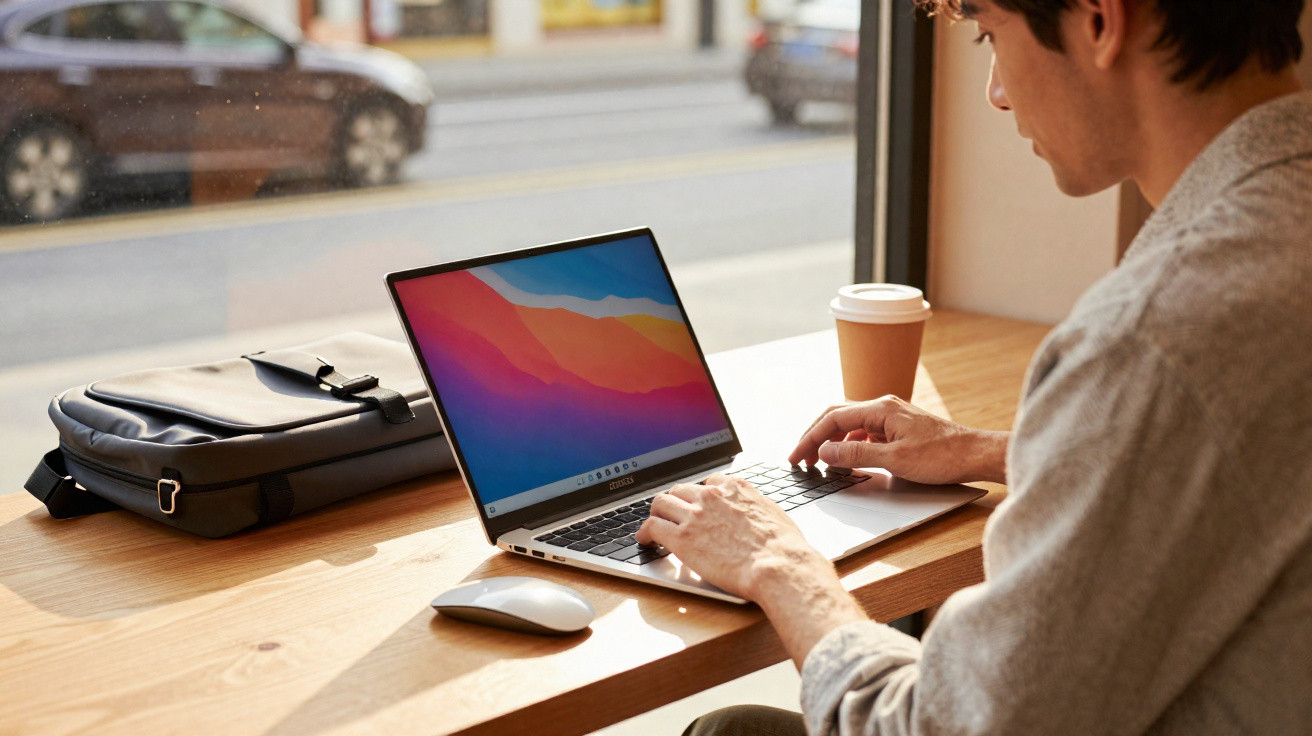
It is the display that catches you first. At a packed press table in Taipei, with every brand competing to be noticed, this laptop seems almost… implausible. Its lid is so slim that you want to handle it carefully, as though it could flex. The chassis feels more like a magazine than a computer. Yet a 4K video plays at maximum brightness across its expansive 16-inch panel, while the fans remain barely perceptible, as if the machine is making no effort at all.
Someone beside me says, only half in jest, “How is this thing real?”
This is the new Asus Zenbook A16: an ultra-thin, ultra-light laptop centred on a large screen that does not feel cumbersome. It sits confidently in a market where most 16-inch laptops still suggest a “desktop replacement” and a sore back from carrying them around.
More unusually, it could finally bring an end to the familiar compromise between performance and portability.
The large-screen laptop that never feels oversized
On paper, the Zenbook A16 appears contradictory: a 16-inch laptop in a body that feels much nearer to a 14-inch model, one that fits into a slim sleeve rather than requiring a thick, padded case. Asus has reduced the bezels so dramatically that the display nearly reaches the edges, leaving your eyes focused on the panel rather than its surround. When you lift it, you brace yourself for a weight that simply is not there.
Its keyboard deck is level, its design is uncluttered, and the hinge feels sufficiently firm to inspire confidence despite the thin profile. There is no noticeable flex and none of the creaking associated with cheap plastic. Tap the aluminium body and it gives back that subdued, dense sound which suggests it was made to be carried about.
The most striking aspect is not the physical design, however. It is the speed with which you stop registering that you have a 16-inch laptop with you at all.
That difference becomes especially clear beside the devices many people still rely on daily. Consider the ageing 15.6-inch “workhorse” that spends part of its life on a desk and part in a backpack, gradually punishing your shoulders. Technically, it is “portable”; in practice, every trip out of the house becomes a decision. The Zenbook A16 reverses that logic. It is the sort of laptop you would genuinely take to a café for a two-hour session without a second thought.
Asus is placing a substantial bet on precisely that experience. We are in sub-1.5 kg territory, with a closed profile approaching tablet-like slimness. For commuters and students, this can be the difference between thinking, “I’ll just use my phone,” and deciding, “I’ll take my laptop and do proper work.”
For a large display to make sense, the panel must be worthwhile in its own right. Asus uses a high-resolution 16-inch screen, offered in OLED or IPS versions according to configuration and market, and intended for both work and entertainment. It provides a wide colour gamut, rich blacks on the OLED model, and enough brightness to cope with harsh office lighting or a train seat by the window. Video timelines, two lengthy documents side by side, and sprawling spreadsheets suddenly become far less unpleasant to manage.
Zenbook A16 performance without a jet-engine soundtrack
Thin-and-light laptops once implied a predictable compromise. You received an attractive chassis, then paid for it through thermal throttling and fans that sounded like a hairdryer as soon as more than 10 browser tabs were open. The Zenbook A16 is plainly designed to move beyond that stereotype. Depending on the region, Asus supplies current Intel Core Ultra or AMD Ryzen processors, alongside fast SSD storage and generous RAM choices.
In practical terms, this is not merely a browsing and note-taking machine. It is the kind of laptop that can support a full nine-hour mixed-work day, with a browser, Slack, Photoshop and perhaps some light video editing running together, without sending you into battery-anxiety territory. Its cooling is set up to keep fan noise low during ordinary work, only becoming properly active when you demand more through exports or heavier software.
Of course, sustained and demanding 3D work can still make it work hard. For most users, though, it sits comfortably in the category of “does everything I genuinely need”.
That is important in a spreadsheet, but it is even more valuable away from one. Imagine being in a client meeting, connected to a projector through HDMI or using wireless casting. You share slides, switch to a Figma prototype, then open a sizeable Excel file that a colleague has just emailed. On older ultrabooks, this is often the moment when responsiveness drops, the fans accelerate and the battery indicator begins to look quietly alarmed in the corner.
The Zenbook A16 makes that situation feel more manageable. Asus claims full-day battery life, and although actual endurance will always vary with usage, early hands-on impressions indicate that it is intended to last through a long day of travel with sensible brightness settings and Wi-Fi enabled. Fast charging also means a brief coffee stop can provide enough power for the following meeting. There is no magic involved; it is modern silicon in a chassis engineered to shift heat efficiently rather than merely appear thin in promotional images.
Why is this pairing especially relevant now? Expectations for portable laptops have changed gradually. Hybrid working, increased video calling and more demanding web applications have made older, low-power ultrabooks seem dated. Equally, no one is keen to return to 3 kg machines. The Zenbook A16 occupies this newer sweet spot: slender enough to remain in your bag, but capable enough to serve as your sole computer at home and in the office.
Using a 16-inch laptop while travelling
The meaningful test for a device such as the Zenbook A16 is not a benchmark score but a normal week. Minor details take on greater importance: whether the lid opens one-handed while you are holding a coffee, how the trackpad behaves while you edit a photograph on a cramped aircraft tray table, and how the keyboard feels at 11 pm when you are completing a report you should have begun earlier.
This is where Asus draws on its Zenbook experience. The keyboard offers reassuring key travel and feels slightly more responsive than the shallow “butterfly” style period that many people still remember, and curse. Its trackpad is broad and accurate, handling multi-finger gestures smoothly. Port provision is notably generous for such a slim machine: USB-C for power and docking, USB-A for the ageing USB stick that a colleague still brings along, HDMI for projectors, and a headphone socket that has stubbornly survived.
If you are moving from a 13- or 14-inch laptop, one useful piece of advice is to allow yourself a few days to adjust. The way you arrange your workspace changes. There is suddenly space for three windows alongside one another, or for a video call to sit beside a document without everything becoming compressed. Once you become accustomed to it, returning to a smaller screen can feel like working through a keyhole.
Plenty of people are reluctant to move to a 16-inch laptop because they remember the wrong sort of models: heavy gaming rigs, school machines that weighed like bricks, and computers you could carry outside but almost never did. The Zenbook A16 pushes back against that baggage. For those accustomed to cafés or co-working spaces, it slips quietly into the routine: large enough for comfortable hours of use, but light and compact enough to take anywhere without deliberation.
Practically speaking, this may alter the way you organise a working day. Rather than dividing tasks between a desktop computer at home and a restrictive laptop when travelling, the A16 can act as a single base. Dock it to an external monitor in the office, disconnect it in seconds, then take exactly the same environment to your sofa or onto the train. There are no awkward resolution changes and no need to think, “I’ll wait until I’m back at my main PC.”
There is a subtler psychological advantage too: reduced friction creates more opportunities to begin that side project, portfolio or video course. With a machine like this, editing a short film or creating a Notion dashboard need not feel punitive. It can feel like using a tool that has finally caught up with your ideas.
What the Zenbook A16 suggests about the future of laptops
Step back and the Zenbook A16 looks like more than an individual product. It forms part of a gradual but persistent shift: the decline of the heavy “desktop replacement” and the rise of large-screen ultraportables. Once you have seen a 16-inch laptop weighing about as much as an older 13-inch model, the previous compromises begin to look outdated. Hardware manufacturers understand this, which is why Asus is giving the A16 such a prominent position.
Another boundary is becoming less distinct: that between productivity and entertainment. This is not a narrowly defined “business laptop”. Its large, colour-rich display and respectable speakers make it equally suited to Netflix in bed or late-night cloud gaming. That two-sided nature is important, particularly for younger buyers who do not want to divide their budget across several devices.
One Asus product manager summarised the idea at the event, while laughing slightly:
“People tell us they want a laptop that’s light like a tablet, works like a workstation, and plays like a console. We can’t break physics, but every generation gets us closer.”
- Thinner bezels are more than a styling choice: they reduce the overall footprint without reducing screen size.
- The move towards more efficient processors enables long battery life within smaller thermal envelopes.
- Large screens are no longer only for gamers and video editors - they are reaching everyday users.
- We are moving towards a time when carrying a 16-inch machine will not seem like a statement, but simply normal.
More honestly, nobody really follows that idealised “perfect productivity routine” every day, where work is always done at a desk with a large monitor and an ergonomic chair. Life is untidy. You reply to emails at the kitchen table, finish slides on a train and watch a tutorial in bed at midnight. Machines such as the Zenbook A16 are designed for that disorder, rather than in opposition to it.
A laptop that quietly resets your daily expectations
There is usually a point around the third or fourth day with a device when the novelty disappears. The specification sheet recedes, the noise from the launch event fades, and one straightforward question remains: do I enjoy living with it? The Zenbook A16 seems intended to succeed through modest, repeated advantages rather than spectacle. It means less strain on your shoulder from a bag, less squinting at confined windows and less fan noise intruding on calls.
The emotional element is more difficult to measure. A good tool can make you notice your routines changing. You begin taking a laptop out with you again rather than relying only on your phone. You reopen an editing project you had avoided because your old computer turned it into a chore. You offer to share your screen in meetings instead of hoping somebody else will do it. Everyone recognises the point at which technology stops obstructing you and quietly recedes into the background. On a good day, the A16 appears aimed directly at that sensation.
The broader question concerns what this could mean for the rest of the market. If an ultra-thin, ultra-light 16-inch machine can become a credible “daily driver”, then products that are heavier or bulkier without a compelling reason face greater pressure. It encourages rivals to reassess their priorities. It also leads users to ask different questions at their next upgrade: not only “how fast is it?”, but “do I actually want to carry this every day?” That may be where the Zenbook A16 leaves its strongest impression - not simply in benchmark results, but in the expectations we develop for every laptop that follows.
| Key point | Detail | Why it matters to the reader |
|---|---|---|
| Ultra-thin, lightweight design | Chassis close to a 14-inch model, weight below 1.5 kg | Easy to carry, with less day-to-day fatigue |
| Large 16-inch display | High resolution, OLED options, exceptionally thin bezels | Greater visual comfort for work, creative tasks and watching content |
| Performance and battery life | Modern processors, fast SSD, battery designed for all-day use | One computer for the office, home and travel |








Comments
No comments yet. Be the first to comment!
Leave a Comment