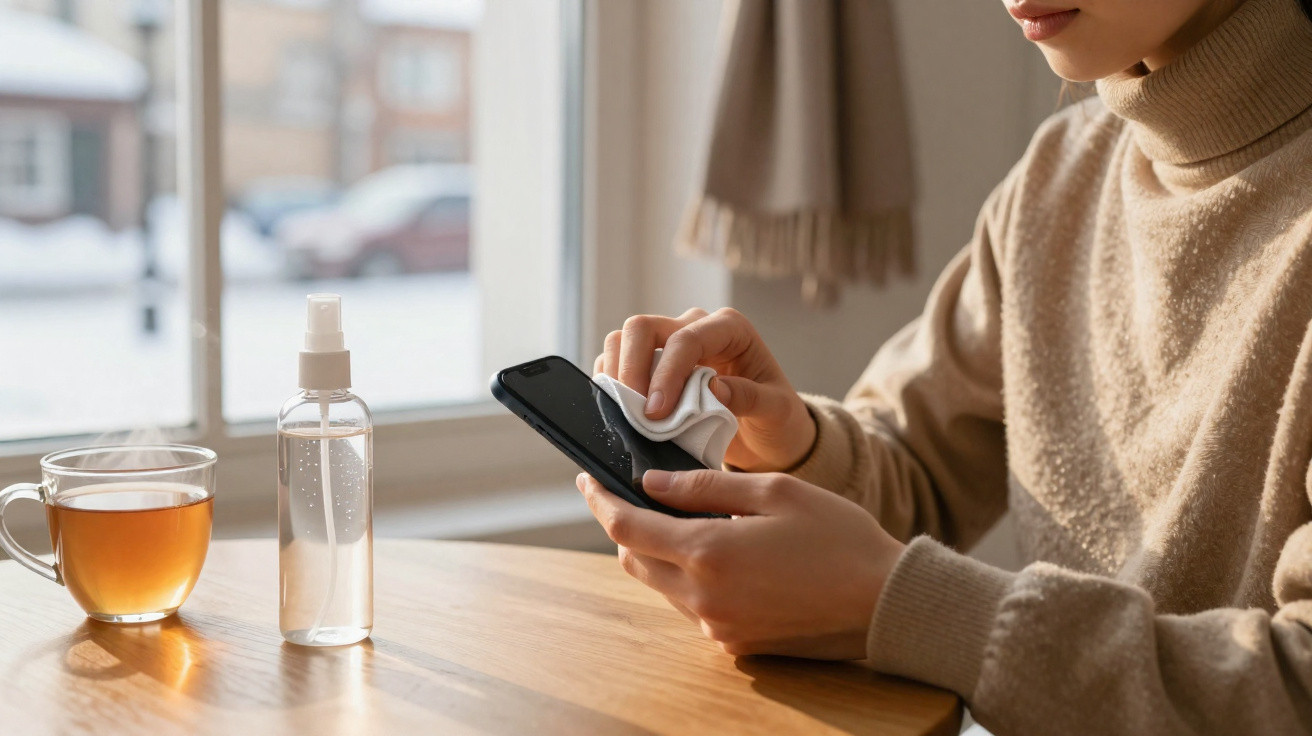
Everyone seemed to be caught in the same anxious winter routine: sniff, cough, tap, scroll, wipe their nose, then tap once more. At the next table, a woman sneezed forcefully into her hand, grimaced and immediately picked up her phone to answer a message, her thumb moving assuredly over the display. Nobody recoiled. Nobody appeared to register it.
In winter, your phone moves between your chilly hands and your warm face dozens of times each day. It goes from your pocket to a bus handrail, from a shop counter to your pillow, and from a gym locker to the dinner table. It seems harmless, familiar and almost reassuring. But its glossy surface silently gathers a seasonal film of germs, skin oil and dirt from the street.
The unsettling thought is that your phone could be the winter habit contributing to illness without you noticing.
Why your phone becomes a winter germ magnet
Winter alters the way we live. We spend more time inside, inhale the same recirculated air and stand closer together on buses and trains. Door handles, touchscreens and lift buttons all become communal surfaces. Your phone touches every one of them before returning to your face as though nothing has happened.
Central heating leaves both the air and your skin dry, making you more likely to touch your face, rub your eyes or adjust a mask or scarf. Every small movement transfers microbes from fingers to glass, and from glass to your mouth. Although a screen looks sleek and spotless, it can act like a crowded high street for viruses and bacteria. It follows you quietly through the day, picking up traces of every place you visit.
On an icy Tuesday morning in Manchester, a GP practice had recorded its fifth flu case by 9 a.m. Its waiting room was filled with winter coats, glowing screens and red noses. A teenager coughed into his fist before passing his phone to his mum to show her a video. Nearby, a toddler licked the edge of a tablet while their parent completed forms using a shared touchscreen check-in.
Research has shown that phones may carry more bacteria than a toilet seat, particularly when they are frequently handled and kept warm. In one December experiment at a London office, swabs from employees’ phones found traces of cold and flu viruses on almost a third of the devices. This was not because anyone was unusually “dirty”, but because people were doing ordinary winter activities: travelling to work, working and scrolling beneath a blanket on the sofa.
Your phone offers germs an ideal microclimate. It warms up in your hand and pocket. It becomes faintly sticky with skin oil, make-up and residue from the snack you ate one-handed while replying to messages. Gloves are repeatedly taken on and off in winter, pockets hold moisture, and small scratches in phone cases retain grime.
Holding your phone against your face shortens the journey germs have to make. Your lips, nose and the sensitive skin around your eyes can all provide points of entry. Unlike a bathroom sink or kitchen worktop, though, a phone is seldom properly cleaned. We rub it on a sleeve and consider the job done.
How to clean your phone twice a day without becoming obsessive
The simplest way to sustain twice-daily cleaning is to link it to routines you already follow. In the morning, put the kettle on, place your phone on the worktop and give it a quick wipe. In the evening, after brushing your teeth and changing into pyjamas, clean your phone before it reaches your pillow. These two brief pauses take under a minute, yet can quietly improve your winter odds.
Take a soft microfibre cloth and use either ready-moistened alcohol wipes containing 70% isopropyl alcohol or a small amount of phone-safe cleaning solution sprayed onto the cloth, never straight onto the device. Wipe the screen, back, edges and case carefully. Allow it to air-dry for a few seconds before tapping away again. There is something almost ritualistic about it, much like rinsing your mug before starting the day.
Let’s be honest: almost nobody truly does this every day throughout the year. Winter is different, however. You are more exhausted, coughs seem to be everywhere and children bring everything home from school. Cleaning your phone twice a day is not about being “perfect”; it is about cutting down an easy and avoidable risk.
The main mistake is assuming that a quick wipe on your jeans will do the job. That merely spreads oil and shifts dirt about, without greatly affecting the microbes themselves. Strong products such as bleach can remove screen coatings or later irritate your skin, so harsher is not necessarily wiser.
At a more human level, this modest task can also influence your mood. It creates a short opportunity to step away from the noise, put your device aside and quite literally wipe the day from it. On a dark winter evening, that small reset can be unexpectedly soothing.
“The phone has become an extension of our hands and faces,” says Dr. Louise Harris, a London-based GP. “In winter, cleaning it regularly isn’t obsessive. It’s just the modern version of washing your hands.”
Imagine a wet Wednesday in January: you arrive home drenched, with your bag dripping and your phone grubby from contactless payments, train handrails and a charger borrowed at work. You drop your keys, pull off your boots and, by habit, reach for the phone again. This is the overlooked crossroads: pick it up as it is, or stop for 30 seconds and reset the device that has travelled everywhere with you.
We have all experienced that faintly unpleasant moment when we spot a smear on the screen and realise it has been pressed to our cheek all day.
- Wipe your phone before eating rather than during a meal.
- Clean the case as regularly as you clean the screen.
- Carry a small pack of alcohol wipes in your winter coat.
- Create a quiet daily reminder for the morning and evening.
- Only postpone cleaning if the phone is clearly wet or very cold; allow it to dry and warm up first.
The small winter phone habit that quietly changes your season
Wiping your phone twice a day will not make you invincible. You will still breathe shared air with strangers, grip handrails and hug people who may be starting to feel unwell. The benefit is subtler: you reduce one of the most straightforward routes of transmission between the outside world and your face.
Psychologically, the habit becomes a prompt. You may begin to notice how often you hand your phone to others, how casually you scroll in bed after travelling on packed trains, and how your screen can move from a gym changing room to your dinner plate without pause. That awareness may gently shape other decisions: washing your hands one extra time, avoiding a scroll in the chemist queue or declining when someone with a heavy cough asks to borrow your phone “just quickly”.
A winter with fewer colds is seldom dramatic. It is defined by what does not happen: delivering a work presentation with your full voice, spending Christmas out from under a duvet, or seeing a child make it through January without another week away from school. Such quiet successes rarely make headlines, but they determine how a season feels.
You may also discover that the task is strangely satisfying. It is a small, bounded action during a season that can feel grey and chaotic. Twice daily, you reclaim 30 seconds from scrolling, handle something deliberately and put a microscopic layer of control between your world and your immune system.
Next time you are on the bus and see people coughing into their phones or prodding screens with winter-dry fingers, you may view your own device slightly differently. Not as a danger or something to dread, but as an object quietly present in the middle of your winter story, waiting to be cared for. Perhaps that is the real change: treating hygiene not as a lecture, but as a means of giving the objects we depend on the same respect we hope our bodies will return.
| Key point | Detail | Why it matters to the reader |
|---|---|---|
| Winter turns phones into germ hubs | More time indoors, shared surfaces and dry skin make your screen a busy route for viruses | Helps explain why you may often become ill when cold weather arrives |
| Twice-daily cleaning is quick and realistic | Build it into morning and evening routines, using gentle alcohol wipes or spray applied to a cloth | Makes the practice seem manageable rather than obsessive or time-consuming |
| Small habit, bigger knock-on effects | Cleaning your phone affects how you use it, who handles it and when you hold it to your face | Offers a straightforward way to reduce risk and feel more in control of your winter health |














Comments
No comments yet. Be the first to comment!
Leave a Comment