
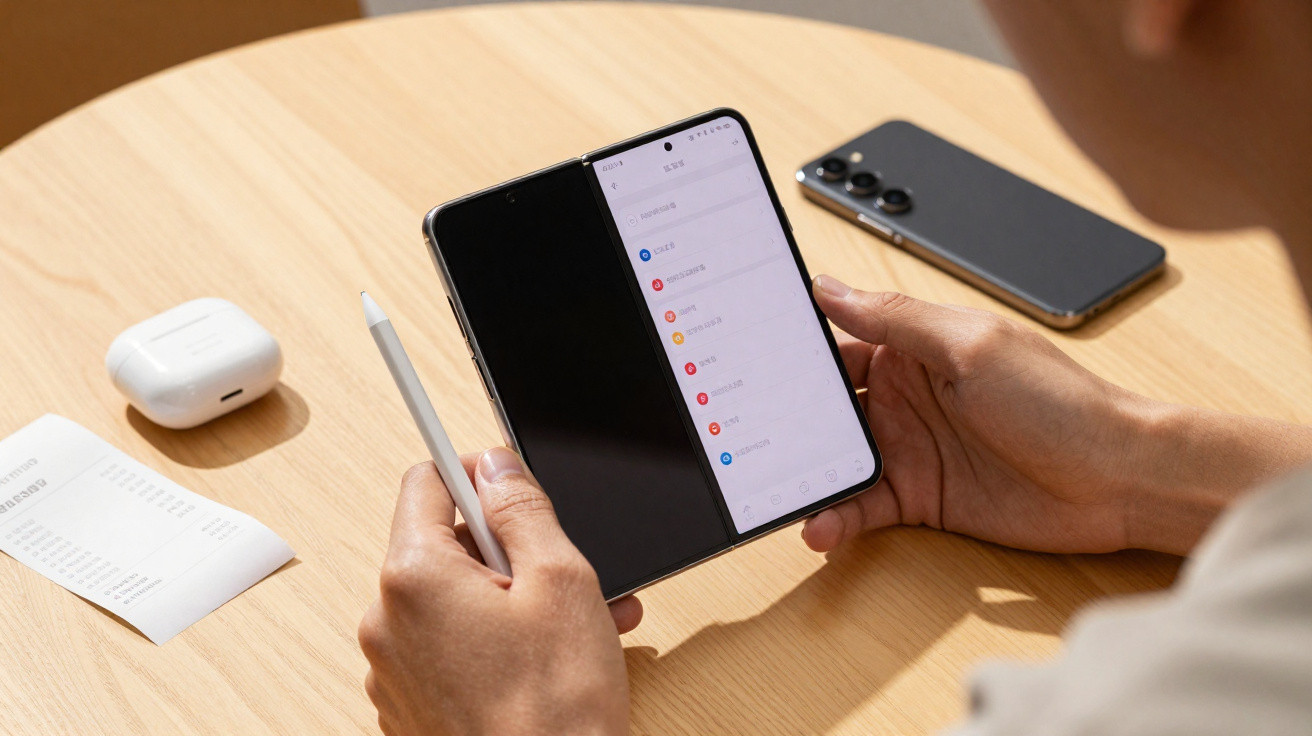
I spent 3 months using the Galaxy Z Fold7, Samsung’s latest foldable smartphone. For many commentators, it represents the very best this technology can offer. And yet, even it didn’t manage to make me enjoy this very particular form factor.
Six years ago, I first got hands-on with the Galaxy Fold, the first mainstream foldable phone. At MWC in Barcelona, Samsung presented what many observers saw as the future of the smartphone. Picture it: a phone you unfold into a tablet. A geek’s dream and a productivity fanatic’s fantasy. Critics, unsurprisingly, were quick to highlight the hardware compromises: it was too fragile, the crease was far too obvious, the camera was too limited, battery life was meagre, and all of it came with a stratospheric price tag.
To be fair, the Galaxy Fold was more of a technical showcase than a finished product. Since then, Samsung has refined the formula dramatically. With the Galaxy Z Fold7, it has managed to iron out most of the flaws traditionally associated with this format. When closed, the Z Fold7 is as slim as a conventional smartphone, the crease is almost imperceptible, the camera has improved, and so has battery life.
According to the vast majority of reviewers and industry watchers, the Galaxy Z Fold7 is the best foldable smartphone ever made. I don’t share that view-my heart leans towards the outstanding Honor Magic V5 (better stamina, a stronger camera, slimmer, and a more comfortable shape in the hand). Still, given that my peers and the specialists have largely crowned the Z Fold7, I decided to use the Galaxy Z Fold7 as my daily device for 3 months.
Why bother? Because up to now, I’ve never managed to stick with a foldable for more than a month. After that, the form factor, the technical limitations, and the lack of any truly useful functionality have always pushed me back to a more traditional handset. But since the Z Fold7 seems so close to perfection, I decided to give the experiment another go-this time for 3 months.
Galaxy Z Fold7 256 GB at the best price
Base price: 2 099 €
| Retailer | Discount | Price | Action |
|---|---|---|---|
| Rakuten | -31% | 1 449 € | View offer |
| Amazon | -27% | 1 535 € | View offer |
| Rueducommerce | 2 099 € | View offer | |
| Boulanger | 2 099 € | View offer | |
| eBay | 2 099 € | View offer | |
| FNAC | 2 102 € | View offer | |
| Samsung | 2 102 € | View offer |
See more offers
Subscribe to Presse-citron
Foldable smartphone: too expensive?
Before I get into my personal experience, it’s worth revisiting why foldable smartphones remain unpopular. In 2025, after 6 years on the market, this format is still struggling to find a broad audience. According to IDC, global foldable smartphone shipments rose from 1 million units in 2019 to 25 million in 2024. That’s a spectacular increase in absolute terms, but it hides a less flattering reality. Set against the 1.24 billion smartphones sold worldwide last year, those sales account for only 2% of the market. In Europe, the share drops to 1% for book-style models, according to Counterpoint Research.
Even more worrying for manufacturers: after five years of annual growth above 40%, the category is losing momentum. DSCC even projected a 4% decline in orders for foldable displays in 2025, with demand levelling off at around 22 million units. And that’s despite the expected arrival of the first foldable iPhone at the end of the year (if the rumours are to be believed). Six years after its grand debut, the foldable smartphone remains a niche market, sustained primarily by an enthusiast audience.
Among the complaints most often raised, price remains the number one barrier to purchase. Manufacturers had promised that prices would fall after five years, helping to democratise the segment. They’ve done the opposite. Six years after the first Galaxy Fold, the Z Fold7 is actually more expensive than its predecessor. You might have expected cheaper options using less advanced technology-but once again, industry players have chosen not to take risks, particularly as the phone market overall has seen a slowdown in unit sales volumes since the end of Covid.
That said, the market continues to grow in value. Consumers are replacing their phones less frequently, but spending more when they do. In France, that budget rose from 370 euros in 2017 to 487 euros in 2023 according to GfK. In 2025, the firm expects a slight drop, to around 450 euros.
That figure also needs to be put into perspective, because smartphone prices have increased sharply too. In 2017, the most expensive iPhone was the iPhone X, launched to celebrate the 10th anniversary of that iconic product. The priciest version sold for 1 329 euros. In 2025, the most expensive iPhone is an iPhone 17 Pro Max (2 TB), sold for 2 479 euros-almost 500 euros more than the Galaxy Z Fold7 at launch. It may soon be overtaken by the first foldable iPhone, whose entry price would supposedly sit (according to rumours) around 2 800 euros. The price trajectory-especially at the premium end-has been dramatic.
Listed at 2 000 euros, the Galaxy Z Fold7 is, for now, the most expensive foldable smartphone on the market. When you spend that kind of money, you’re entitled to expect the very best-and for a long time. Traditional smartphones have already proved they can meet that level of expectation. Foldables haven’t. Once the wow effect wears off, they still struggle to fit naturally into everyday use. Why is that?
Galaxy Z Fold7 256 GB at the best price
Base price: 2 099 €
| Retailer | Discount | Price | Action |
|---|---|---|---|
| Rakuten | -31% | 1 449 € | View offer |
| Amazon | -27% | 1 535 € | View offer |
| Rueducommerce | 2 099 € | View offer | |
| Boulanger | 2 099 € | View offer | |
| eBay | 2 099 € | View offer | |
| FNAC | 2 102 € | View offer | |
| Samsung | 2 102 € | View offer |
See more offers
Wow, it folds! And then what?
There’s no denying Samsung’s engineers have produced one of the most mature foldables on the market. They’ve addressed the major pain points of the format (not all of them-I’ll come back to that) to make it easier to live with day to day. At 215 grams on the scales, it’s lighter than a Galaxy S25 Ultra (218 g) or an iPhone 17 Pro Max (227 g). The hinge has been reinforced, which delivers two benefits: the crease is less noticeable (both visually and by touch), and the phone feels more robust.
The inner and outer displays are better than ever, thanks to Samsung Display’s expertise. As a result, entertainment (video, gaming) feels elevated. I genuinely enjoyed watching a series, reading an ebook, browsing an article (on Presse-citron, obviously), or playing games on the internal screen. Having a small tablet that you can slip into a pocket also makes it possible to work in a way that’s simply more comfortable than on a standard smartphone.
Even so, I’ve rarely felt this much frustration as I did using the Galaxy Z Fold7 every day. The first issue is that the overly tall outer screen still doesn’t make for a pleasant “phone” experience. The Z Fold7 remains a tablet that you fold shut, not a smartphone that you unfold. I constantly felt cramped when doing quick, everyday tasks like typing messages (typos are everywhere, and I don’t even have large fingers), checking social media, or just moving around the interface. The Z Fold7’s ergonomics in its smartphone form still need refinement.
On top of that, Samsung has made some baffling choices around productivity. I can’t understand why this phone isn’t compatible with a stylus. Being able to use that kind of accessory on the inner screen would have helped me a lot for photo editing and note-taking, among other things.
I also find it frustrating that, after all these years, the engineers still haven’t uncovered features that truly transform the experience. The killer feature of foldable smartphones is still missing. And a great phone is, above all, defined by its software. Without distinctive use cases, the Z Fold7 is essentially just a smartphone that can become larger when you want extra visual comfort. That’s all.
That lack of distinctive features runs into another (brutal) truth: from a technical standpoint, the Galaxy Z Fold7 doesn’t stack up against the very best smartphones on the market. Photography? No better than a two-year-old premium model. Battery life? Barely a day, as long as you don’t lean too heavily on the inner screen. Performance? Excellent, but it heats up very quickly. Charging? Very slow.
Taken together, these points of friction make the experience feel hard work at times. When you’re paying 2000 euros, you’re entitled to the nec plus ultra. The Galaxy Z Fold7 isn’t that, despite its many strengths. At this price, it also raises real anxiety about longevity. I’d really struggle to accept that a tiny grain of grit in the hinge mechanism could make my phone unusable.
The power of habit
Beyond technical and pricing considerations, there’s a deeper reason foldables find it hard to win over the mainstream: the power of habit. For fifteen years, billions of users have absorbed the “rectangular touch slab” format into their everyday gestures. Take the phone from your pocket, unlock with a thumb movement, type a message, put it away-these micro-actions repeat dozens of times a day until they become automatic.
In 2009, researchers at University College London ran an experiment to measure how long it takes for a new habit to take hold. Over twelve weeks, 96 participants tried to adopt a new daily behaviour (drinking a glass of water upon waking, doing fifteen minutes of running after dinner, eating a piece of fruit with every meal).
The findings, published in the European Journal of Social Psychology, dismantled the myth of “21 days to change a habit”. In reality, the time required varies hugely between individuals: from 18 days for the simplest actions to 254 days for the most complex, with an average of 66 days. Some participants still hadn’t fully automated their new behaviour by the end of the three-month observation period. So my 90-day experiment could, in theory, have been enough to reshape my habits. The problem is that the Z Fold7’s day-to-day friction almost certainly exhausted my patience first.
If you look more closely at neuroscience, you find these habits are handled by deep brain structures (the striatum and the caudate nucleus in particular) that operate on autopilot. It’s highly efficient for conserving cognitive resources, but it comes with a downside: it resists change. A deeply ingrained habit can persist even when we’re motivated to drop it. That helps explain why so many resolutions fail, why diets are so hard to stick to, and why I still can’t properly embrace the foldable format despite being drawn to the technology.
Marketing professionals refer to these products as “resistant innovations”. In a landmark study, researchers Ram and Sheth define these as innovations that require consumers to significantly alter established behaviours, beliefs, or routines. In their work, the main driver of resistance isn’t price, or even product quality, but the level of discontinuity it introduces into a user’s everyday life. The bigger the change demanded, the slower and harder adoption becomes.
The history of consumer technology backs them up. The dishwasher, invented in the late 19th century, only truly took hold in homes from the 1970s onwards. The microwave oven, commercially available from 1947, stagnated for thirty years before becoming commonplace. Cash machines, introduced in the late 1960s in the United States and the United Kingdom, took nearly two decades to become widely adopted.
Foldable smartphones are following the same path. Six years after the first Galaxy Fold launched, the segment remains largely the preserve of well-off tech enthusiasts, willing to spend 2 000 euros to sample the future of mobile. The mainstream public watches from the sidelines, perhaps waiting for a truly revolutionary function that finally justifies disrupting their routines.
To persuade millions of people to change gestures repeated dozens of times a day for fifteen years, you’d need to offer a benefit commensurate with the effort required. But in its current state, the foldable smartphone doesn’t deliver anything on that scale. A larger display for watching videos or running two apps side by side? It’s nice, yes-but not essential.
Will the future foldable iPhone be the model that finally brings this format into the mainstream? For Apple, the pressure will be immense. Because if even the brand that revolutionised the phone market can’t make us love the foldable smartphone, then who can?



Comments
No comments yet. Be the first to comment!
Leave a Comment