
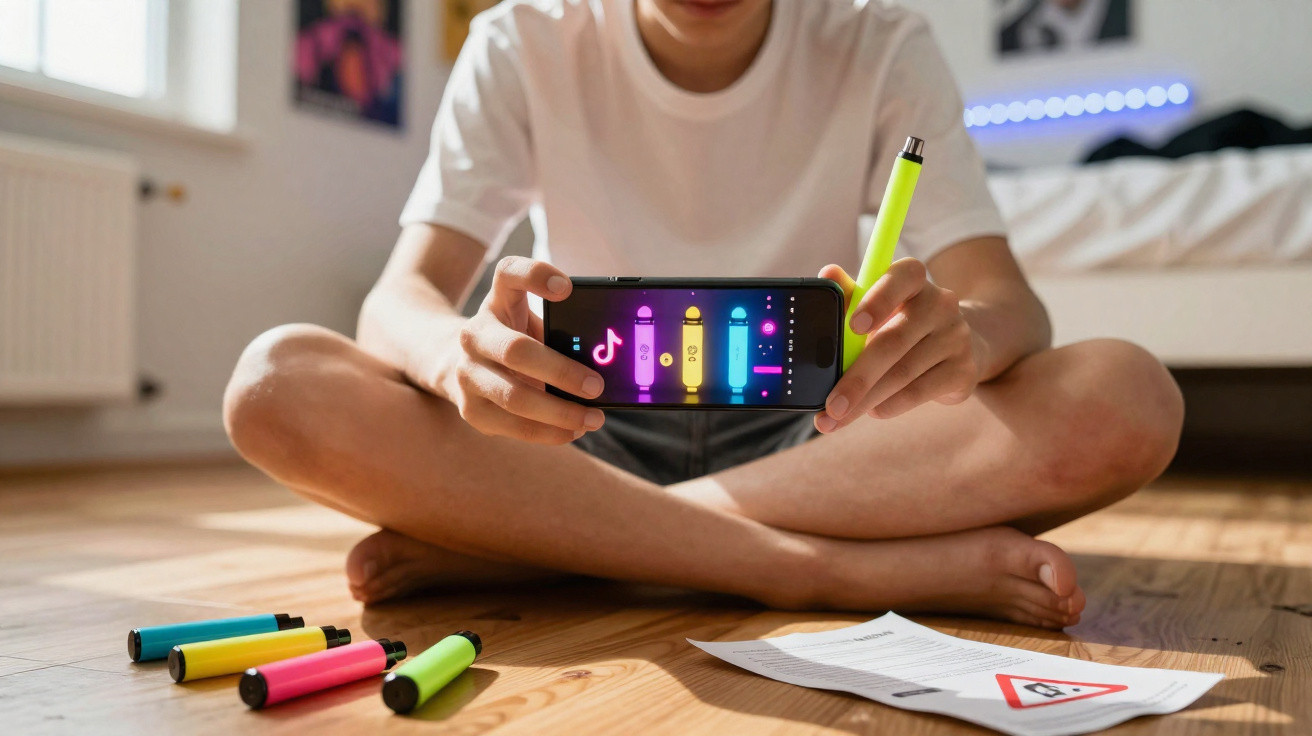
A teenager takes a quick draw from something that resembles a lip gloss tube, then tucks it away in a bag. To a nearby adult, it might pass unnoticed. To another teenager, it could be instantly recognisable.
Later on, that same teenager scrolls TikTok and comes across a clip showing someone buying a vape without presenting ID. The soundtrack is catchy. The comments are packed with punchlines. It plays like a trend, not a red flag.
That mismatch sits at the centre of a new study in the journal Addiction. The researchers found that young people can receive sharply different messages about illicit vapes depending on which online spaces they use.
Where official websites tend to offer lengthy explanations of regulations and health harms, TikTok can serve up videos that frame illegal vaping as funny, fashionable, or exciting.
“Our research shows that young people encounter very different messages about illicit vapes depending on where they look online,” said Dr Emma Ward, from UEA’s Norwich Medical School and one of the study’s lead researchers.
Youth vaping is rising
Vaping among young people has increased rapidly. Action on Smoking and Health reports that 20% of 11- to 17-year-olds have tried vaping, and 7% are users. In 2019, just 0.8% were e-cigarette users.
Illicit vapes raise the stakes. Some have nicotine levels that are too high, come with oversized tanks, have inadequate health labelling, or lack approval altogether.
A small number have contained THC or synthetic cannabinoids. Since June 2025, disposable vapes have been banned in the UK.
TikTok and health advice
A team at the University of East Anglia assessed what young people might see by comparing official material found via Google with TikTok videos associated with illicit vaping hashtags.
They gathered 200 TikTok videos and retained 58 that focused on illicit vaping. Alongside that, they examined 18 educational resources, then weighed up differences in tone, evidence, and overall appeal.
“By analyzing both Google search results and TikTok content, we were able to compare formal health messaging with the informal content young people are most likely to consume day-to-day,” said Eleanor Bray, Research Associate at UEA’s School of Psychology and the study’s lead author.
TikTok normalizes illicit vaping
Across the videos, a clear trend emerged. Many presented illicit vaping as ordinary, humorous, or smart. The most frequent thread was a casual attitude towards breaking the law.
Some clips demonstrated how to purchase vapes without showing ID. Others offered advice on concealing devices from parents or teachers. Some sellers advertised vape “bundles” paired with sweets or cosmetics.
“What stood out was how inconsistently illicit vaping is addressed across platforms. On TikTok, illegal products were sometimes actively glamorized, with vendors marketing devices through ‘bundle’ deals designed to evade age verification,” Bray noted.
The danger feels less real
The most popular videos were built to feel like youth culture: music, jokes, beauty trends, quick edits, and shared slang.
Videos tied to the thrill of breaking rules attracted more than 24.5 million likes.
That matters because repeated exposure reshapes judgement. When vaping shows up over and over as normal or stylish, the risks can start to feel distant.
Official advice falls short
The educational resources were frequently careful and accurate. Even so, they often did not set out the specific risks of illicit vapes clearly.
Not a single resource was rated excellent for explaining the health risks of illicit vapes. Some only briefly mentioned high nicotine content, illegal chemicals, or underage sales. Others offered minimal detail on what sets illicit products apart.
Many also relied on dense paragraphs and legalistic phrasing. One message stated, “If you are a child, do not vape.” Young people are more likely to benefit from straightforward, relevant information that does not feel detached from real life.
Content that’s engaging but misleading
The issue is not only whether information is correct; it is also whether it holds attention. TikTok posts are quick, personal, and designed to be shared.
An accurate health page can struggle for visibility when competing with short, socially driven videos.
“This fragmented online environment is concerning,” said Dr Ward.
“When accurate information is hard to find or feels unappealing, young people may turn instead to content that is more engaging but also more misleading, particularly on fast-growing video platforms like TikTok.”
Vape subculture is growing
The researchers also identified signs of a developing illicit vape subculture, with its own hashtags, jokes, concealment tips, and in-group language. For teenagers, that sense of belonging can be particularly influential.
“These TikTok videos attract significant attention and can feed into an emerging illicit vape subculture, where young people exchange tips, experiences, and ways to bypass age restrictions,” said Dr Ward.
Creators can switch hashtags, use coded terms, or embed vape promotion inside lifestyle content, which can make harmful material more difficult to detect and remove.
Young people need involvement
Regulation matters, but regulation alone will not solve an online attention problem. The study argues that public health teams should work alongside young people and produce content for the platforms they already use.
In practice, that means plain language, short-form video, practical guidance, and messages that do not sound like a lecture.
“Public health messaging is more likely to be effective when it works with young people and the platforms they already use,” said Bray.
“To protect young audiences, we need online information that is not only accurate, but also accessible, engaging and relevant to their everyday lives.”






Comments
No comments yet. Be the first to comment!
Leave a Comment