
China’s commitment to sodium-ion batteries is nothing new. Because they are made using more plentiful (and cheaper) raw materials, these batteries are widely seen as a potential catalyst for making electric mobility more accessible.
Mass production is now getting under way, with these batteries set to appear both in cars and in energy-storage systems. However, backing this technology has forced the industry to tackle a technical hurdle that goes well beyond simply swapping out lithium.
The hard carbon bottleneck in sodium-ion batteries
Unlike lithium-ion batteries, sodium ions are larger, which rules out the use of conventional graphite anodes. To deliver stability, long service life and fast charging, manufacturers are turning to so-called “hard carbon” - a material whose production has become one of the most significant pressure points in the supply chain.

© Changan - The Changan Nevo A06 was the first car to use sodium-ion batteries.
Initially, this hard carbon came mainly from biomass - specifically, carbonised coconut shells - sourced from South-East Asia. It worked technically, but it created a new external dependency, precisely what China’s battery industry is keen to avoid. Even if domestic coconut production were used, it would only allow enough material to be produced for around 6.3 GWh of batteries per year, far below anticipated demand.
Forecasts already point to a market above 100 GWh by 2027, making the search for alternatives unavoidable.
Related: CATL will produce the batteries that promise to be the cheapest of all
Enter coal
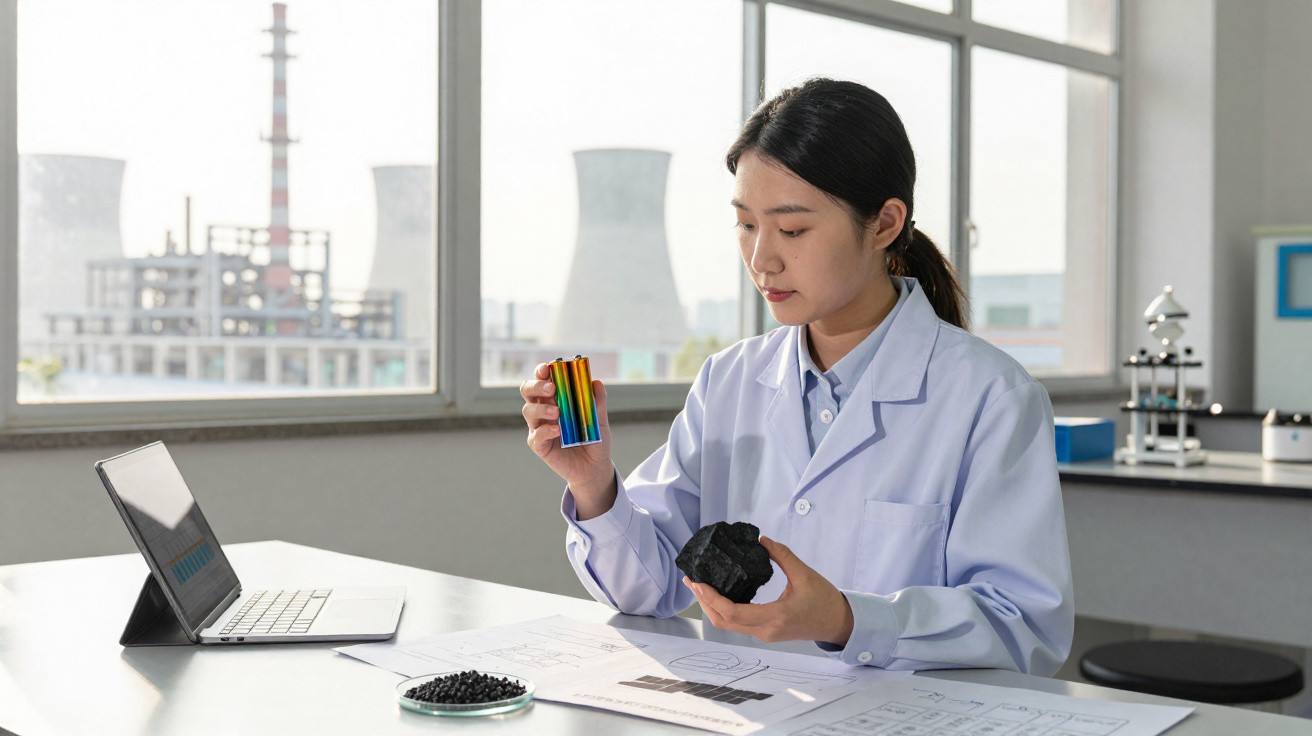
To break that reliance, China’s battery industry has identified an abundant alternative within its own borders: anthracite coal. Yes, really. The drive behind this green technology will, in this case, lean on a fossil fuel - the hard-carbon anode accounts for between 10% and 20% of a cell’s total mass.
Chemical-sector companies are retooling production lines to convert this type of coal into high-purity hard carbon, significantly cutting dependence on imported raw materials. For the industry, the decision is not only about resource availability, but also about how efficient the manufacturing process can be.
Where turning agricultural waste such as coconut shells into usable carbon recovers only about 2.5% of the original mass, processing anthracite can reach yields close to 45%. That gap translates directly into a far more efficient, and more economically competitive, route to production.
You can also listen here: Spotify - “TEN TIMES CHEAPER. New sodium batteries WILL CHANGE EVERYTHING”
That advantage is already showing up in pricing. The cost of hard carbon has dropped to under 30,000 yuan per tonne (around €3,600 at the current exchange rate). And the industry is aiming higher still: a price below 20,000 yuan per tonne (€2,380 at the current exchange rate).
By leaning on coal in this way, China moves closer to a strategic objective: building a largely self-sufficient supply chain for sodium-ion batteries, based mainly on domestically available raw materials.
At the same time, lower costs help make these batteries cheaper still, pointing to stronger uptake of sodium-ion batteries (instead of LFP lithium-ion), particularly in the most affordable electric cars - where price remains one of the most decisive factors.




Comments
No comments yet. Be the first to comment!
Leave a Comment