
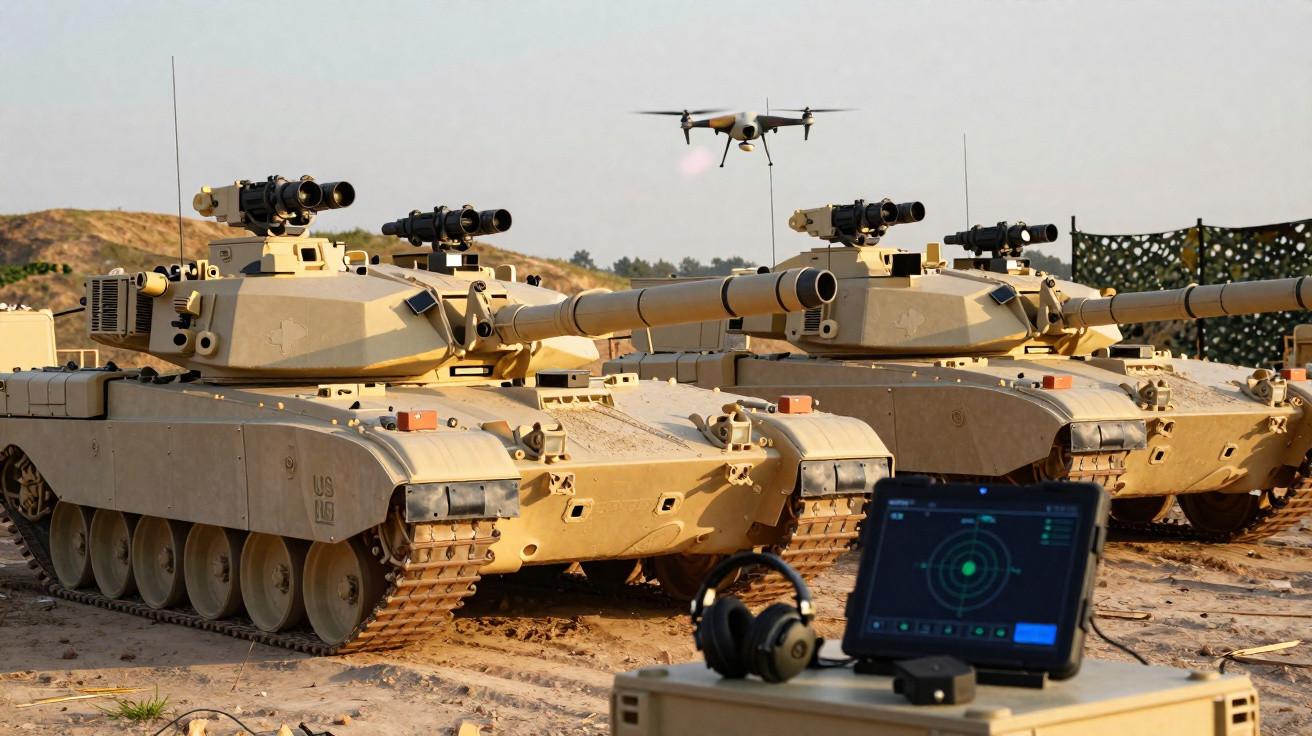
To strengthen its survivability on modern battlefields-where the use of unmanned aerial systems is increasingly evident-the US Army has released the first images of an M1 Abrams tank and an M2 Bradley infantry fighting vehicle fitted with the Bullfrog anti-drone system. Specifically, it is a lightweight, autonomous weapon system developed by Allen Control Systems, designed to detect, track and neutralise potential small, low-cost unmanned threats.
Bullfrog anti-drone system on the M1 Abrams and M2 Bradley
Steven Simoni, who currently serves as president of the company, addressed the vulnerability of armoured formations, stating: “Mechanised infantry and armoured platforms, from troop carriers to fighting vehicles like the Bradley, are vulnerable to cheap, fast, lethal drones acting as aerial improvised explosive devices. Allen Control Systems’ Bullfrog will reverse that, giving control back to US and allied ground forces.”
It is worth noting, however, that this system remains in a testing phase prior to any wider introduction across the main body of US armoured fleets.
Technical characteristics of the Bullfrog system
Looking at the technical features underpinning the new Bullfrog system, the manufacturer explains that it is equipped with a 12.7 mm machine gun, with a rate of fire of around 600 rounds per minute. Other armaments can also be integrated, such as 7.62 mm M240 machine guns or the M134 Minigun.
Another key point is the inclusion of different operating modes intended to ease crew workload, including configurations for semi-autonomous operation or fully autonomous use. In terms of reach, Bullfrog clearly presents itself as a short-range defensive option, with an estimated range of about 1,500 metres.
Why the US Army is pursuing decentralised short-range air defence
It is also useful to highlight that each system weighs about 75 kilograms when not loaded with ammunition, meaning it does not significantly affect the mobility of the armoured vehicles on which it is installed. This matters because the US Army has been seeking an approach that allows its mobile platforms to function as part of a decentralised front-line air-defence network, supporting rapid deployment in aid of other units.
In itself, this reflects a shift away from other currently available solutions-primarily missile-based-whose greatest effectiveness is typically seen against larger aircraft.
Along the same lines, it is hard to separate these new technological developments and combat tactics from the war in Ukraine since 2022, where battlefields have clearly demonstrated widespread use of low-cost drones to strike armoured units on both sides of the trenches. In the view of US analysts, the US Army’s move towards adopting this type of capability is a clear step towards a refreshed doctrine-one that will likely extend beyond the Bullfrog system itself, and beyond the two armoured vehicle models on which it has been fitted so far.


Comments
No comments yet. Be the first to comment!
Leave a Comment