
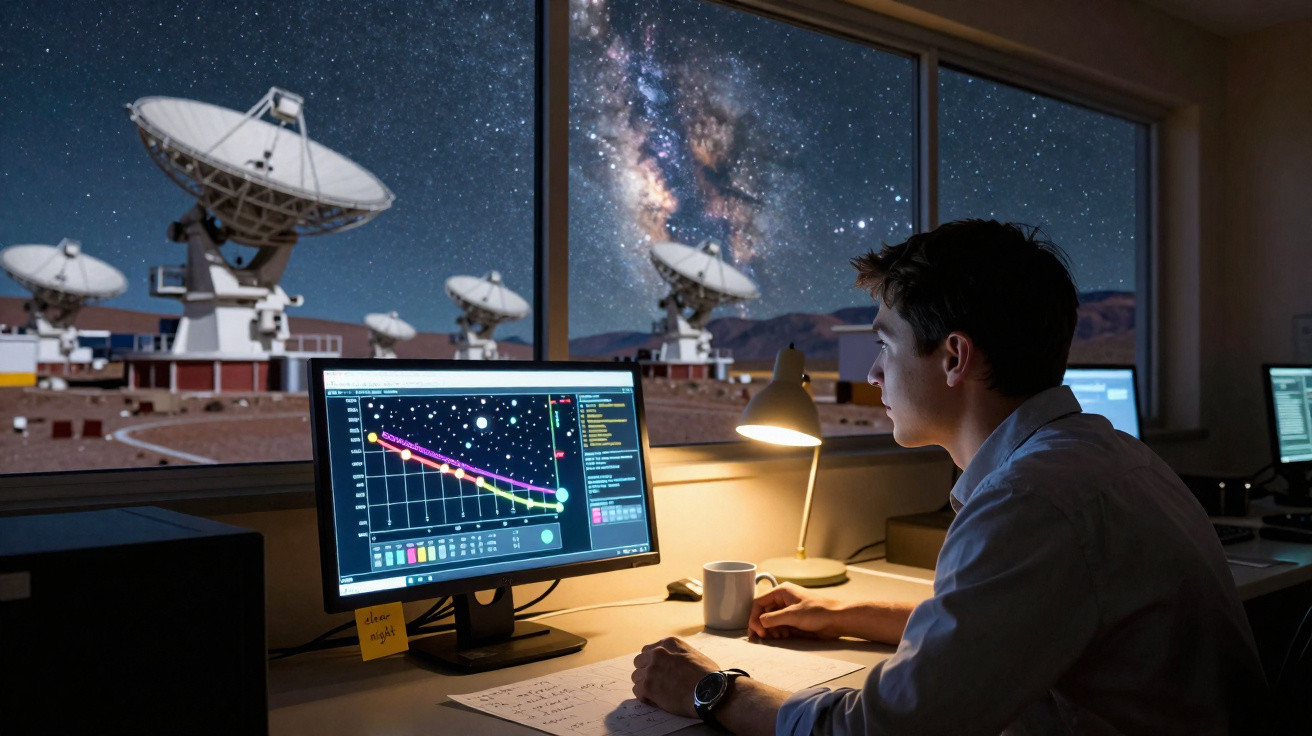
Each evening, astronomers wrestle with the same riddle - and this year an AI system helped crack it.
Conditions never sit still: the weather turns, the Moon waxes and wanes, and turbulence in the atmosphere smears starlight differently from one hour to the next.
Choose the wrong object and a telescope can squander an entire night that cannot be reclaimed. In tests, the AI system reached the same level as the astronomers who normally make those choices.
The work was led by Alex Drlica-Wagner, an astronomer at Fermilab and professor at the University of Chicago, working with Aravindan Vijayaraghavan, a computer scientist at Northwestern University.
Both researchers are part of the National Science Foundation–Simons Foundation AI Institute for the Sky, a collaboration known as SkAI.
Every clear night is a gamble
Selecting what to observe is not just about what is interesting - it is about using limited time wisely.
For a slot on a major telescope, astronomers may wait months.
If an observation is planned badly, the result can be soft-focus or overwhelmed by moonlight, obscuring the faint or distant targets it was meant to capture. Repeating that same observation may be impossible for many months.
“Large telescopes are national or international resources,” Drlica-Wagner said.
“Many astronomers around the world want time to use these telescopes, and that time is limited. If everyone could use their time more efficiently, then the community will be able to do more science.”
The computer learned from old decisions
Drlica-Wagner’s research centres on large sky surveys. Vijayaraghavan develops machine-learning systems.
With their SkAI teams, they created a system that teaches itself how to schedule observations, rather than relying on hand-written rules that astronomers have accumulated over decades.
The team trained the system using years of archival data from the Dark Energy Survey, which maps the sky using a large camera attached to a telescope in Chile.
“We trained the model on years of historical observations by showing it where the telescope was pointing at one moment and asking it to predict the next observation,” Drlica-Wagner said.
“Then we compared its prediction to what astronomers actually did and asked it to correct its mistakes.”
After enough cycles of feedback, the system began choosing targets independently.
It factored in moonlight and changing atmospheric conditions in the same way a human scheduler would - without anyone needing to explicitly encode those rules.
Real nights in the Chilean mountains
During the past spring and summer, the system controlled scheduling for two live observing runs on the 4-metre (13-foot) Víctor M. Blanco Telescope at Cerro Tololo Inter-American Observatory in Chile.
It allocated observing time for the 570-megapixel Dark Energy Camera, built by the Department of Energy and installed on the Blanco.
Rather than producing a single rigid plan for the whole night, the system revised its decisions as conditions evolved - for example, when cloud arrived or the Moon climbed - mirroring how a human scheduler would adjust mid-shift.
On site, the deployment was carried out by Paul Chichura, a SkAI postdoctoral researcher, together with University of Chicago doctoral student Rachel Hur and NOIRLab scientist Guillermo Damke.
“This is an important milestone toward more autonomous observatories,” Drlica-Wagner said.
“One of the main achievements is that we set up all the infrastructure needed to deploy this self-driving telescope on a national observatory.”
“Currently, I would say its performance is comparable to a human’s ability. As the next step, we plan to teach the computer to do a better job than a human.”
What a busier sky will need
More facilities are about to begin operations, including the NSF-DOE Vera C. Rubin Observatory. Together, they will collect vastly more data each night than any scheduler - human or computer - has previously needed to manage.
A quicker, adaptive scheduling approach could allow multiple telescopes to coordinate and make better use of every hour of dark sky - an objective the SkAI team is already working towards.
“It is exciting to see ideas from AI and reinforcement learning brought to telescope scheduling, where every decision must balance changing conditions and scarce observing time,” Vijayaraghavan said.
“Developing intelligent scheduling systems for astronomical surveys also raises fascinating new machine learning problems, and we are excited to continue exploring them through this project.”
It is not yet known whether a computer can outperform an experienced astronomer at scheduling - only that it can match one so far. The SkAI team’s next move is to trial strategies a human scheduler might never consider.
“If we can automate this technical operational task so it requires less human effort, then astronomers can have more time to think about more scientifically interesting problems and focus on discovery,” said Drlica-Wagner.
Image/ Video Credit: CTIO/NOIRLab/NSF/AURA/P. Horálek (Institute of Physics in Opava)





Comments
No comments yet. Be the first to comment!
Leave a Comment