
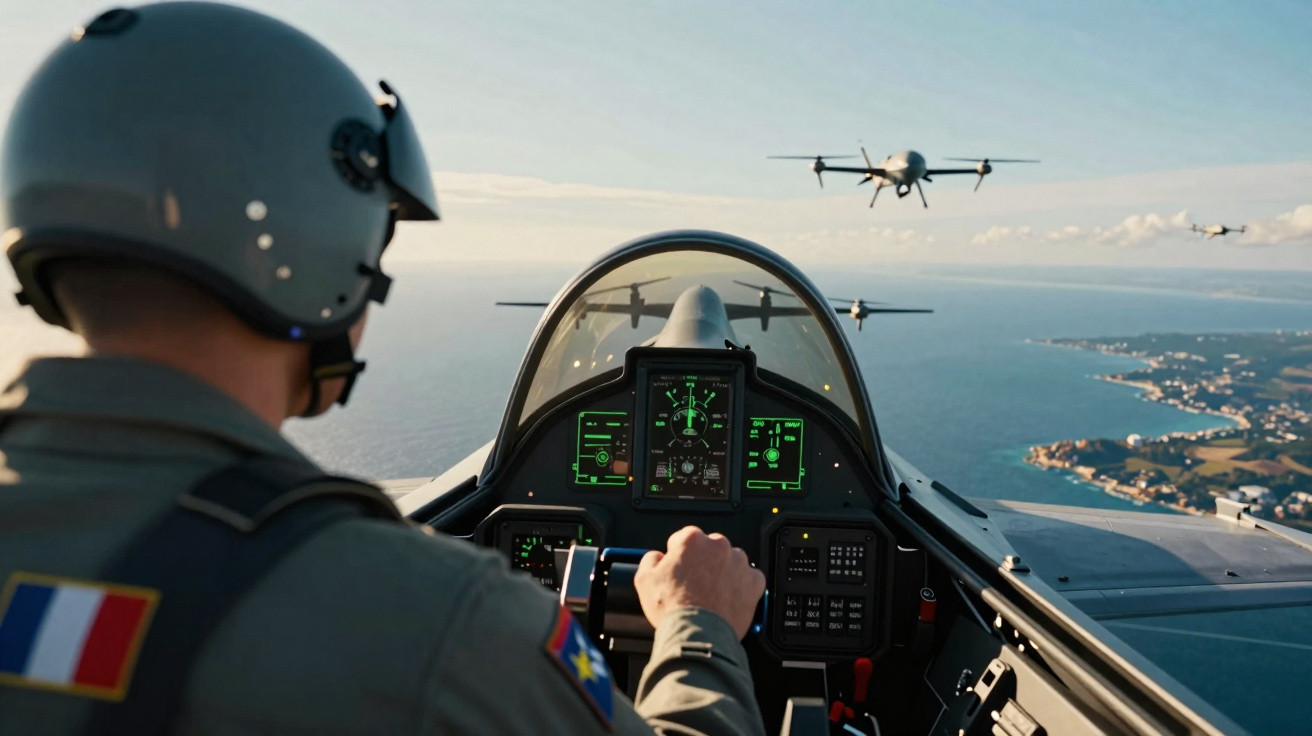
A French Rafale has achieved its first confirmed shootdown of a drone while on a NATO Air Policing mission, a milestone for France’s role in surveillance operations along Europe’s eastern flank. The incident followed the entry of an unmanned aircraft into Latvian airspace from Russian territory, triggering the immediate scramble of Alliance aircraft deployed to the Baltic region.
How the intercept unfolded for the French Rafale
Military authorities said French fighters stationed at Šiauliai Air Base in Lithuania took off after receiving an alert about the drone’s presence. After locating and identifying the target, they destroyed it over an uninhabited area, avoiding harm to people and damage to infrastructure.
NATO’s response to the incursion
The event occurred on Monday morning, when the drone crossed into Latvian airspace. Latvia’s Armed Forces stated that the aircraft entered from Russia as a result of Russian electronic warfare activity, although they did not specify who originally launched it.
Once the threat was detected, officials issued precautionary warnings to residents in the eastern regions of the country. While the operation was ongoing, people were instructed to remain under shelter until the situation was brought under control.
Latvia’s Defence Minister, Raivis Melnis, explained that NATO command made the final decision to shoot down the drone. The aircraft was destroyed near the town of Berzekne, about 30 kilometres from the Russian border.
Latvian authorities confirmed that no-one was injured and that there was no material damage. After the operation ended, airspace operations returned to normal and surveillance systems continued monitoring the area.
Latvia’s Prime Minister, Andris Kulbergs, highlighted the performance of the forces involved. In a social media post, he praised the “rapid decision-making and professional action” shown during the response.
A NATO official, for their part, stated: “This once again demonstrates NATO’s determination and capacity to deter and defend”. The comment came shortly after France formally confirmed that its aircraft had taken part in neutralising the target.
A backdrop of rising tension in the Baltic
The shootdown comes amid a growing number of drone-related incidents along NATO’s eastern borders. Over recent months, several countries in the region have reported incursions or diversions involving unmanned aircraft linked to the Russia–Ukraine war.
Estonian officials have noted that episodes such as those in Latvia and Moldova underline how the war in Ukraine continues to generate risks beyond its borders. At the same time, Latvia has recently announced steps to strengthen its counter-drone defence capabilities.
France’s Rafale role in NATO Air Policing from Šiauliai
France’s participation in NATO’s Air Policing mission has been especially active throughout 2025 and 2026. In May, Rafale fighters intercepted two Russian Armed Forces Sukhoi Su-24 tactical bombers flying without a detailed flight plan in areas under Allied monitoring.
In early June, the same French aircraft were again tasked to intercept Sukhoi Su-30SM2 fighters from the Russian Navy’s Naval Aviation that entered monitored zones without an announced flight plan. In both instances, the aircraft launched from Šiauliai and escorted the Russian jets until they left the area.
The drone shootdown therefore marks a further development in the mission France has been conducting in the Baltic states since March this year. As well as reflecting the heightened alert posture on NATO’s eastern flank, it is the first confirmed drone shootdown by a French Rafale during an Alliance Air Policing operation.





Comments
No comments yet. Be the first to comment!
Leave a Comment