
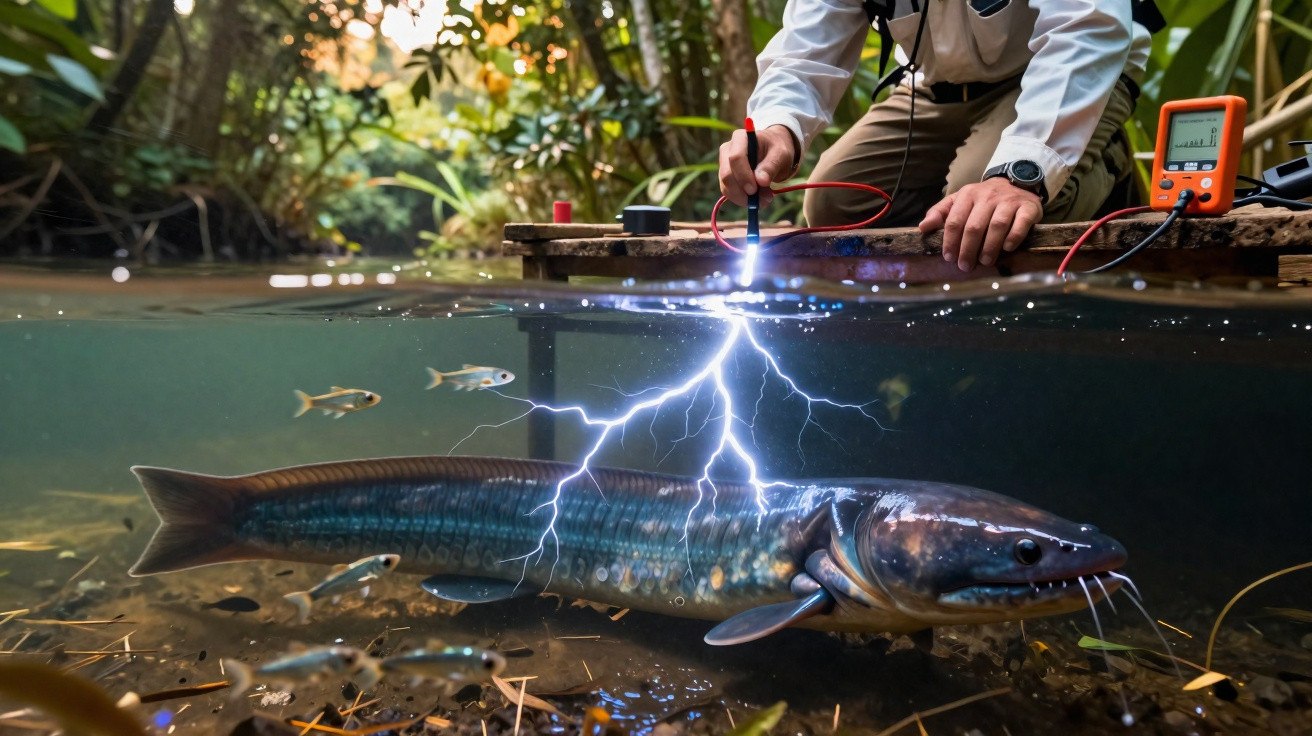
A typical Brazilian household socket supplies 127 or 220 volts. An electric eel, however, can deliver a discharge of up to 860 volts-enough power to stun fish, deter predators and bring down animals far larger than itself. What is most striking is that this electricity does not come from any hidden battery, but from thousands of cells working in unison inside the animal’s body.
Can an electric eel really bring down a horse?
The story became widely known in 1800, when the naturalist Alexander von Humboldt reported horses being surrounded by electric eels during an expedition in South America. In his account, the fish made contact with the animals and released repeated shocks. Some horses lost control of their movements and were said to have drowned in the chaos.
For a long time, scientists questioned whether the episode was plausible. In 2016, however, experiments showed these fish can indeed leap out of the water, press their bodies against a threat and intensify the shock’s impact. So while they do not typically hunt horses, they do have a defensive capability powerful enough to disorientate even a large animal.
Which species produces the 860-volt discharge?
The record is held by Electrophorus voltai, a species scientifically identified in 2019 in the Amazon region. Until then, it was assumed there was only a single species of electric eel. Genetic and anatomical studies revealed three distinct species, each adapted to different habitats and each with its own electrical capacity.
Electrophorus voltai has since become known as the animal with the highest bioelectric voltage ever recorded. That does not mean every shock reaches exactly 860 volts. The strength varies with the individual’s size, the circumstances and how contact occurs. Even so, the figure is several times higher than a domestic socket.
How does the fish’s body generate electricity?
Most of an electric eel’s body is taken up by organs made of thousands of cells called electrocytes. These are modified muscle cells that no longer produce movement, instead creating differences in electrical charge. Each cell generates only a small voltage, but together they produce an exceptionally powerful discharge.
The electrocytes are arranged like batteries connected in series. When the brain sends the signal, thousands activate almost simultaneously and their small voltages add up. The process is like lining up multiple batteries inside a vast, living remote control:
- The brain detects prey or a threat
- Nerves send a signal to the electric organs
- Thousands of electrocytes activate at once
- Individual charges add together rapidly
- The discharge travels through the water and strikes the target
Watch the video shared by the YouTube channel Nat Geo Animals showing a powerful electric eel in action in its natural habitat.
Is the shock only used to attack?
Electric eels use strong discharges to immobilise fish and crustaceans before swallowing them. The pulses affect the prey’s nerves and muscles, triggering involuntary contractions and preventing escape. They can also produce rapid sequences to force hidden prey to move, giving away its position.
Weaker discharges act like a radar in dark, muddy waters. The eel generates an electric field around its body and senses disruptions caused by nearby objects or living creatures. It also uses electrical signals to communicate. Despite the name, it is not a true eel, but a freshwater fish related to knifefish.
Why does this animal demand immediate respect?
A single discharge does not always kill a healthy person, but it can cause pain, a temporary loss of muscular control and dangerous falls. In water, the risk rises because the person may become disorientated and drown. Repeated shocks, heart problems and close contact make the situation even more hazardous-so the animal should never be touched or provoked.
The electric eel is a reminder that nature developed a biological weapon long before humans understood electricity. If you encounter one in the wild, keep your distance and alert a responsible local person or professional. Respecting this fish helps prevent accidents and protects one of evolution’s most remarkable adaptations.






Comments
No comments yet. Be the first to comment!
Leave a Comment