
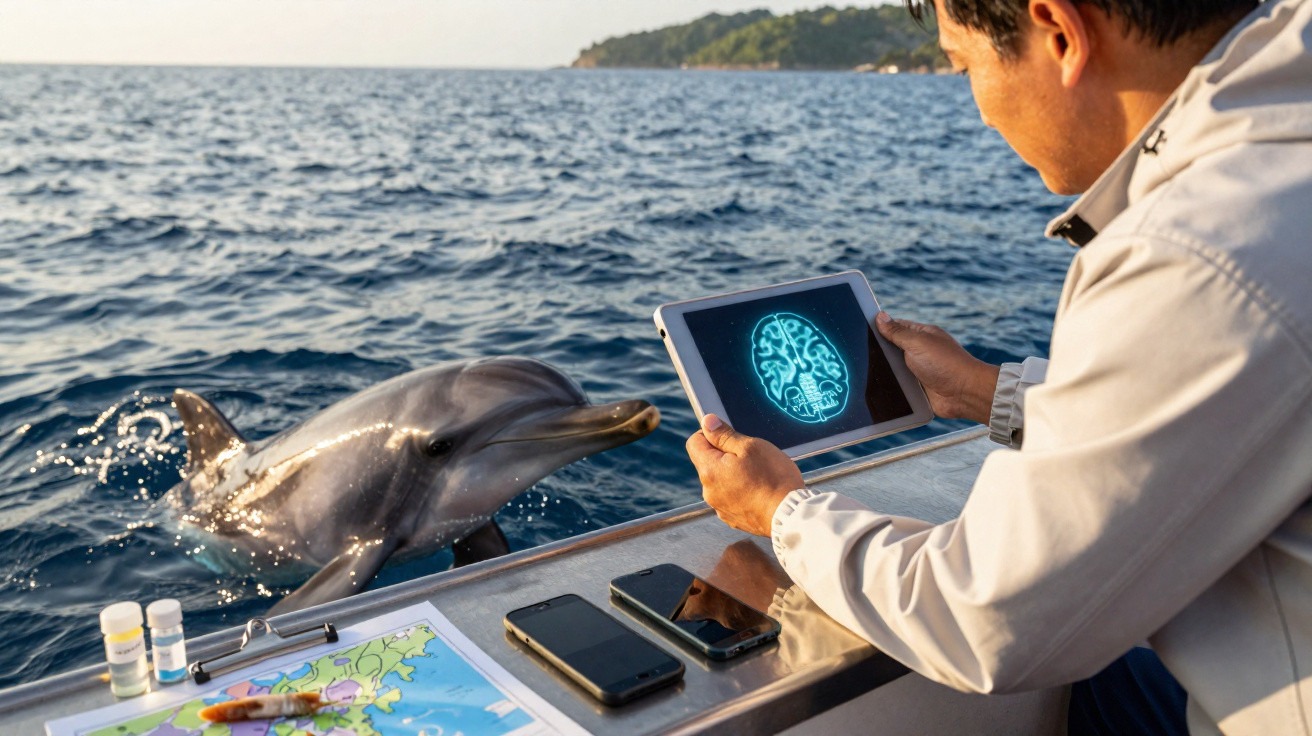
Chemicals used to give phone, laptop and television screens their crisp look are being detected in marine mammals - including within their brains.
A new study indicates that these compounds can accumulate in dolphins and porpoises over years, renewing concern about what e-waste and everyday electronics may be feeding into ocean food webs.
The work was carried out by researchers from City University of Hong Kong alongside international collaborators.
They tested tissue from Indo-Pacific humpback dolphins and finless porpoises from the South China Sea for a class of contaminants known as liquid crystal monomers (LCMs).
“"Our research reveals that LCMs from everyday electronics are not just pollution – they’re accumulating in the brains of endangered dolphins and porpoises,"” said corresponding author Yuhe He, a researcher at City University of Hong Kong.
“"This is a wake-up call: the chemicals powering our devices are now infiltrating marine life, and we must act now on e-waste to protect ocean health and, ultimately, ourselves."”
Chemicals don’t stay locked in devices
LCMs are the core ingredients that allow liquid crystal displays to manipulate light. In practice, they help screens toggle pixels on and off to produce the sharp images people now take for granted.
The issue is that these substances do not remain sealed inside devices indefinitely. As electronics age, break, are serviced, or are discarded, LCMs can be released into the environment.
Researchers have increasingly reported them in places typical of contemporary pollutants: indoor air, household dust and wastewater.
From there, movement into coastal waters is plausible - particularly around heavily populated cities and industrial corridors where leakage from waste and runoff can be difficult to prevent.
Earlier research has already suggested that certain LCMs may pose health risks to people and aquatic organisms. What has been less well understood is how these chemicals travel through marine ecosystems.
Do they largely remain in water and sediments? Do they concentrate in small animals and then move up the food chain? And can they reach apex predators such as dolphins and porpoises?
This study set out to reduce that uncertainty.
Inside the South China Sea food chain
To do so, the team analysed tissue samples collected between 2007 and 2021 from Indo-Pacific humpback dolphins and finless porpoises living in the South China Sea.
The region is a key habitat for both species, and it is already stressed by shipping traffic, coastal development and pollution.
The researchers tested blubber, muscle, liver, kidney and brain tissue for 62 separate LCMs.
What they found was troubling: LCMs were present in several tissues, brain included. This is significant because the brain is shielded by the blood–brain barrier, which prevents many circulating substances from entering. Detecting LCMs there implies these compounds can pass that barrier and reach sensitive neural tissue.
Blubber was expected to contain the highest levels because fat commonly acts as a reservoir for pollutants - and that expectation was confirmed, with blubber generally showing the greatest concentrations. However, the chemicals were not confined to fatty tissue.
Even at low concentrations, the presence of LCMs in organs such as the brain is noteworthy because these tissues can be less tolerant of chemical interference. The study highlights potential neurotoxic risks as a concern, while also making clear it has not demonstrated direct harm in wild animals.
Where the chemicals may be coming from
The profile of compounds detected also hinted at where they may originate.
A small number of chemicals made up most of the LCMs identified. The researchers point out that comparable LCMs have been reported in fish and invertebrates that dolphins and porpoises prey on.
That pattern supports a straightforward route of exposure: the animals are probably taking in these chemicals mainly through food, rather than absorbing them directly from seawater.
The team also attempted to estimate which consumer electronics contribute most to the mixture. Based on the specific LCMs found, the study suggests televisions and computer monitors are likely the main source, with smartphones accounting for a smaller proportion.
That does not mean phones are harmless - rather, the chemical “fingerprints” align more closely with larger displays and the waste streams linked to them.
Large screens may also be more prone to ending up in poorly managed e-waste pathways, particularly in places where informal recycling and dumping still occur.
Samples that reflect our screen era
A notable aspect of the research is that it offers more than a single moment in time: it draws on over a decade of samples. This allowed the researchers to examine changes over time, at least for porpoise blubber.
They observed that LCM concentrations generally increased during the period when liquid crystal displays expanded rapidly, then decreased more recently as manufacturers moved towards more LED-based display technologies.
This matters because it suggests a connection between consumer technology trends and contamination measured in marine wildlife. It also implies that manufacturing changes - and regulation, if paired with proper waste handling - could eventually reduce exposure.
Exploring the biological impact
To better understand possible biological effects, the team also conducted laboratory tests using cultured dolphin cells.
Several widely used LCMs - including the four most prominent compounds detected in the animals - altered gene activity linked to DNA repair and cell division.
This is not equivalent to demonstrating illness or damage in living dolphins. Even so, it indicates these chemicals may not be biologically inert once inside an organism.
If LCMs disrupt fundamental cellular processes, that raises questions about long-term impacts, particularly for animals already facing multiple environmental pressures.
The authors ultimately call for more detailed research on how LCM pollution affects wildlife, alongside stronger measures to improve e-waste regulation and disposal.
A dumping ground in the ocean
The reasoning is straightforward. If chemicals used in everyday screens can accumulate in endangered marine mammals and even reach the brain, then the oceans are becoming a downstream dumping ground for the electronics era.
A further, uncomfortable implication is that dolphins and porpoises are unlikely to be the only species affected. If LCMs pass first through fish and invertebrates, they are probably moving through broader food webs as well.
The study does not argue that people should panic about owning a television. It does, however, reinforce a consistent message from environmental science: substances built into consumer goods do not remain contained in those products forever.
In time, some portion escapes - and the natural world is left to deal with what remains.




Comments
No comments yet. Be the first to comment!
Leave a Comment