
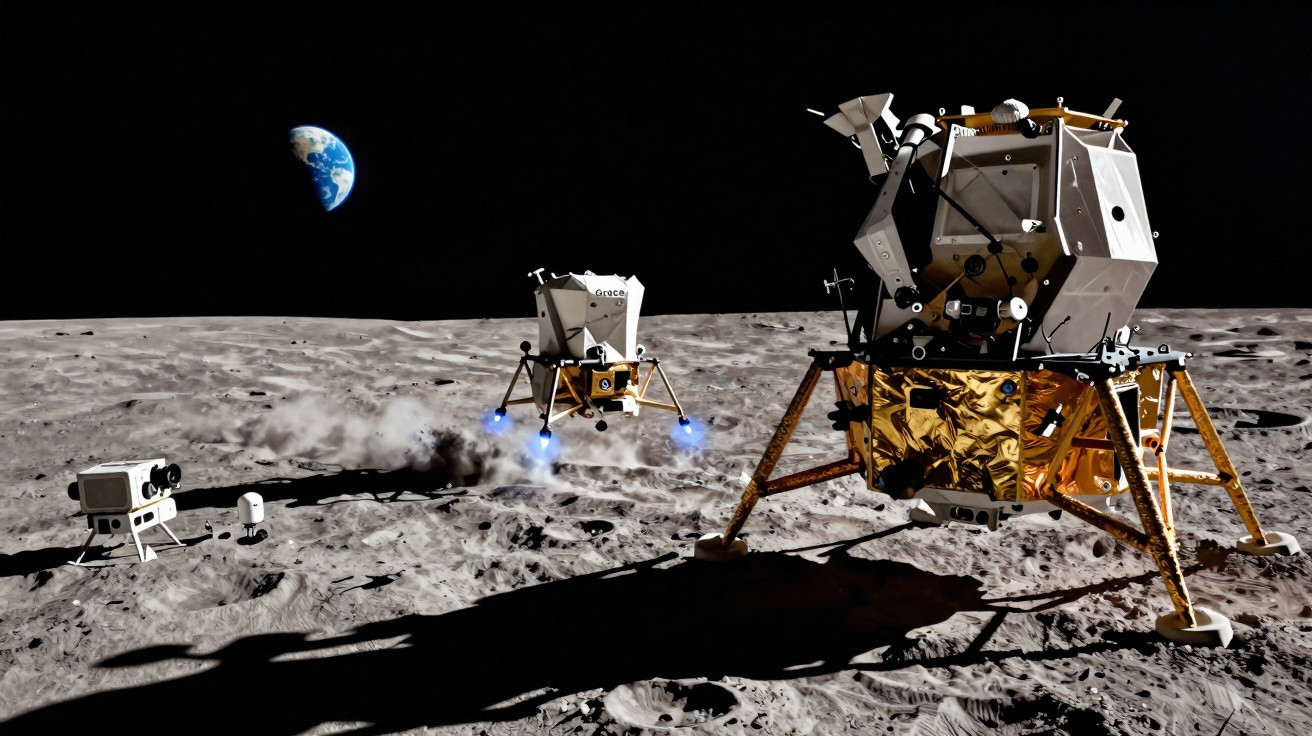
A drill built to look for ice. A test of a 4G network. Three rovers, plus a hopping drone unlike anything flown before.
After making history last year as the first private company to land on the Moon, Intuitive Machines is now set for a second lunar touchdown on Thursday, carrying advanced payloads intended to help pave the way for future crewed missions.
Mission timeline and the Mons Mouton landing site
The Houston-based firm is aiming for a landing no earlier than 12:32 pm ET (1732 GMT) at Mons Mouton, a plateau close to the Moon’s south pole - further south than any robotic mission has reached so far.
NASA will livestream the attempt starting an hour before touchdown, as Athena - a 4.8-metre (15.6-foot) hexagonal lander, roughly as tall as a giraffe - begins its descent towards the surface.
"It kind of feels like this mission is straight out of one of our favorite sci-fi movies," said Nicky Fox, NASA’s associate administrator for science.
Commercial Lunar Payload Services (CLPS) and the race to the Moon
Intuitive Machines’ first landing in February 2024 was a major milestone, but the lander ended up resting on its side - an outcome the company is keen to avoid on this attempt.
The stakes are higher after Texas-based competitor Firefly Aerospace successfully brought its Blue Ghost lander down on Sunday, becoming the second private company to reach the Moon.
Both missions fall under NASA’s US$2.6-billion Commercial Lunar Payload Services (CLPS) programme, which works with private industry to reduce costs and support Artemis - NASA’s effort to return astronauts to the Moon and, later, press on to Mars.
A hopper named Grace
Athena is heading for highland terrain about 160 kilometres (100 miles) from the lunar south pole. Once on the ground, it is scheduled to deploy three rovers as well as a one-of-a-kind hopping drone called Grace, named for the late computer-science pioneer Grace Hopper.
Among Grace’s most ambitious goals is a hop into a permanently shadowed crater - a location where sunlight has never reached - something never previously attempted by humanity.
NASA’s Ingenuity helicopter showed that powered flight can work on Mars, but the Moon’s lack of an atmosphere rules out conventional flight. That makes hoppers such as Grace an important technology for future exploration.
MAPP, Athena’s largest rover and about the size of a beagle, will help trial a Nokia Bell Labs 4G cellular network linking the lander, MAPP itself and Grace - equipment designed with the aim of one day integrating into astronaut spacesuits.
Yaoki, a smaller rover built by the Japanese company Dymon, is engineered to withstand drops in any orientation, giving it added flexibility.
The miniature AstroAnt rover, fitted with magnetic wheels, will attach itself to MAPP and use its sensors to record temperature differences across the larger rover.
Athena is also carrying PRIME-1, a NASA instrument package featuring a drill intended to search for ice and other chemicals beneath the lunar surface, alongside a spectrometer to study what the drill uncovers.
Sticking the landing
Before any of the science and technology demonstrations can get underway, Intuitive Machines first has to achieve a clean landing - a task complicated by the Moon’s airless environment, which eliminates parachutes and leaves spacecraft dependent on accurate navigation and carefully controlled engine thrust over dangerous terrain.
Prior to Intuitive Machines’ first mission, only national space agencies had managed a lunar landing, and NASA’s previous touchdown dated back to Apollo 17 in 1972.
On the company’s initial attempt, its Odysseus lander arrived too quickly, snagged a foot on the surface and fell over, shortening the mission once its solar panels could no longer produce sufficient power.
For this flight, the company says it has implemented key improvements, including upgraded cabling for the laser altimeter, which supplies altitude and velocity measurements to support a safer touchdown.
Athena lifted off last Wednesday aboard a SpaceX Falcon 9 rocket, which also carried NASA’s Lunar Trailblazer probe - though the trip has not been entirely trouble-free. Controllers on the ground are working to restore contact with the small satellite, which is meant to map how water is distributed across the Moon.
© Agence France-Presse



Comments
No comments yet. Be the first to comment!
Leave a Comment