
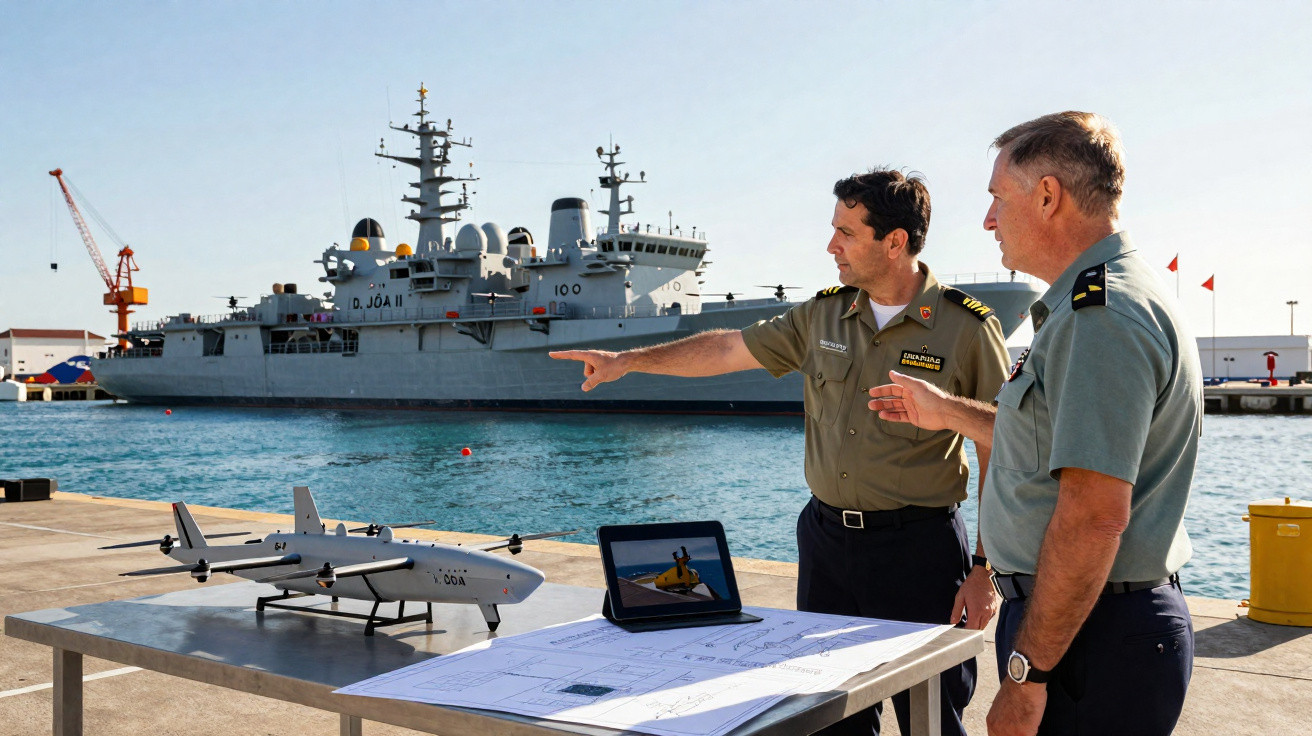
Damen Naval and the “D. João II” concept
The Dutch shipbuilder Damen Naval, which is building Portugal’s drone carrier at the Galați yards in Romania, intends to market further units of this Multifunctional Naval Platform - an original concept from the Navy - to other countries. However, the Portuguese state will not receive industrial property rights from those sales. At most, the Navy will not have to pay licence fees if it later wants ships of this type built at different shipyards.
Damen Naval’s Chief Executive Officer, Roland Briene, was in Estoril last week for the convention of the Aerospace, Security and Defence Industries Association of Europe (ASD). In a conversation with Expresso, he praised the “D. João II” concept and acknowledged that other navies are interested in Portugal’s drone carrier, which he described as representing the “future”.
PRR funding, timeline and design approach
Funded by the Recovery and Resilience Plan (PRR), the vessel was floated at the start of last month and is expected to be delivered to the Navy in the first half of next year. “It is a revolutionary concept and it was the former head of the Portuguese Navy, Admiral Gouveia Melo, who came up with the idea,” Briene highlighted in an interview on the sidelines of the convention that brought together Europe’s defence industry giants. “Based on the concept he laid out, our engineering and design team started developing the project, and that is how we arrived at this standard platform.”
As the executive explains, the goal was to design “a ship that did not have fully military specifications, capable of supporting the Portuguese Navy’s ambition when it comes to drone activities”.
The ship was not designed to military specifications so that it could be financed under the PRR, but future units may be militarised. The “D. João II” itself can also be militarised, if required, through the type of drones it carries, because it is a modular vessel.
Intellectual property, export plans and what Portugal gains
In Briene’s view, “the future lies in unmanned systems or reduced-crew systems, through a mothership that can be a frigate or a maritime patrol vessel”. That, he says, is why Damen wants to sell the concept to other navies: “It’s funny that, during the conference - and I’ve been here for two days - I’ve already been asked that question about 10 times,” he replies.
“We hold the intellectual property of the design and can manufacture it for other countries and other navies. Obviously there is a lot of interest, but everyone is waiting to see what happens,” Briene says. “As soon as the ship goes to sea and other navies see it operating, it will generate more interest. This is the new way of war, involving aquatic drones and aerial drones to operate across different types of warfare, and it is not the most traditional.” Portugal will be the first European Union country to operate a ship built from scratch with this nature and purpose.
Although the platform was developed from a national concept, as Damen’s representative acknowledges, sharing rights does not translate into direct revenue for the state - unlike, for example, the KC-360 transport aircraft, co-manufactured with Embraer, where the state earns more than €11 million per sale, according to Defence Ministry figures.
“Given the source of funding (PRR) and its amount (€132 M), the design ownership rights are shared between the Portuguese state and the company Damen, while it was safeguarded that the concept was developed in full by the Portuguese Navy,” clarified Navy spokesperson Commander Ricardo Sá Granja. Even so, Expresso found that this “sharing” means the national benefit is essentially limited to the option of having ships of the same class built at competing yards without paying industrial rights to Damen - a figure the Navy’s answers estimate at between €15 million and €20 million.
As the Navy spokesperson explains, for Portugal to hold the vessel’s industrial property rights it would have been “necessary to have had the financial capacity to pay for the Basic Design and the Detailed Design”, as well as “all the development of the systems that equip the ship”, which did not happen because of the limits of the PRR financial package.
Shipbuilding capacity constraints in Portugal
Other specialised sources consulted argue that Portugal does not have sufficient shipbuilding capacity and that building up that capability would be too costly to profit from orders. West Sea’s Viana do Castelo shipyard - the only yard that could do it - has its capacity fully taken up by the construction of offshore patrol vessels, and is said to have submitted a very expensive proposal.




Comments
от 5 460 р https://www.kovanie-ogrady.ru/catalog/pamyatniki-zchenshchine/granitnyy-pamyatnik-pr-31/
Работы под ключ https://www.kovanie-ogrady.ru/catalog/pamyatniki-dedyshke/granitnyy-pamyatnik-pg-18/
Что входит в благоустройство могилы https://www.kovanie-ogrady.ru/catalog/pamyatniki/granitnyy-pamyatnik-pr-5/
Подсыпка на могилу — способ поднять место захоронения, если могила просела, или улучшить внешний вид участка https://www.kovanie-ogrady.ru/catalog/pamyatniki-babyshke/granitnyy-pamyatnik-pv-33/
Материал — недорогая альтернатива стяжке, мраморной крошке, тротуарной плитке, гранитному полу https://www.kovanie-ogrady.ru/catalog/vertikalnye/pamyatnik-iz-granita-pv-10/
Песок имеет эстетичный внешний вид, делает захоронение более заметным https://www.kovanie-ogrady.ru/catalog/kovanye-izdeliya/kovanaya-ograda-na-mogilu-kaplya/
Гранитные или бетонные цоколи Металлические ограды с резными узорами Декоративные столбики из камня Разделительные плиты между соседними могилами https://www.kovanie-ogrady.ru/catalog/tsokoli/granitnyy-tsokol-ts-13/
Брусчатка https://www.kovanie-ogrady.ru/catalog/pamyatniki-docheri/granitnyy-pamyatnik-dpg-5/
Чтобы сделать светящийся уличный фонарь из жестяной банки вам понадобится молоток, несколько гвоздей разного размера, круглый деревянный брусок и тиски https://xn----8sbbqwjb8ce.xn--p1ai/
Сделайте набросок на листке, а затем перенесите его на саму банку https://xn----8sbbqwjb8ce.xn--p1ai/
От того, насколько он обширный, зависит объем дополнительных работ — сооружение бытовых построек и мест отдыха, декорирование участка https://xn----8sbbqwjb8ce.xn--p1ai/
В любом случае требуется монтаж уличного освещения https://xn----8sbbqwjb8ce.xn--p1ai/
Уличные светильники должны располагаться на опорах или тросах https://xn----8sbbqwjb8ce.xn--p1ai/
Возможно располагать светильник на стенах зданий в микрорайонах, если при таком монтаже будут выполнены условия:
Дневной вид дома можно перенести и на позднее время благодаря умело размещённым светильникам https://xn----8sbbqwjb8ce.xn--p1ai/
Но если проявить креатив и использовать лампочки разной мощности и типа, то можно создать новый и стильный вид, подчеркнув особенности здания и рельефы, которых не заметно днём https://xn----8sbbqwjb8ce.xn--p1ai/
Самое большое применение и варианты исполнения имеют столбовые опоры из металла https://xn----8sbbqwjb8ce.xn--p1ai/
Они имеют в поперечном сечении полый круг или многогранник, легкие, безопасные, долговечные https://xn----8sbbqwjb8ce.xn--p1ai/
По сравнению с железобетонными опорами или решетчатыми столбами требуют меньше затрат на монтаж и эксплуатацию https://xn----8sbbqwjb8ce.xn--p1ai/
Они сужаются кверху, тем самым уменьшается раскачка при порывах ветра https://xn----8sbbqwjb8ce.xn--p1ai/
То есть можно сделать вывод, что самый дешевый светильник на столбе стоит порядка 2100-2200 рублей https://xn----8sbbqwjb8ce.xn--p1ai/
Максимальные цены зависят от толщины вашего кошелька и желания https://xn----8sbbqwjb8ce.xn--p1ai/
Возможно, вас также заинтересует садовая гирлянда на солнечных батареях https://xn----8sbbqwjb8ce.xn--p1ai/
Leave a Comment