
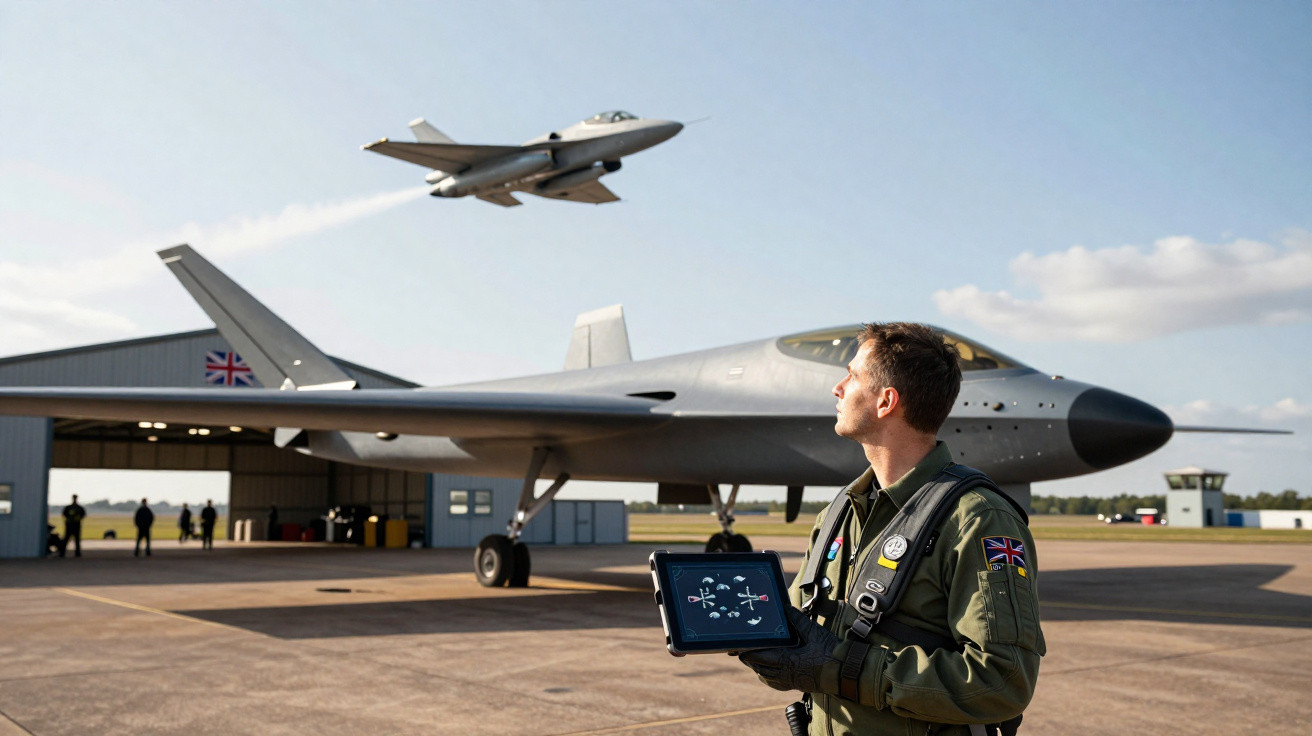
The Storm Fighter programme, led by the Royal Air Force (RAF) and BAE Systems, is set to begin flight trials of the new Brontanax collaborative combat drone in 2027. The system forms part of the United Kingdom’s work on future air-power capabilities and is intended to operate alongside crewed aircraft such as the Eurofighter Typhoon, the F-35 and, later on, the Tempest fighter-boosting combat options while lowering risk to pilots.
Brontanax will be the United Kingdom’s first autonomous collaborative drone
BAE Systems unveiled Brontanax at the Farnborough International Airshow, presenting it as the first UK-developed autonomous, uncrewed Collaborative Combat Aircraft (CCA). The aircraft was conceived and built at the company’s Warton site in Lancashire, with more than 500 staff contributing to development, alongside over 75 large and small British aerospace firms.
Design, build site and industrial team behind Brontanax
The Brontanax air vehicle was produced at Warton, Lancashire, and its development involved hundreds of BAE Systems employees as well as a broad UK supplier base spanning more than 75 aerospace companies of varying sizes.
Brontanax mission roles, control options and modular growth
Brontanax is expected to deliver electronic warfare functions and precision strike against both ground and air targets. It is described as being roughly comparable in size to BAE Systems’ Hawk trainer and can be remotely directed either by a Eurofighter Typhoon pilot or by a mission commander. With an open architecture and modular design, the platform is intended to accept new capabilities as threats change.
The Storm Fighter programme aims to integrate crewed and uncrewed aircraft.
The UK Ministry of Defence has recently confirmed that the CCA effort will be renamed Storm Fighter. The initiative includes £300 million in government funding and sits within the Defence Investment Plan (DIP), which sets out £298 billion of spending over the next four years, including dedicated funding to strengthen air and space power and to develop advanced uncrewed systems.
According to the UK Minister of State for Defence Readiness and Industry, Luke Pollard, Storm Fighter will enable a new generation of autonomous aircraft to augment the Eurofighter Typhoon, the F-35 and the future Tempest. “Today I am pleased to reveal that our new autonomous combat aircraft programme will be called Storm Fighter. Storm Fighter will make the Royal Air Force (RAF) the first sixth-generation air force in Europe,” Pollard said during the Global Air and Space Chiefs Conference.
The UK Secretary of State for Defence, Wes Streeting, in turn highlighted what the new system means for domestic industry. “We are investing £ 300 million in our Storm Fighter programme to develop an autonomous combat aircraft here in the United Kingdom. This launch demonstrates the industrial capability we have to deliver on our ambition to become the first sixth-generation air force in Europe”, he noted.
Testing at Warton and the route into service
The RAF’s Chief of the Air Staff, Air Chief Marshal Sir Harv Smyth, said the service expects the prototype to make its first flight in 2027 and added that the programme will speed up the integration of advanced technologies. Similarly, Simon Barnes, Managing Director of BAE Systems’ air division, said Brontanax will extend the operational reach of crewed aircraft, increase available combat capacity, and help keep pilots out of high-risk areas.
Before the flight-test campaign begins, Brontanax will undergo ground testing at Warton. Under Storm Fighter plans, this collaborative combat drone is expected to enter service before the end of the decade and to become a core element of the UK’s future air-combat force structure, built around close integration between crewed platforms and autonomous systems.




Comments
No comments yet. Be the first to comment!
Leave a Comment