
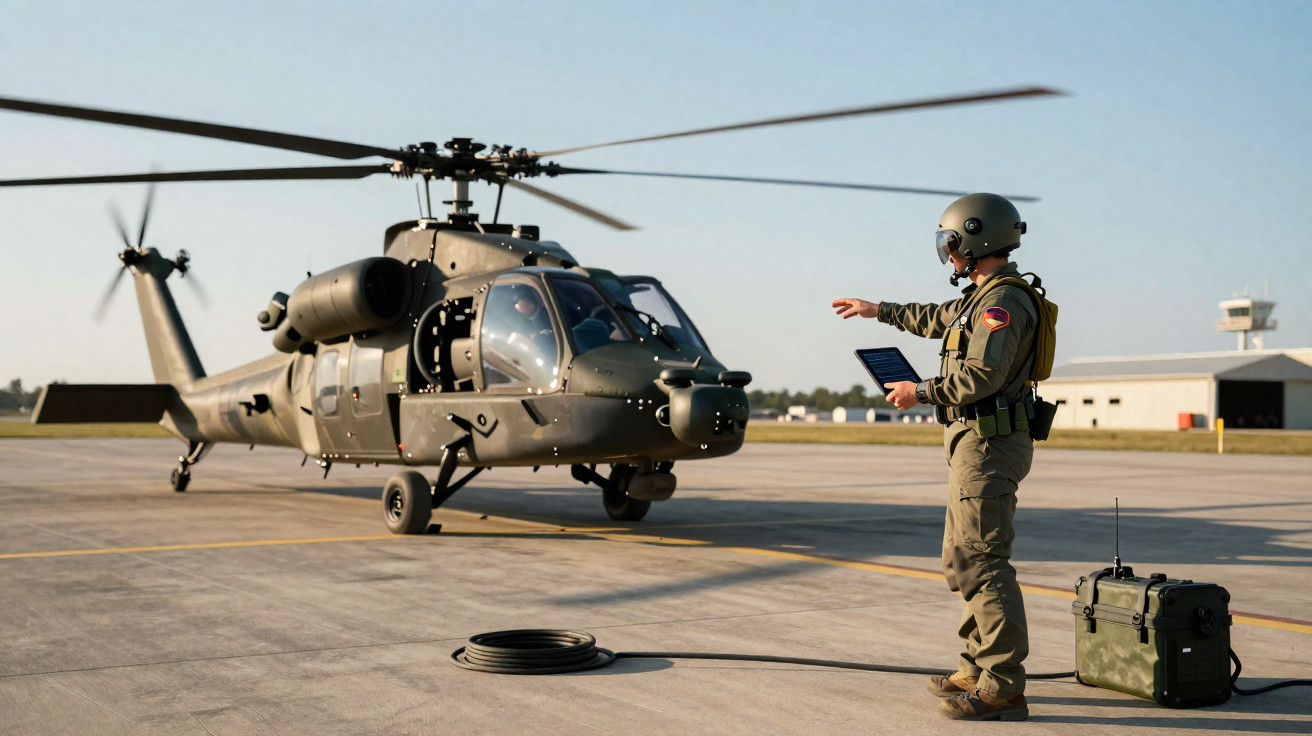
In tomorrow’s air war, crewed aircraft are expected to be accompanied by uncrewed airborne platforms that fly alongside and provide support-at least, that is the capability the United States Army is aiming to field. Alongside the well-known United States Air Force Collaborative Combat Aircraft (CCA) effort, defence manufacturer Anduril has recently unveiled Thunder, a rotor-based uncrewed aerial system (UAS) conceived as a companion platform for the US Army’s Cheyenne helicopter and future rotary-wing aircraft.
The rise of loyal wingman drones in air warfare
In contemporary conflict, aircraft are having to contend with a growing set of threats, drones included. At the same time, aircraft themselves have become ever more intricate engineering systems, and armed forces want them to be multi-role-meaning they must carry larger payloads to deliver across a broader range of missions. One way to protect crews in crewed aircraft while boosting mission effectiveness is to deploy a drone that flies in close support. That drone can also take additional payloads, including missiles and other weapons.
The uncrewed aircraft would be run using artificial intelligence to lessen the pilot’s cognitive burden; however, certain choices-such as firing missiles-would still be made by a human rather than the machine.
US Collaborative Combat Aircraft (CCA) programme milestones
In the United States, the initiative focused on a companion platform for crewed fixed-wing aircraft is the CCA programme. Two companies were chosen for Increment 1, the programme’s first phase: Anduril’s FQ-44, known as Fury, and General Atomics’ YFQ-42A, referred to as Dark Merlin. Increment 2 is now under way, with additional firms taking part.
As the technology continues to mature, new milestones are being reached. Recently, the United States Air Force reported that, in mid-July, an Anduril YFQ-44 drone fired an AIM-120 AMRAAM (Advanced Medium-Range Air-to-Air Missile) at a digital target in the Mojave Desert, California. The Air Force Chief of Staff, General Kenneth S. Wilsbach, said that “we are one step closer to delivering capabilities to the warfighter”.
A week later, at the time of writing, air-traffic observers reported that an Anduril YFQ-44-tail number 25-1003-was flying through US airspace. The United States Air Force subsequently confirmed that, between 20 and 24 July 2026, the Air Force’s CCA Experimental Operations Unit (EOU) was conducting an Agile Combat Employment (ACE) exercise at Creech Air Force Base, Nevada. Military operators were overseeing end-to-end ground and flight operations for both the YFQ-42 and the YFQ-44.
Anduril Thunder: rotorcraft autonomous attack companion for US Army helicopters
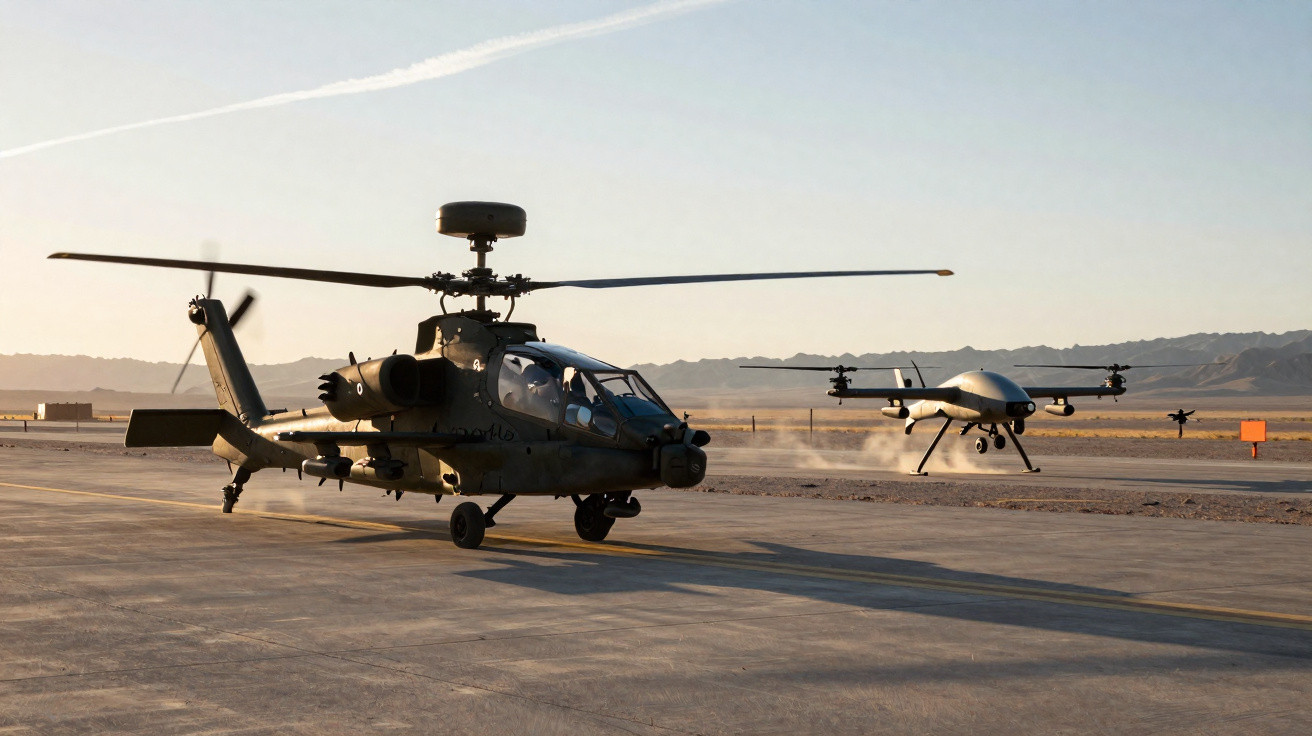
Even as the CCA programme keeps moving forward, defence industry work is also producing comparable systems for other aircraft types. On 20 July, Anduril introduced Thunder, which it describes as a Group 5, rotor-based autonomous attack aircraft, “designed specifically to multiply combat power and increase the survivability of current and next-generation crewed attack and assault aircraft”.
Because Thunder is a vertical take-off and landing (VTOL) platform, it does not require a runway. According to the company, it can carry precision munitions, air-launched effects, rockets, electronic warfare payloads, UAS protection systems and cargo, and it is also designed to integrate future mission systems quickly.
Anduril added that Thunder’s main payload bay “can be configured with” ten air-to-surface missiles-such as Hellfire, JAGM or Barracuda-100M-sixteen deployable effects-such as Altius-600-or seventy-six 70 mm rockets, as well as a further twelve counter-uncrewed effectors in the nose-mounted payload module. That represents a substantial amount of firepower.
Speaking to specialist defence outlets, Anduril executives said that Thunder’s expected speed and capabilities could allow the attack helicopter to function as a loyal wingman for the United States Army Aviation’s Boeing AH-64 Apache attack helicopter and the Lockheed AH-56 Cheyenne multi-mission combat helicopter.
Thunder’s first flight is planned for some point in 2027, and production could begin as early as 2029 or 2030, depending on demand. Pricing has not yet been released, although the company has positioned Thunder as an “attritable” platform-meaning it is built to accept an operationally tolerable level of risk and loss in high-intensity scenarios.
International parallels: Australia and the United Kingdom
Other armed forces have their own approaches to the CCA concept. Australia, for instance, contracted Boeing Australia to develop the MQ-28 Ghost Bat. The platform recently took part in Exercise Valiant Shield 2026, held in the Indo-Pacific region. Valiant Shield ran from 22 June to 1 July and, during the exercise, Ghost Bat aircraft reportedly flew alongside crewed platforms.
In a similar vein, the Royal Air Force plans to develop a “guardian angel and an attack dog” for its Typhoon and F-35 combat aircraft and, ultimately, Tempest, according to recent remarks by the Chief of the Air Staff, Air Chief Marshal Sir Harv Smyth.
Outlook for South America
South American air forces are in the process of updating their principal combat fleets. Although drones are being introduced to support land forces and there is some interest in uncrewed surface vehicles, the notion of a South American version of the CCA-or any of its many variants-still sits, for now, on a distant horizon.




Comments
No comments yet. Be the first to comment!
Leave a Comment