
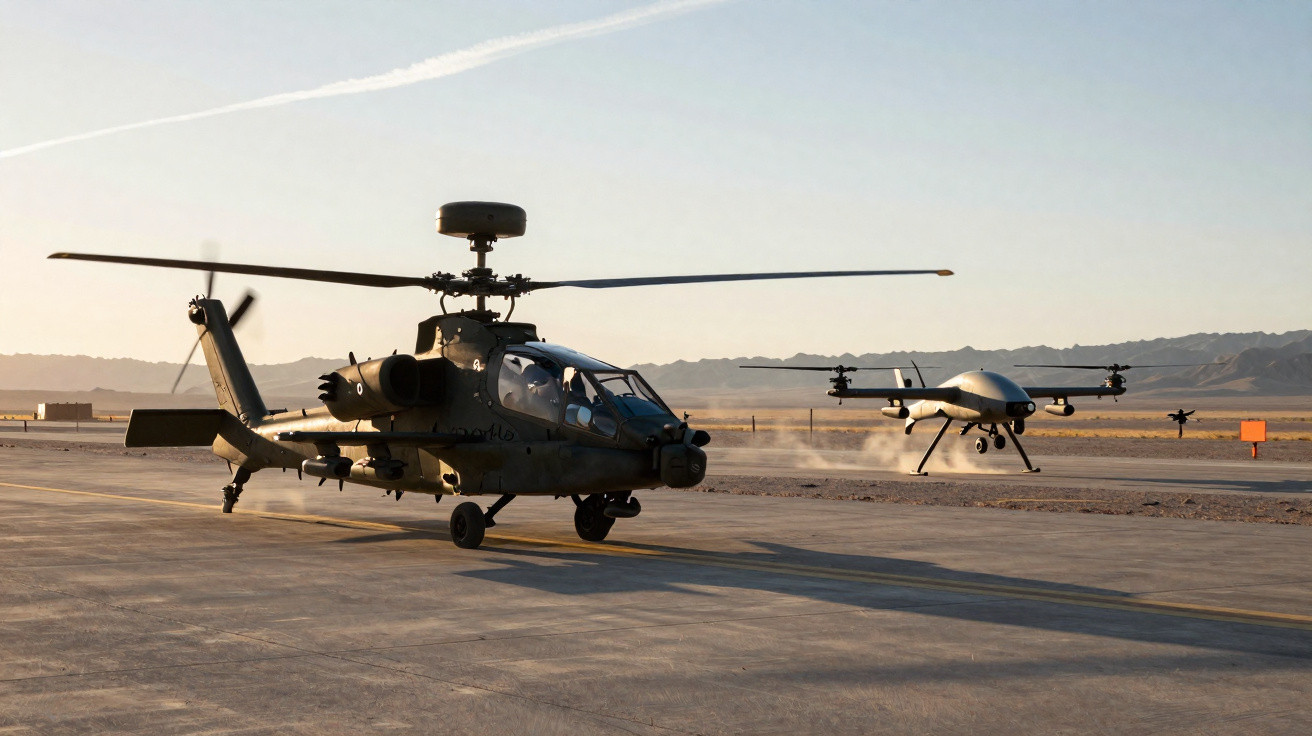
Companion drones in future air combat
The US armed forces envisage a future in which crewed aircraft routinely operate with uncrewed companion platforms that fly alongside them. Alongside the well-known US Air Force Collaborative Combat Aircraft (CCA) effort, defence manufacturer Anduril has now revealed Thunder-a rotor uncrewed aerial system (UAS) intended to accompany the US Army’s Cheyenne helicopter and forthcoming rotary-wing types.
Modern air operations are increasingly hazardous, with threats proliferating-including hostile drones. At the same time, crewed aircraft have become more sophisticated and are expected to be multi-role, which pushes them to carry a wider range of payloads across different mission sets. One way to both protect aircrew and extend what a crewed aircraft can do is to pair it with a drone flying in formation.
In that concept, the uncrewed platform can take on additional payloads-missiles and other weapons among them. It would rely on artificial intelligence for operation, easing the pilot’s cognitive burden; however, key choices (for example, whether to launch missiles) are still expected to remain with a human rather than an autonomous system.
The US Air Force Collaborative Combat Aircraft (CCA) programme
In the United States, the flagship initiative aimed at pairing drones with crewed fixed-wing aircraft is the CCA programme. For Increment 1, the first phase, two firms have been selected: Anduril’s FQ-44 (Fury) and General Atomics’ YFQ-42A (Dark Merlin). Work on Increment 2 is already under way, with additional companies taking part.
Recent milestones with Anduril’s YFQ-44
The technology is advancing and hitting new benchmarks. The US Air Force recently said that, in mid-July, an Anduril YFQ-44 launched an AIM-120 AMRAAM (Advanced Medium-Range Air-to-Air Missile) at a digital target over California’s Mojave Desert. Air Force Chief of Staff Gen. Kenneth S. Wilsbach said, “we’re one step closer to delivering capabilities to the warfighter.”
A week later, at the time of writing, flight trackers indicated that an Anduril YFQ-44 (tail number 25-1003) was transiting US airspace. The US Air Force then confirmed, “from July 20-24, 2026, the Air Force Collaborative Combat Aircraft (CCA) Experimental Operations Unit (EOU) is conducting an Agile Combat Employment (ACE) exercise at Creech AFB, Nevada. Military operators are leading end-to-end ground and flight operations for both the YFQ-42 and YFQ-44.”
Anduril Thunder, a Group 5 autonomous attack rotorcraft
As the CCA effort progresses, defence firms are also exploring comparable companion systems for other kinds of aircraft. On 20 July, Anduril introduced Thunder, which it describes as a Group 5 autonomous attack rotorcraft “specifically designed to multiply the combat power and increase the survivability of current and next-generation crewed attack and assault aircraft.”
Thunder is a vertical take-off and landing (VTOL) design, so it does not need a runway. Anduril says the platform can be equipped to carry precision munitions, air-launched effects, rockets, electronic warfare payloads, counter-UAS force-protection systems, and cargo, and that it is set up for rapid incorporation of future mission systems.
The company added that Thunder’s primary payload bay “can be configured with” ten air-to-ground missiles (for example, Hellfire, JAGM, Barracuda-100M), sixteen launched effects (for example, Altius-600), or seventy-six 70mm rockets-plus a further twelve counter-UAS effectors located in the nose payload module. That is a substantial weapons load.
Speaking to defence news agencies, Anduril executives said that, given Thunder’s anticipated speed and performance, the attack rotorcraft could act as a loyal wingman for US Army Aviation’s Boeing AH-64 Apache and the Lockheed AH-56 Cheyenne multi-role attack helicopters.
Thunder’s maiden flight is planned for some point in 2027, and it could move into production as early as 2029 or 2030, depending on demand. Anduril has not disclosed a unit price, although it has characterised Thunder as “attritable.”
Similar programmes abroad
Other armed forces are pursuing their own counterparts to the CCA idea. In Australia, for instance, the Australian Defence Force has contracted Boeing Australia to develop the MQ-28 Ghost Bat. The aircraft took part in Exercise Valiant Shield 2026 in the Indo-Pacific. The exercise ran from 22 June to 1 July, and Ghost Bat reportedly flew alongside crewed aircraft during the event.
In the United Kingdom, the Royal Air Force is also looking towards paired uncrewed systems. Air Chief Marshal Sir Harv Smyth, the Chief of the Air Staff, recently said the RAF intends to develop a “guardian angel and an attack dog” to operate with the RAF’s Typhoon, F-35, and ultimately Tempest combat aircraft.
Across South America, air forces are upgrading their front-line fighter fleets. While drones are being bought to support ground forces-and there is some interest in uncrewed surface vessels-the prospect of a South American equivalent of the CCA (or any of its many variants) still appears to be a distant ambition for now.






Comments
No comments yet. Be the first to comment!
Leave a Comment