
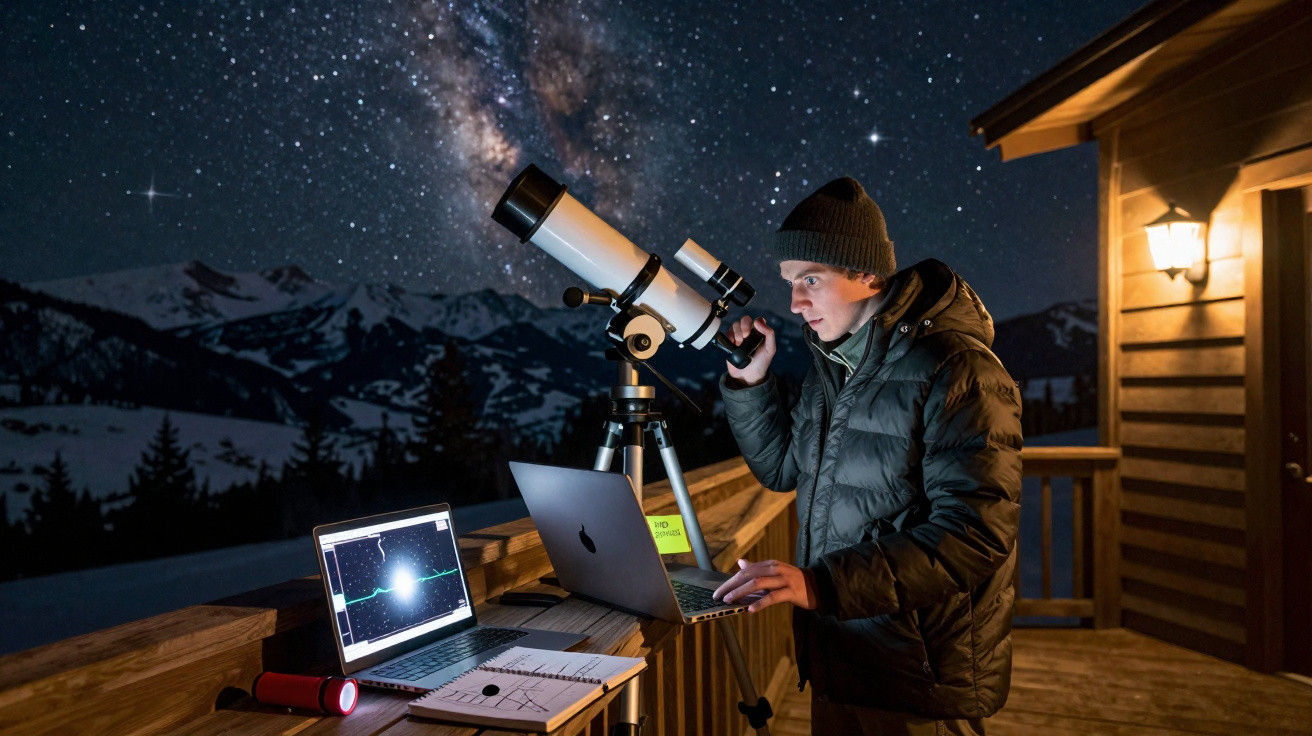
The search for new planets gained an unexpected chapter in Colorado. Scientists used straightforward tools installed in a modest structure to study deep space, proving that major space discoveries do not always require multi‑billion‑pound satellites or extremely advanced technology to reshape modern science.
How did the search for exoplanets begin in Colorado?
In 1999, a small instrument altered the course of global astronomy. A telescope measuring just 10 cm (4 inches) across was operated inside a rough wooden shed, showing that continuous monitoring of the sky could produce valuable data about distant celestial bodies.
The trailblazing project was led by determined researchers in the United States. Scientists David Charbonneau and Timothy M. Brown directed the observations at the High Altitude Observatory, aiming to test complex ideas through an innovative approach that stayed focused on practical results.
To meet its scientific goals, the experiment relied on a few essential elements:
- STARE telescope: a modest device tasked with monitoring stellar brightness.
- Rustic shed: a simple wood structure that housed the key instrumentation.
- Star HD 209458: the selected primary target for the tests.
- Applied photometry: the technique used to measure subtle changes in light.
- Planetary transit: the astronomical event that confirmed the planet in orbit.
What was the major discovery around the star HD 209458?
The study gathered momentum when the team trained its optics on a particular point. The central aim was to track the light output of the star HD 209458-an object thought to hold crucial clues about hidden worlds in the universe.
The measurements revealed a slight, repeating dip in that star’s brightness. This intriguing pattern suggested that the exoplanet named HD 209458 b was orbiting and passing directly in front of its sun, creating a noticeable light blockage.
How did photometry revolutionise the study of space?
Precise measurement of starlight proved to be both highly workable and cost‑effective. The technique known as photometry enabled astronomers to detect tiny variations in energy output, opening new routes to chart distant planetary systems efficiently.
Light measurement
Brightness variations across the cosmos
Photometry examines the intensity of radiation emitted by stars over time.
With that information, scientists can indirectly identify hidden celestial bodies orbiting those stars.
Before this historic milestone, many people questioned whether this kind of tracking would work in practice. The success of the early experiment validated the planetary transit method as a dependable tool, cementing a new era of striking astronomical discoveries.
The main advantages of this methodology include:
- High precision when collecting light data.
- Low operating cost compared with satellites.
- Ability to identify planets beyond the Solar System.
Why did the STARE telescope surprise the scientific community?
The instrument known as STARE exceeded what many scientists of the time expected. Despite running with limited resources inside that small wood cabin, the optical system delivered results that challenged far larger and more complex equipment.
The simplicity of the hardware stood in sharp contrast to the scale of the space breakthrough unfolding at the time. That contrast showed how human creativity, combined with scientific rigour, can overcome a lack of heavy financial investment in astronomical research.
The legacy of the initiative includes several key outcomes:
- Encouraging the development of new, more accessible technologies.
- Motivating young astronomers to apply creativity in the field.
- A practical reminder that big data demands persistence.
What is David Charbonneau’s impact on astronomy today?
The astrophysicist went on to lead further in‑depth investigations to find celestial bodies across the galaxy. His work helped inspire modern projects aimed at identifying distant planets, laying crucial groundwork for future studies into whether other systems might contain an atmosphere and water.
Today, the international community views that achievement as the real start of a revolution. The early push to observe exoplanets fundamentally changed our understanding of the universe, demonstrating that human knowledge has no impassable boundaries.
Official source: Information compiled directly from The Kavli Prize.






Comments
No comments yet. Be the first to comment!
Leave a Comment