
There are moments that do not merely hint at what comes next - they show the future already up and running. That is exactly what we witnessed in Seixal, where bp has taken a major step in the electric car charging revolution by installing Europe’s first 1 megawatt public charger.
This infrastructure, delivered through a partnership between Iberdrola and bp pulse, is now live - although currently capped at 600 kW per connector - and makes Portugal the first European venue to trial this technology with public access.
bp’s decision to debut Europe’s first public 1 MW charger in Portugal is no accident. It reflects how quickly Portuguese drivers embrace new solutions, and it underlines the country’s strategic role as a testbed for innovation in electric mobility.
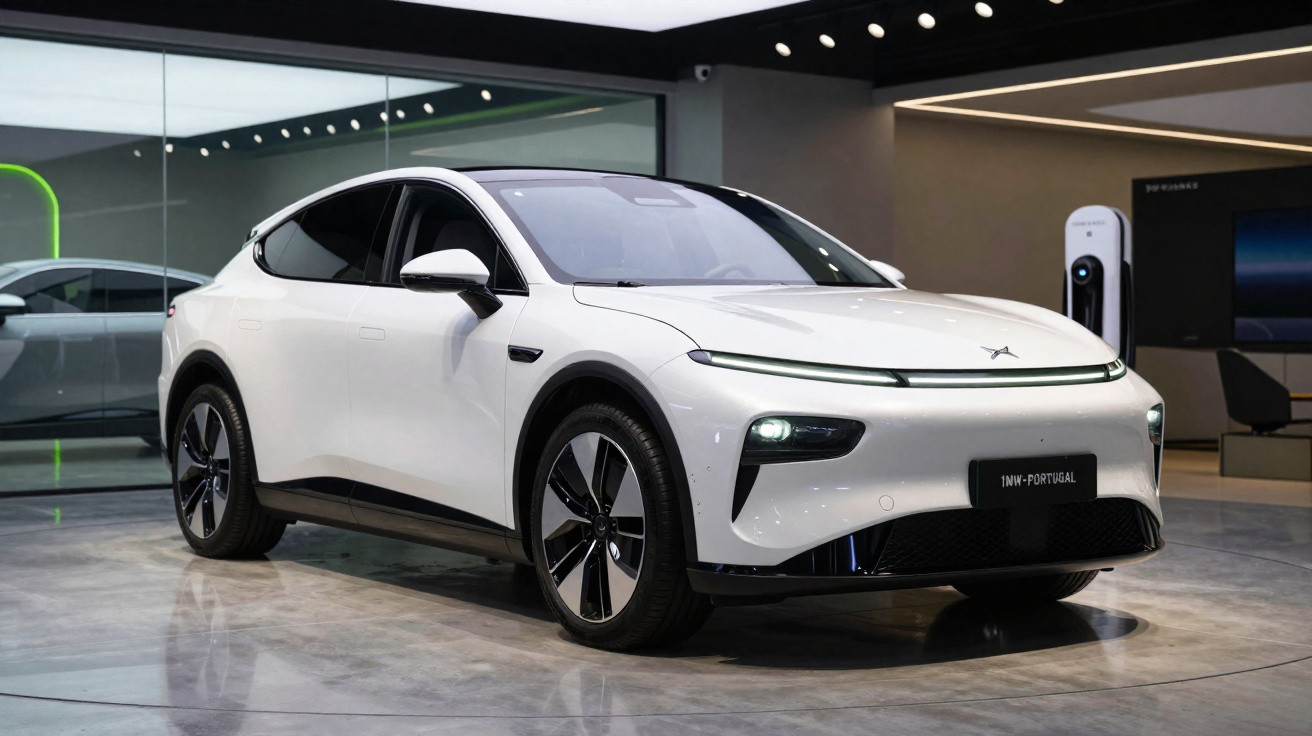
To see how far this can go, we paired it with the right car: the XPENG G9 2025, the fastest-charging electric vehicle currently on sale in Portugal. Machine met machine - charger met car - in a high-voltage conversation captured in a video in which we explain how it all works.
A megawatt that resets the scale
A megawatt is more than a unit of measurement - it marks a new order of magnitude. It equals 1,000 kilowatts of power, enough to supply between 1,500 and 2,500 homes, or roughly 10% of the energy used by a packed football stadium on a Champions League night. For the first time, that level of power is concentrated in a single charging point open to the public - right here on the south bank of the Tagus.
The hardware has a technical name: Alpitronic HYC-1000. And it is not just another charging post - it is a glimpse of what is next. Installed by Iberdrola | bp pulse, it functions as a proving ground for a new generation of ultra-rapid chargers.
The main unit, connected to two dispensers, can deliver up to 1,000 kW of combined output, automatically adjusting energy delivery depending on how many vehicles are charging. Think of it as an electric conductor, distributing power without missing a beat.
The new frontier of rapid charging
For years, “rapid charging” effectively meant 50 kW - a figure that climbed slowly over time. Today, that definition is outdated. The HYC-1000 supports up to 600 kW per connector even without liquid-cooled cables - a temporary ceiling set for thermal reasons. When the cable temperature reaches around 52 °C, the system reduces power as a safety measure.
Future versions will bring liquid-cooled cables designed to sustain 600 kW (or more) throughout the full charging session. Further ahead, the Megawatt Charging System (MCS) will arrive, aimed at lorries and industrial vehicles, offering 1 MW of power per cable. According to bp, Portugal will be among the first countries to test it.
While the technology sounds futuristic, the user experience stays familiar: card payments, integration with the usual apps, an invoice with a VAT number, and full cost transparency. And at some of these sites, bp is also backing the Pingo Doce & Go concept, turning charging time into something genuinely useful in the day.
The XPENG G9 and a new way of measuring time
On the vehicle side, the XPENG G9 2025 is the first electric car sold in Portugal prepared for charging power above 500 kW. Its 93.1 kWh battery and 800 V SiC architecture allow it to go from 10% to 80% in just 12 minutes - or, translated into motion, 1 kilometre of range per second.
With 575 hp, 695 Nm, and up to 585 km WLTP range, the G9 blends performance and efficiency with a tech-led cabin that feels concept-car-grade: two 14.96-inch 2.4K displays, Dynaudio audio with 20 speakers and Dolby Atmos 7.1.4, intelligent air suspension, and even 50 W wireless charging with active ventilation.
Portugal at the forefront of electrification
According to bp, installing this first 1 MW charger is a milestone that goes beyond the technology itself. It signals confidence in Portugal’s ability to lead the electric transition, anticipating what will become the new normal on European roads within a few years.
And when a car can take in the energy equivalent of an entire stadium in twelve minutes, it becomes clear that the electric revolution no longer hinges only on batteries. It is only a matter of time before stopping to recharge stops being a problem.






Comments
No comments yet. Be the first to comment!
Leave a Comment