
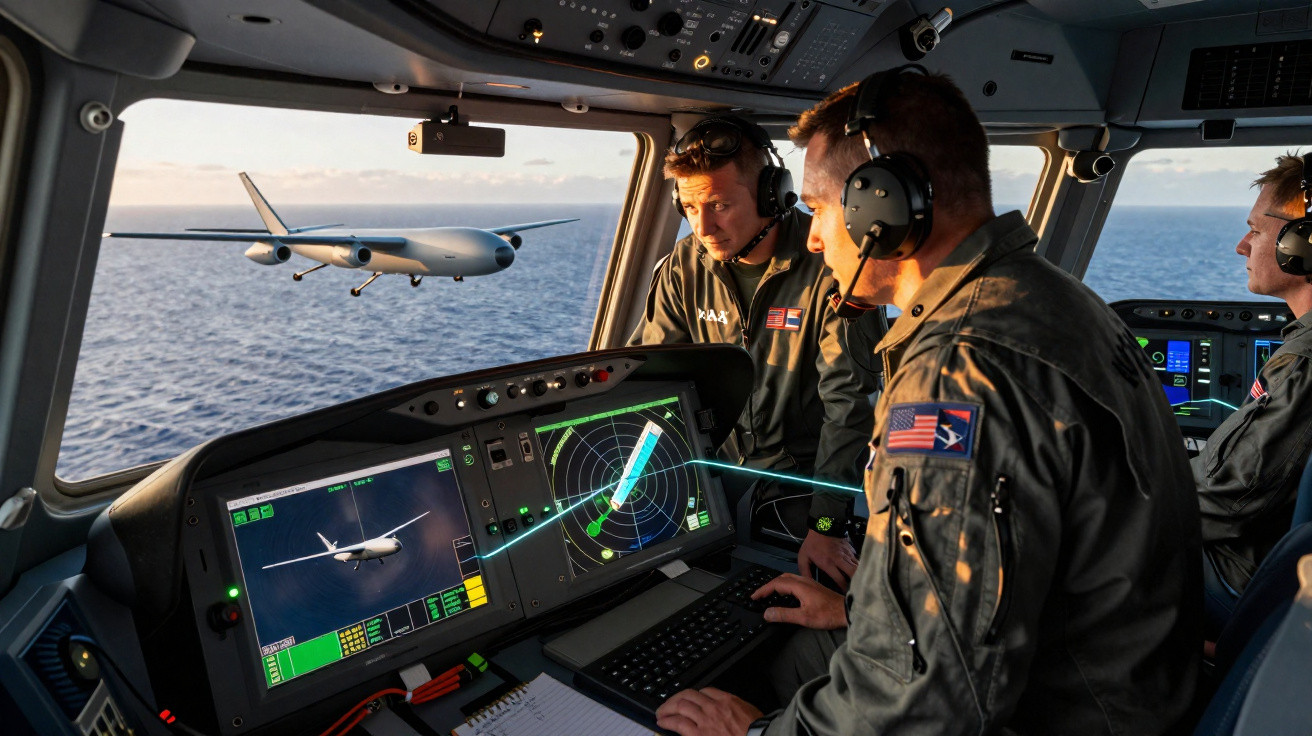
Northrop Grumman and Boeing have successfully carried out a technology demonstration highlighting improved interoperability between the P-8 Poseidon maritime patrol and reconnaissance aircraft and the MQ-4C Triton naval drone. The trial focused on confirming that the two airborne systems can be integrated and work together using standards-based, advanced collaboration.
The joint demonstration drew on artificial intelligence (AI) as well as open-mission systems and universal command-and-control interfaces.
P-8 Poseidon and MQ-4C Triton: how the interoperability test worked
During the event, an operator on board a P-8A Poseidon sent mission instructions to an MQ-4C Triton drone, directing it towards a specific operating area. Once the request was received, the MQ-4C autonomously planned the route and executed the transit to the designated location.
AI, open-mission systems and a standardised interface for data sharing
For this demonstration, Triton used AI algorithms to collect, process and share data with the P-8A. The information handover-including satellite relay-was conducted through a standardised interface that enables mission planning and execution across different platforms.
Boeing P-8 programme vice-president Tory Peterson said the joint demonstration between the MQ-4C Triton and the P-8 Poseidon “...highlights real capability and interoperability for the United States and its allies. We are investing so that current and future P-8A operators around the world can extend the reach and effectiveness of their missions with low-risk, evolutionary upgrades to the most advanced maritime patrol and reconnaissance aircraft already in service”.
The demonstration also underscored the ability for coordinated collaboration between crewed and uncrewed systems in jointly controlling intelligence, surveillance and reconnaissance (ISR&T) missions, target finding and anti-surface warfare.
The MQ-4C Triton maritime patrol drone continues to expand capabilities
The MQ-4C Triton is a high-altitude, long-endurance (HALE) uncrewed aerial system developed by Northrop Grumman. The drone was designed to conduct maritime patrol and maritime ISR missions, target location, search and rescue, and signals intelligence. Triton can operate at altitudes above roughly 15,240 metres for more than 24 hours, with a range of about 13,705 km.
The United States Navy and the Royal Australian Air Force are the primary Triton operators. Its operational integration with crewed aircraft broadens surveillance capacity for assigned missions; both the MQ-4C and the P-8 Poseidon aircraft can be employed together across a wide spectrum of tasks.
More recently, at the Defence Industry Forum held alongside the NATO Summit, Northrop Grumman and Airbus Defence and Space signed a Memorandum of Understanding aimed at bringing the MQ-4C Triton system into the Alliance’s ISR Force fleet. This cooperative framework involves multiple European partners, with the goal of optimising how UAV services are implemented for NATO operations and strengthening allied maritime surveillance capabilities.




Comments
No comments yet. Be the first to comment!
Leave a Comment