
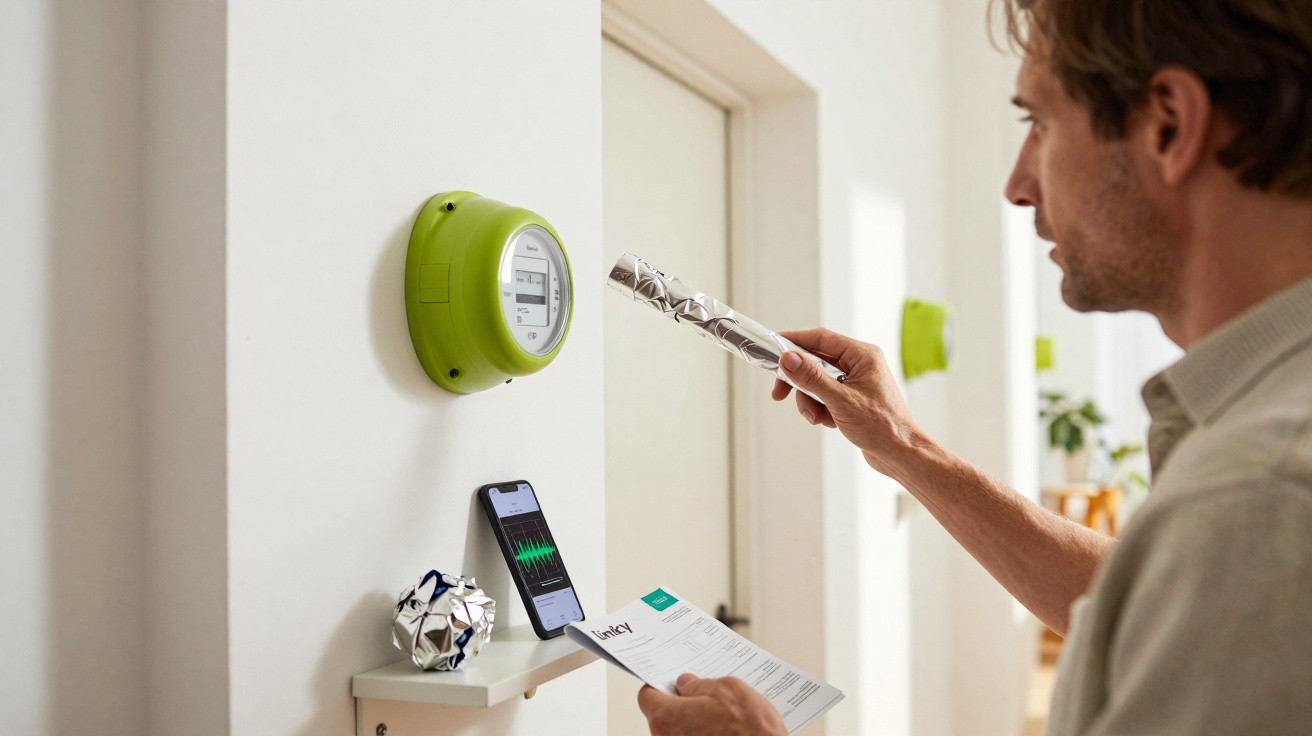
More and more people in France are wrapping their Linky smart meter in aluminium foil, believing it will shield them from electromagnetic waves. In practice, it is not just ineffective - it can be genuinely dangerous.
A social-media “fix” for the Linky smart meter
On TikTok, Instagram and other platforms, videos presenting this as a simple trick are racking up views: cover your Linky meter in aluminium foil and you will supposedly block electromagnetic waves.
Since it was rolled out in 2015, the Linky meter has become a familiar part of France’s energy set-up. It enables automatic meter readings and reduces the need for engineers to travel to homes, yet it still attracts anxiety from some users - sometimes for misguided reasons. Common claims include the idea that it contains a hidden spy camera (it is actually just a status LED) and that it constantly sends personal data, even though it only communicates once a day, at night.
What the evidence says about Linky electromagnetic waves
Concerns about electromagnetic waves sit at the centre of the wider argument. Some people report headaches, dizziness and other symptoms that they associate with their Linky meter. However, the scientific findings do not support the idea of harmful exposure.
A detailed 2017 investigation by the Agence nationale des fréquences (ANFR) shows that Linky’s emissions are well below regulatory thresholds - between 25 and 37 times lower than the permitted limit values. The emissions are also lower than those produced by many everyday household devices, such as Wi‑Fi routers and common electrical appliances.
This type of fear previously focused on smartphones and then wireless earbuds. The panic became so widespread that companies such as Fazeup sold so-called anti-wave patches. A few months later, scientific studies showed that these patches were not only useless but, worse, they increased wave emissions.
Aluminium foil around a Linky meter: a very, very bad idea
Wrapping a Linky meter in aluminium foil is just as pointless. Worse still, using aluminium foil as a protective shield carries serious risks. By blocking natural ventilation, it can cause the meter to overheat, potentially leading to power cuts and even fire hazards. More concerning, because aluminium foil is conductive, it creates an electrocution risk for anyone handling the meter or nearby electrical wires.
The growing popularity of this practice online - where some clips reach tens of thousands of views - is a clear illustration of how misinformation can undermine household electrical safety. “Tricks” that look harmless at first glance can have severe consequences when they involve electrical equipment.
When the Linky meter actually sends data
It is also worth remembering that the Linky meter transmits data only once per day, for a short period between midnight and 6 a.m. Any emissions are therefore not only low, but also limited in time.



Comments
No comments yet. Be the first to comment!
Leave a Comment