
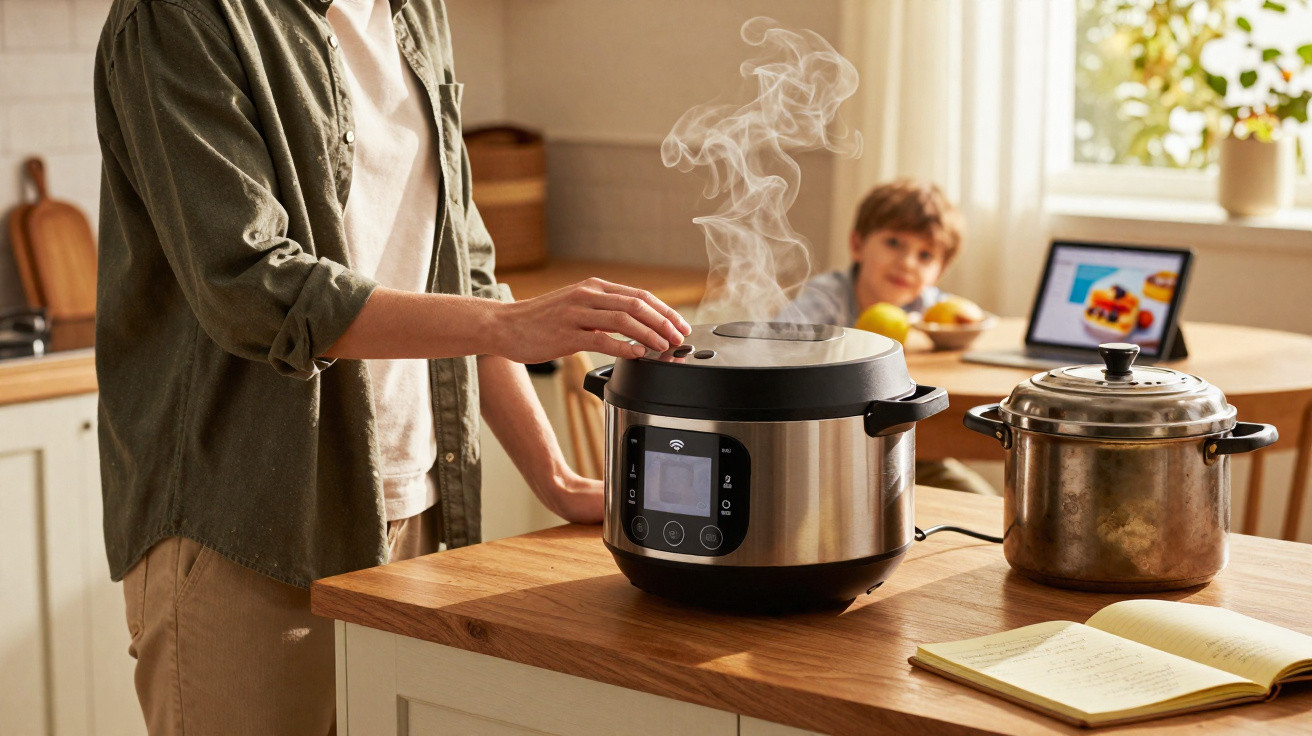
The first time the new smart cooker shrieked, the children started crying. It was a Tuesday - pasta night - that perfectly ordinary sort of evening when hunger and homework crash into each other at about 7pm. On the worktop, the gleaming kitchen robot flashed red, emitted frantic beeps like an alarm clock in a panic, and declared in a synthetic voice: “Error. Pressure valve blocked.”
Their old metal pressure cooker used to sit in the corner and quietly hiss, like a weary uncle keeping out of the way. Now the kitchen felt more like a cockpit about to abort take-off. Mum grabbed her phone to check the app, Dad pulled up a YouTube how‑to, and the saucepan of tomato sauce cooled as everyone bickered over which button to press.
Welcome to the smart cooker revolution. Or, depending on your luck, the beginning of a slow-motion domestic calamity.
From grandma’s whistle to Wi‑Fi recipes: what just changed in our kitchens
Step into an appliance shop now and the traditional pressure cookers have been shoved to the back, treated like slightly awkward antiques. In pride of place you’ll find glossy, touchscreen “kitchen robots” that claim they can chop, fry, steam, bake and even “think” on your behalf. They’re not merely cooking, they’re there to “guide your culinary journey” and “optimize your lifestyle”, if you believe the slogans.
Households swap the dependable stainless‑steel pot they trusted for two decades for a gadget that asks for software updates. What was once a simple weight on a lid and a familiar hiss has become sensors, QR codes and alerts on your phone. On paper, that looks like progress. In practice, dinner can hinge on Bluetooth connections and firmware versions.
One French insurance company has noted a quiet but consistent uptick in claims involving “multifunction cooking robots” over the last five years. Nothing catastrophic - just plenty of small, annoying mishaps: sauce sprayed everywhere, worktops scorched, and short circuits after a leak.
Consider Laura, 34, who was delighted to buy a smart cooker for her young family. For the first few weeks it felt like magic: risottos without constant stirring, stews left to slow-cook while she sat on Zoom calls, yoghurt set overnight. Then came the moment she now remembers too clearly. She opened the lid after a notification saying “Safe to open”, and was met by a fountain of boiling soup. The sensor had misread the internal pressure, the app later said. Laura still uses the machine, but when she turns the valve she now steps back, as if it’s a small, friendly bomb.
A big part of the issue is that older pressure cookers were frightening - yet they made sense. You could hear them. You watched the weight bounce, learnt what the steam meant, and you recognised when something wasn’t right.
Smart cookers, by contrast, hide that physical feedback behind layers of automation. They sell you on “set and forget”, and people do, in fact, forget. They fill the bowl, select “Chili con carne – 35 min”, walk away and put their faith in the algorithm. When it goes wrong, you’ve got no instinct to lean on - just baffling error codes.
And let’s be truthful: almost nobody sits down with an 80‑page digital manual before making their first family meal.
How to use your smart cooker without turning your kitchen into a lab experiment
If there’s already a smart cooker on your worktop, the aim isn’t to be scared of it. It’s to handle it as a tool - not as a magic wand.
Start by choosing three meals you genuinely make every week: perhaps a soup, a curry and a batch of rice. Get to know those three programmes properly. Pay attention to what preheating sounds like, how much steam you see, and what the lid feels like once the pressure is genuinely gone.
For the first five times you use pressure mode, stay in the kitchen for the entire cycle. Look, listen and smell. Turn your smart cooker from a mystery box into a neighbour you can at least predict.
Most mishaps with these robots aren’t caused by “bad technology”. They happen because, on a long day, humans take tiny shortcuts.
You lift the lid too quickly “just this once”. You fill past the max line because the cousins are coming. You drape a tea towel over the steam outlet to stop the cupboards fogging up. Every manufacturer warns against all of this - yet real life turns up anyway, complete with spilled milk and toddlers screaming.
We all know the moment: dinner is running late, messages keep pinging, and you start treating safety steps as negotiable. That is exactly when the smart cooker stops being helpful and becomes a risk multiplier.
“People think ‘smart’ means ‘safe by default’,” says a home-appliance engineer who tests these robots for a living. “But sensors can fail, apps can lag. Your attention is still part of the safety system.”
Never block or cover the steam outlet
Even with fancy valves and splash guards, steam still needs a clear way out. Put anything over it - a towel, a lid, a utensil - and you’re turning it into a wild card.Stay below the real max line with liquids
That faint mark inside isn’t there for decoration. Starchy foods such as lentils, pasta or beans can foam up and block valves.Treat “Ready to open” as a suggestion, not a law
Give the lid a gentle tap, watch for any remaining steam, and if you’re unsure, wait an extra minute. The food will cope; your fingers will be grateful.
Are we gaining freedom or losing control?
The boom in smart cookers says a lot about modern cooking. We want home‑made food, but we organise our lives around notifications and deliveries. So we buy machines that promise both: proper ingredients, on autopilot.
For some homes, that really is a quiet revolution. A working parent can add onions, lentils, stock and spices, choose a programme, and return to a hot meal rather than yet another takeaway bag. For others, the very same kitchen robot ends up abandoned, daunting, or used only for rice because everything else feels like too much faff.
There’s a fine line between handing something over and becoming dependent. When recipes live only inside an app, when timings shift with software updates, when a minor bug leaves us feeling useless in our own kitchens, something important changes. We stop being people who cook and become people who manage devices that cook.
| Key point | Detail | Value for the reader |
|---|---|---|
| Understand the new risks | Smart cookers hide pressure and heat behind automation and error codes | Helps you stay alert instead of blindly trusting the machine |
| Keep one foot in “manual” know‑how | Learn sound, steam, fill levels and safe opening by repetition | Gives you confidence and control even if the tech glitches |
| Use tech as a helper, not a master | Choose a few core recipes and stable routines rather than chasing every feature | Turns the robot into a real time-saver, not a stressful gadget |
FAQ:
- Question 1 Are smart cookers really more dangerous than old pressure pots?
- Answer 1
They’re not automatically more dangerous, but the risks are different. Old pots were simple and noisy, so you noticed problems fast. Smart robots are quieter, more sealed and more complex, so mistakes can be less obvious and more surprising.
- Question 2 What’s the safest way to release pressure on a kitchen robot?
- Answer 2
Always stand to the side, keep your face and hands away from the valve, and use a long utensil if there’s a manual release. If there’s a natural-release option, use it for soups, sauces and anything thick, even if it takes longer.
- Question 3 Can children safely help with a smart cooker?
- Answer 3
Kids can help measure ingredients, season, and choose recipes, but adults should handle lid closing, pressure mode, and opening. Think of it like the oven door: they can be around it, not in charge of it.
- Question 4 Do I still need a traditional pan if I own a full kitchen robot?
- Answer 4
Yes. A basic pan or pot is faster and more intuitive for many small tasks: frying an egg, reheating leftovers, boiling a quick pasta. The robot is great for set-it-and-walk-away dishes, not every single move in the kitchen.
- Question 5 How do I know if my smart cooker has a defect or if it’s just user error?
- Answer 5
If you see repeated error codes, unusual smells, visible cracks, or steam escaping from unexpected places, stop using it and contact support. If food regularly overflows or burns, first check fill lines, recipes and sealing ring – most of the time, that’s where the problem hides.


Comments
No comments yet. Be the first to comment!
Leave a Comment