
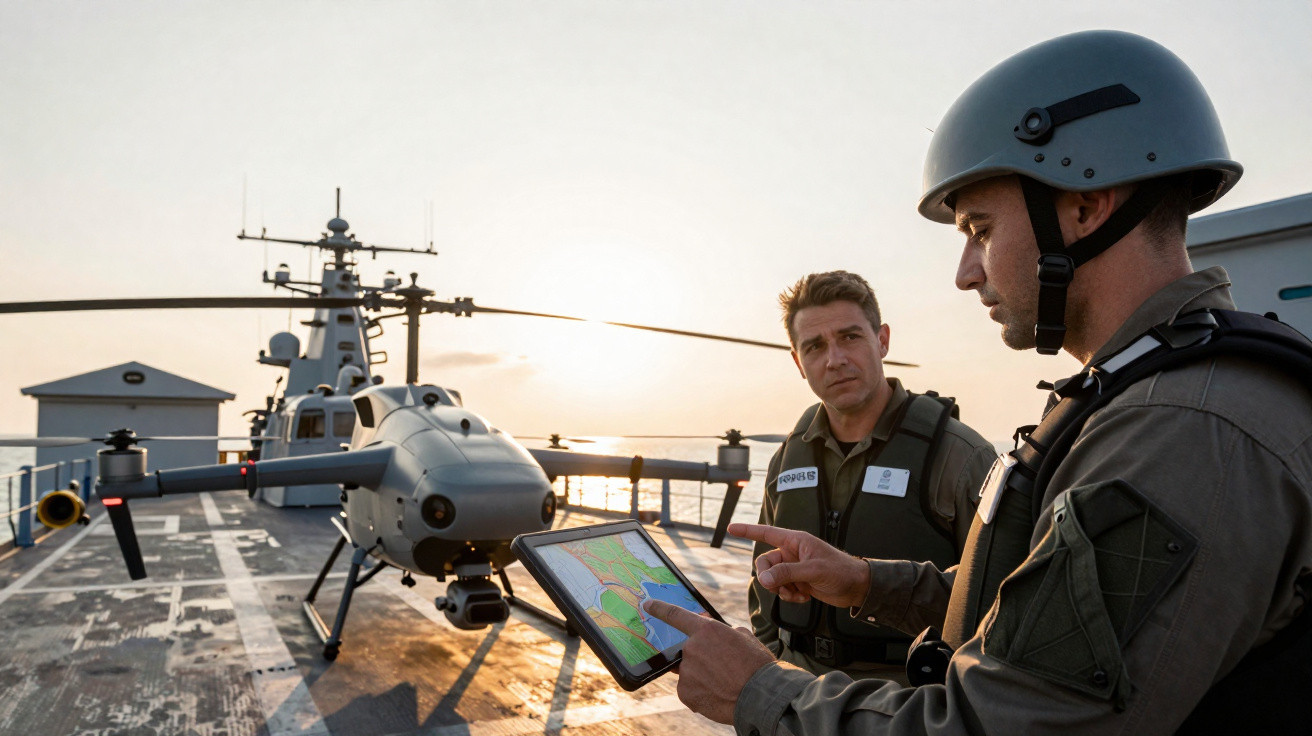
France is steadily reshaping what naval aviation will look like next, through a choice that could change how surface ships detect, interpret and respond to events at sea.
In southern France, away from the spotlight, a small unmanned helicopter has now progressed beyond the test phase. In doing so, it gives the French Navy a capability that many partner nations are still only exploring through studies and limited trials.
France makes the first move on Airbus’s naval drone
On 14 January 2026, in Marignane, France’s defence procurement agency (DGA) signed a production contract with Airbus Helicopters and Naval Group covering six VSR700 unmanned aerial systems. This is not a ceremonial order of prototype airframes; it is the first time a major Western navy has placed an order for series-built naval drones of this specific kind.
Initial deliveries are scheduled to translate into operational entry from 2028. That timeline gives the French Navy time to refine doctrine, train personnel and complete ship integration while others are still weighing options. Although six aircraft may appear limited, the significance lies elsewhere: this is the moment a demonstrator becomes an operationally fielded capability.
Launched in a small batch of six, the VSR700 shifts from “interesting prototype” to “real tool” in the hands of an operational navy.
For Airbus Helicopters, the contract also changes the industrial challenge. Producing a few aircraft for experimentation is one thing; delivering a repeatable, certified system that a navy can depend on over many years is quite another. Airbus has therefore created a dedicated industrial set-up for VSR700, shaped around unmanned-system realities: long-term support, fast-paced upgrades, cyber protection and strict safety constraints.
A flying sensor mast: the VSR700’s ISR configuration
An eye far beyond the ship’s horizon
The French Navy’s ordered configuration is geared towards Intelligence, Surveillance and Reconnaissance (ISR). Put simply, it is intended as a ship’s airborne sensor extension rather than a small armed platform. It provides a warship with persistent eyes and ears well beyond mast height-coverage that crews cannot maintain continuously.
The sensor fit will include:
- A maritime surveillance radar, pushing detection well past the radar horizon
- An electro‑optical turret for visual identification by day and by night
- An AIS receiver to collect and analyse transmissions from civilian vessels
Naval Group will be responsible for integrating the drone into a ship’s existing combat architecture through its Steeris Mission System. In practice, that makes the VSR700 more than equipment stored on deck: it becomes a fully networked element inside the ship’s combat system, comparable in integration to embedded sensors such as radar or sonar.
The VSR700 becomes another combat system sensor, sharing data in real time with the ship’s operations room rather than acting as a stand‑alone gadget.
This level of integration is critical. Some ship-capable drones can land on a frigate yet still function as external add-ons, using awkward data links and separate operator stations. France is pursuing the reverse approach: personnel in the operations room should consume the drone’s outputs like any other ship sensor, with shared tracks and a fused tactical picture.
Not a helicopter killer, but its long-range teammate
Keeping the pilot where decisions matter
The VSR700 is not intended to supplant embarked helicopters such as the NH90 or Panther. Instead, it is designed to complement them. Crewed helicopters retain the complex, higher-risk tasks: anti‑submarine warfare, winching, special forces insertion, medical evacuation, armed interdiction. The unmanned aircraft is meant to take on the long-duration, repetitive and data-intensive work.
When teamed with a crewed helicopter, the VSR700 can remain aloft for longer, sustain continuous surveillance across a broader area and fly repeated patterns without fatigue. In turn, the helicopter crew can approach an area or conduct an intervention with a clearer view of the surface and coastal situation.
Airbus has already demonstrated cooperation between VSR700 and manned helicopters through its “HTeaming” concept. Under that approach, people keep authority over tactical choices, while the drone expands the information picture and provides additional sensors on demand.
Unmanned does not mean unsupervised: the VSR700 gives naval aviators more options, not less control.
From a civil trainer to a hardened naval asset
Building on the Cabri G2 platform
The VSR700 is not a clean-sheet aircraft. Its airframe lineage comes from the Cabri G2, a light helicopter produced by the French manufacturer Helicoptères Guimbal. Starting with a certified, proven civil platform offers clear benefits: established flight characteristics, existing support pathways, and avoidance of years of aerodynamic trial-and-error.
Turning that base into a naval military system-within the SDAM programme led by the DGA and the French Navy, with Naval Group-required extensive changes. The aircraft needed corrosion protection for salt exposure, strengthened avionics, secure data links, automated take‑off and landing for shipboard use, and redundancy in critical systems. Before moving to series production, engineers drove the airframe to its operational limits and then cleared it.
More than a spy drone: missions beyond pure military use
A multi‑role tool waiting for new concepts
Although ISR is the initial French Navy focus, the VSR700’s underlying architecture is intended to support multiple missions. Airbus and prospective customers are already examining future payloads and roles that extend beyond classic maritime surveillance.
- Ship‑to‑shore and ship‑to‑ship logistics: moving light cargo, spare parts or urgent medical supplies between ships or from shore bases
- Armed reconnaissance: carrying light precision munitions if rules of engagement and export policies later permit
- Civil protection: spotting fires across large forest regions, assessing floods, and supporting search efforts after earthquakes or storms
That flexibility may prove important as governments increasingly prefer dual‑use capabilities serving both defence and civil security. A fleet that trains with the navy in peacetime could also assist domestic authorities during emergencies, potentially easing political opposition to procurement spending.
France steps into the drone age at sea
France has often faced criticism for falling behind in unmanned systems, particularly when compared with the United States, Israel or Turkey. Ordering the VSR700 does not remove that gap overnight, but it signals a distinct strategy: mature systems under industrial control, designed from the outset to match French ships and doctrine, and able to evolve through upgrades over decades.
From 2028, French naval aviation will begin operating with unmanned partners routinely embarked. That will influence training, flight-deck routines, rules of engagement and maintenance practices. For crews, the change may feel incremental; viewed externally, it is a generational shift towards ships operating as networked nodes with both human and robotic air components.
Who else is watching? Early users and interested navies
A small but growing circle of observers
At present, France is the only nation to have placed a firm VSR700 order under the SDAM programme. Even so, several overseas navies have already assessed the system, whether through operational activity or experimental campaigns.
The Royal Navy, for example, carried out VSR700 trials from a British vessel to evaluate the potential contribution of a rotary‑wing drone to maritime surveillance. Italian and Spanish naval personnel have monitored development closely and undertaken capability studies, particularly around ISR and building the surface picture. In Asia, certain navies seeking an ISR capability without maintaining a dedicated helicopter have also expressed quiet interest during demonstrations.
The picture as 2026 begins is as follows:
| Country / organisation | Status | Use case / context |
|---|---|---|
| France – French Navy | Firm order (6 systems) | Embarked ISR, SDAM programme |
| United Kingdom – Royal Navy | Operational trials | Evaluation of embarked naval UAV |
| Italy (navy) | Interest / studies | Naval ISR capability analysis |
| Spain (navy) | Interest / observation | Maritime surveillance |
| Potential export clients | Preliminary talks | Naval ISR, logistics, multi‑mission roles |
France’s order does more than equip its own fleet; it sends a signal that the design has moved from promising to real.
Export programmes often remain stuck at the “evaluation” stage because no lead customer is willing to be first. With Paris now committed, other ministries can more easily justify advancing discussions without feeling they are backing an unproven idea.
A tight, high‑tech market with a few serious rivals
VSR700’s place among naval rotary‑wing drones
Rotary‑wing UAVs designed for shipboard use sit in a niche, highly demanding market. Unlike small land-launched tactical drones, naval VTOL systems must cope with heavy sea states, tight deck footprints, salt corrosion, strong winds and deep integration into sophisticated combat systems. As a result, only a small number of manufacturers compete seriously.
Notable families currently include:
- Schiebel Camcopter S‑100: in service with around twenty navies; proven and widely used, but generally with a smaller payload and less deep integration into major combat systems.
- Northrop Grumman MQ‑8 Fire Scout: long operated by the US Navy and based on the Schweizer 333; highly capable but large and expensive, with its role now contracting as budgets and priorities shift.
- IAI rotary‑wing UAVs: Israel Aerospace Industries offers options focused on ISR and support to special operations, typically delivered via state-to-state arrangements.
- Chinese VTOL naval drones: multiple vertical take‑off designs exist, but export track records are limited and available documentation remains thin, particularly for navies aligned with NATO standards.
Against that backdrop, VSR700 occupies a middle tier: greater ambition in range and integration than lighter options such as the S‑100, yet more streamlined and cheaper to run than heavier systems like Fire Scout. Most importantly, it was conceived to connect cleanly with modern European frigates and corvettes.
Many drones can fly from a ship; far fewer blend cleanly into a Western naval combat system with shared tracks and secure data flows.
What this shift means for future conflicts and crises
The introduction of systems like VSR700 prompts broader questions for naval forces and civilian stakeholders alike. Modern surface combat increasingly hinges on detection-who sees whom first-and on maintaining continuous tracking without wearing out crews. A ship able to keep a drone on station for hours gains a real advantage in contested waters, particularly against small, fast or low‑signature threats.
There are also downsides to manage. Greater autonomy means more software, more code and a larger cyber attack surface. Opponents will seek to jam, spoof or penetrate data links. At the same time, operating drones near civilian shipping or in congested straits will require tighter rules that combine maritime law, airspace regulation and defence rules of engagement.
On the other hand, unmanned aircraft can reduce human risk. Rather than sending a crewed helicopter into an area with uncertain air defences or possible unmarked mines, commanders could first deploy a VSR700 to build understanding. In natural disasters, an unmanned platform can reach places where damaged infrastructure makes crewed flights unsafe or unworkable.
France’s early move to field this Airbus system does not automatically translate into maritime dominance. It does, however, provide French ships with a capability many rivals do not yet have: an integrated, reusable naval drone that can turn each frigate into a compact information hub, with a robotic aircraft ready on deck when needed.
Comments
No comments yet. Be the first to comment!
Leave a Comment