
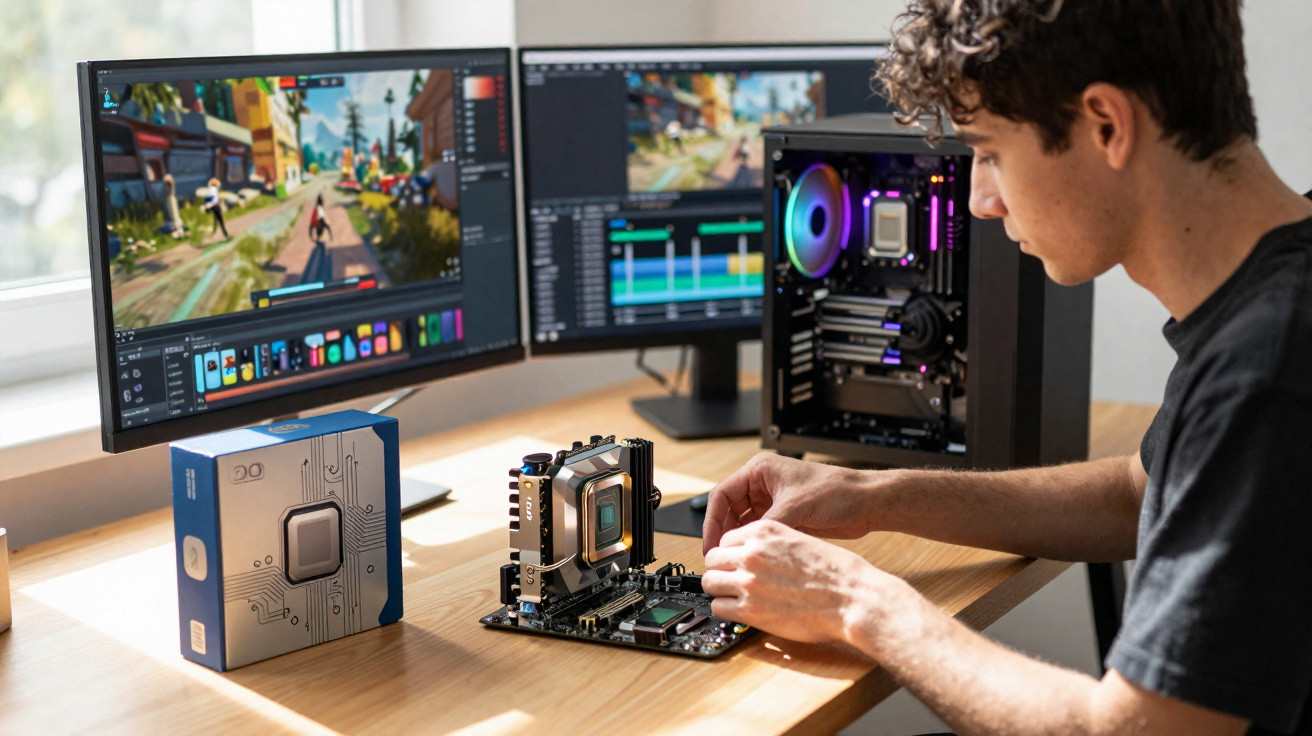
Intel is quietly lining up a major platform change intended to counter AMD’s recent strength in gaming and high-end productivity. The Nova Lake architecture, expected to underpin the upcoming Core Ultra 400 family, is being designed around very high core counts, an enormous shared cache, and a bigger emphasis on AI workloads than any mainstream Intel CPU so far.
Intel wants to erase doubts about its high-end future
Intel’s latest desktop releases have generally been solid, yet they have often felt like modest steps forward rather than a true leap. Many enthusiasts have been holding out for something that looks and feels genuinely different, not just another iteration of the same foundations. Internally, Nova Lake - pencilled in for late 2026 - is positioned as that turning point.
To get there, Intel is reportedly introducing two fresh core types: the performance-first “Coyote Cove” P-cores and the efficiency-led “Arctic Wolf” E-cores. The intention with both designs is to raise IPC (instructions per clock), which directly affects how much work each core can complete at a given clock speed.
Intel is effectively promising a fresh start: new cores, new cache structure, and a platform built with AI and gaming head-on in mind.
The objective is straightforward: waste less power when workloads are light, improve performance per watt, and deliver a credible response to AMD’s Ryzen and Ryzen X3D processors in both throughput and gaming frame rates.
Up to 52 cores and a “big last level cache”
The headline figure is the projected core count. Industry reports and internal-looking leaks indicate that the fastest Core Ultra 400 desktop parts could reach 52 cores overall, combining P-cores, E-cores, and a small number of ultra-low-power “LPE” cores intended for background activity.
This keeps Intel’s hybrid strategy, but pushes it far harder than before. Rather than simply adding a few extra small cores, Nova Lake is expected to rely heavily on numerous E-cores for highly parallel workloads, while reserving P-cores for latency-sensitive tasks such as gaming and creative applications.
The cache story is just as bold. Intel is said to be rebranding its last-level cache as “bLLC” - Big Last Level Cache - while increasing capacity to figures more commonly associated with AMD’s 3D V-Cache approach.
Premium Nova Lake chips may ship with up to 288 MB of shared L3 cache, directly challenging AMD’s cache-heavy gaming processors.
A large, low-latency cache helps the CPU keep more data on-die instead of repeatedly fetching it from slower system memory. In gaming, that frequently means steadier frame times and higher average FPS, particularly at 1080p or 1440p where the CPU can be the limiting factor.
Expected configurations for Core Ultra 400 desktop
From what is currently known, some of the anticipated SKUs could look like the following:
| Core Ultra 400 (Ultra 9) | Core Ultra 400 (high-end) | Core Ultra 400 (mid-range) | |
|---|---|---|---|
| Total cores | 52 (48 + 4 LPE) | 42 (38 + 4 LPE) | 28 (24 + 4 LPE) |
| Core breakdown | 16 P-cores / 32 E-cores | 14 P-cores / 24 E-cores | 8 P-cores / 16 E-cores |
| L3 cache (bLLC) | 288 MB | 288 MB | 144 MB |
| Socket | New socket | New socket | New socket |
All signs point to a new socket across the board, which implies today’s Intel motherboards will not support these chips. That will frustrate some upgraders, but it also suggests Intel wants to remove older platform constraints - particularly around power delivery and memory routing.
AI at the centre: a sixth‑gen NPU with 74 TOPS
Although many PC gamers will be watching cores and clocks most closely, Nova Lake’s biggest long-term play may be its AI hardware. Intel reportedly plans to include a sixth-generation NPU (Neural Processing Unit) rated at up to 74 TOPS (trillions of operations per second).
With roughly 74 TOPS on tap, Nova Lake NPUs aim to far exceed today’s Copilot+ PC requirements, which sit around 40–45 TOPS.
That level of throughput targets more than simple assistant features. Running local large language models, accelerating photo and video effects, automatic background removal, live transcription and translation, and AI-aided coding can all benefit from a fast, dedicated NPU rather than leaning only on the CPU or GPU.
By moving these tasks to an efficient AI block, Intel can also help laptops stay quieter and desktops run cooler during extended AI-assisted editing sessions or content generation.
No Hyper-Threading, more physical cores
One of the more unexpected choices is the apparent removal of Hyper-Threading. Intel seems prepared to drop simultaneous multi-threading, instead prioritising more physical cores and higher IPC per core.
In theory, that can make life easier for operating-system scheduling and may reduce internal contention for resources within each core. It could also help thermals and stability at high frequencies, as each core has fewer concurrent execution contexts to manage.
For applications that already scale well across many threads, the upside is clear: more genuine cores available. Workloads such as 3D rendering, compiling large codebases, or modern video encoding should see steady improvements if the predicted per-core uplift arrives.
Intel vs AMD by 2026: a brewing showdown
Nova Lake will not arrive in isolation. AMD is expected to have Zen 6 in the market around the same period, setting up a direct face-off where both companies push high core counts, increasingly aggressive cache strategies, and stronger on-device AI acceleration.
AMD has enjoyed a clear gaming advantage with its X3D line thanks to vertically stacked cache. Intel’s bLLC approach appears less reliant on exotic packaging, but it is chasing the same goal: keep more game data close to the cores and cut down trips to RAM.
On AI, both Intel and AMD are rushing to satisfy Microsoft’s shifting requirements for on-device AI features and whatever comes next for Copilot or similar assistants. A 74 TOPS NPU would give Intel a substantial marketing angle, particularly for creative professionals and developers experimenting with local models.
What this could mean for gamers and creators
If these figures prove accurate, a top-end Core Ultra 400 paired with a fast graphics card could become a compelling option for high-refresh 1440p and 1080p gaming. A very large bLLC should help reduce stutter in open-world games that stream data heavily or run complex simulations, especially in CPU-demanding genres such as grand strategy, MMOs, or large-scale shooters.
For creators, the combination of plentiful E-cores alongside stronger P-cores could be useful for mixed, real-world workflows. In principle, you could stream, run a local AI upscaler for your webcam, encode gameplay, and keep a browser full of tabs open without overwhelming the main performance cores.
- P-cores focus on latency-sensitive work: gaming, audio chains, active timelines in editing suites.
- E-cores plough through background throughput: encoding, batch exports, file compression, code compilation.
- LPE cores keep low-priority activity ticking over: updates, synchronisation tools, background AI agents.
Key terms and concepts worth unpacking
IPC (instructions per clock) refers to how many operations a core completes per cycle. For example, a 20% IPC increase at the same clock speed can feel like a whole generational jump, particularly in lightly threaded applications.
Cache is high-speed memory built into the processor. L1 and L2 sit close to each individual core; L3 (in this case, bLLC) is shared across many cores. Games and simulations can benefit hugely from a large, fast L3 because data access and core-to-core communication become quicker and more consistent.
TOPS is a throughput measure for AI accelerators. More TOPS does not automatically guarantee better real-world results, but once software is optimised for the hardware, a stronger NPU can run bigger or more complex AI tasks locally without obvious slowdowns.
Possible scenarios for buyers and PC builders
For people on current Intel platforms, the move to a new socket creates a natural decision point around 2026–2027: either remain on an existing motherboard and upgrade to the final supported CPU, or shift to a Nova Lake board - potentially alongside DDR memory configurations tuned to its revised cache and power design.
For users on older AMD or Intel systems, Nova Lake’s release window could be a good moment to plan an upgrade. A balanced build could pair a mid-range Core Ultra 400 (28 cores, 144 MB bLLC) with a strong but not flagship graphics card, aiming for excellent 1440p gaming while also enabling AI features and future Windows updates tied to NPU capability.
There are risks to consider. Rapidly increasing core counts can produce diminishing returns if software does not scale, or if scheduling across P-, E- and LPE cores becomes difficult. Power draw will also need scrutiny, both under full load and at idle, given the sheer number of cores on the die.
Even so, the potential gains are substantial. A clearly defined hybrid design, a huge last-level cache, and a serious NPU together suggest PCs that not only score higher in benchmarks and push more frames, but also feel quicker and more responsive as everyday applications increasingly rely on AI behind the scenes.



Comments
Некоторые модели прожекторов поставляются с выведенным отрезком провода, в таком случае можно не разбирая прибора подключить и проверить его работоспособность https://xn----8sbbqwjb8ce.xn--p1ai/
В этом случае контакты зачищаются и припаиваются к длинным проводам https://xn----8sbbqwjb8ce.xn--p1ai/
Все стыки тщательно изолируются https://xn----8sbbqwjb8ce.xn--p1ai/
Контроль сопротивлений кабельной продукции https://xn----8sbbqwjb8ce.xn--p1ai/
Условия проведения испытаний, требования к окружению и прибору https://xn----8sbbqwjb8ce.xn--p1ai/
Измерение сопротивления изоляции мегаомметром https://xn----8sbbqwjb8ce.xn--p1ai/
Порядок измерения мегаомметром https://xn----8sbbqwjb8ce.xn--p1ai/
Оценка результатов испытаний и их периодичность https://xn----8sbbqwjb8ce.xn--p1ai/
https://xn----8sbbqwjb8ce.xn--p1ai/
https://xn----8sbbqwjb8ce.xn--p1ai/
https://xn----8sbbqwjb8ce.xn--p1ai/
Контурное освещение предполагает вместо установки уличных фонарей воспользоваться специальными диодными шнурами для украшения кровли, элементов дома, перил или обмотки колон https://xn----8sbbqwjb8ce.xn--p1ai/
Трубки легко монтировать, затраты электричества небольшие и освещение яркое, чтобы выделить нужные компоненты дизайна https://xn----8sbbqwjb8ce.xn--p1ai/
Это современный вариант освещения участка загородного дома https://xn----8sbbqwjb8ce.xn--p1ai/
Самые экономичные уличные фонари подбирают для зон, где они будут работать постоянно, в любое время года, максимально возможное время в течение суток https://xn----8sbbqwjb8ce.xn--p1ai/
Как правило, это освещение периметра, входной зоны и парковки https://xn----8sbbqwjb8ce.xn--p1ai/
Наиболее экономичны из уличных садовых светильников, которые работают от электричества (сети), — светодиодные светильники для дачи, а также оснащенные КЛЛ (компактными люминесцентными лампами) https://xn----8sbbqwjb8ce.xn--p1ai/
Определение средств индивидуальной защиты https://xn----8sbbqwjb8ce.xn--p1ai/
Меры по снижению влияния вредных факторов, снижения степени опасности и предотвращения несчастных случаев https://xn----8sbbqwjb8ce.xn--p1ai/
Перечень и классификация СИЗ https://xn----8sbbqwjb8ce.xn--p1ai/
Порядок приобретения и выдачи, ответственность за использование https://xn----8sbbqwjb8ce.xn--p1ai/
https://xn----8sbbqwjb8ce.xn--p1ai/
https://xn----8sbbqwjb8ce.xn--p1ai/
https://xn----8sbbqwjb8ce.xn--p1ai/
Также можно выделить отдельную категорию светильников с фотореле https://xn----8sbbqwjb8ce.xn--p1ai/
Они позволяют регулировать освещение в зависимости от времени суток https://xn----8sbbqwjb8ce.xn--p1ai/
Также обратите внимание уличные фонари с датчиком движения https://xn----8sbbqwjb8ce.xn--p1ai/
Очень удобны уличные светильники на солнечных батареях https://xn----8sbbqwjb8ce.xn--p1ai/
Leave a Comment