
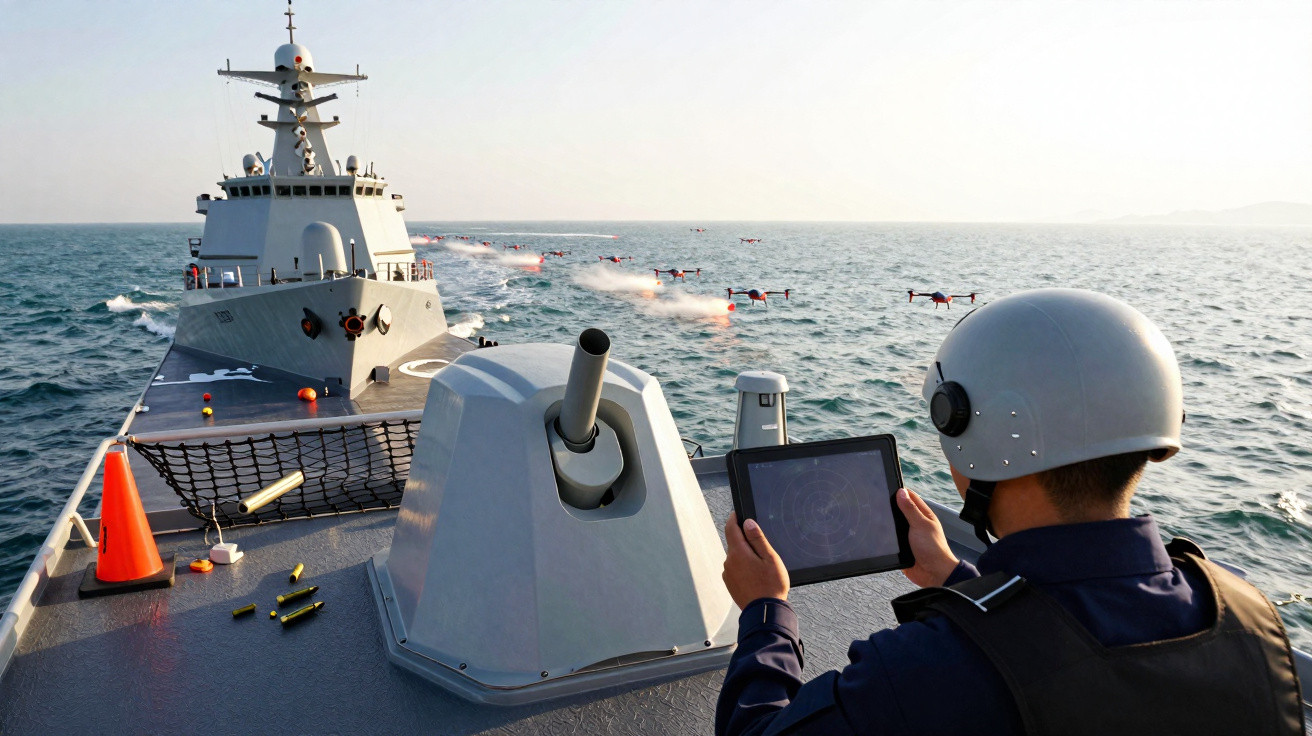
What could pass for a science‑fiction horror scene has become routine training for the People’s Liberation Army Navy. It has opened 2026 by running live drills against dense swarms of low‑flying drones intended to flood and exhaust a ship’s defensive systems.
China quietly rehearses the nightmare of future naval warfare
Video aired by Chinese state media shows the exercise putting frontline warships under pressure from repeated waves of small, high‑speed drones flying only a few metres above the water.
At that height, standard maritime sensors are pushed to the edge of their capability. Sea states create heavy radar “noise”, surface clutter masks tiny returns, and crews can be left with only seconds to react.
Low altitude turns cheap drones into stealthy threats: they hide in sea clutter, then erupt into view when it is almost too late.
Chinese planners seem to have arrived at a stark judgement: sheer quantity can defeat even highly capable ships. A destroyer might field advanced radar and potent missiles, but it is constrained by magazine depth, operator workload and computing capacity. Swarms-dozens, even hundreds-of expendable drones are built to test those constraints until the system breaks.
The brutal maths of drones versus missiles
Economics sits at the heart of this evolution. A contemporary ship‑launched surface‑to‑air missile can run to several hundred thousand pounds (or dollars) per round.
By contrast, a small drone carrying explosives-if produced at scale-can cost a small fraction of that; some are priced more like a family car than anything approaching a fast jet.
Using a costly missile for every inbound drone may keep a ship intact in the short term, but each shot reduces the remaining stock. A commander who destroys ten drones with ten missiles has, in a narrow sense, “won”-while paying heavily in both cash and future readiness.
The paradox: each kill can be a tactical success and a strategic loss if it drains weapons faster than the enemy drains drones.
That tension is central to the drills. Warships are confronted with successive attack waves, forcing crews to sort contacts quickly and choose which tracks to dismiss, which to jam, and which to destroy with limited interceptors. They must also preserve enough firepower for a potential final, more damaging strike that may follow initial harassment.
- First wave: limited numbers to probe reaction speed and rules of engagement
- Second wave: a larger swarm that mixes in decoys and non‑lethal drones
- Third wave: the main blow, timed for when defences are fatigued and stocks partly spent
The ship as a bubble that must not burst
In Chinese military writing, modern warships are frequently framed as a “defensive bubble”. Hull design, sensors and weapons form overlapping protective rings, and the swarm’s purpose is to punch through wherever that bubble is thinnest.
Protection is generally arranged in tiers:
| Layer | Role | Typical tools |
|---|---|---|
| Outer layer | Spot and categorise threats early | Long‑range radar, airborne assets, satellites |
| Middle layer | Engage confirmed threats | Surface‑to‑air missiles, electronic warfare |
| Inner layer | Final‑moment defence | CIWS guns, short‑range missiles, jammers, decoys |
Within this framework, a single drone is manageable. A hundred sea‑skimming drones arriving from multiple directions, however, create a loud, rapidly shifting tactical picture. In that environment, operators must work in terms of sectors, timing windows and volumes of airspace-not neat, one‑by‑one targets.
Fire too soon and the inner layer may be spent before the true attack materialises. Wait too long and even “near misses” can still leave fragments and warheads crashing into the superstructure.
The new art for ship commanders is not just hitting targets, but deciding which targets they can afford to ignore.
Why Taiwan is watching these drills very closely
These exercises are not aimed solely at viewers inside China. On the far side of the Taiwan Strait, defence planners read them as a practical rehearsal for challenges they expect to pose-and to face.
Taiwan has embraced what analysts often label the “porcupine” strategy: instead of trying to mirror China ship‑for‑ship or aircraft‑for‑aircraft, Taipei seeks to make any invasion attempt brutally costly.
Low‑cost, disposable drones slot neatly into that concept. They can be built in volume, dispersed in small storage sites, launched from roads or basic platforms, and directed towards high‑value naval targets.
In recent years, Taiwan has purchased large quantities of loitering munitions from the United States and has pressed domestic industry to convert target drones into strike systems. A notable case is the Chien Feng IV-a rapid, repurposed target drone derived from the American MQM‑178 and adapted into a high‑speed kamikaze platform.
Recycling old platforms into new weapons
The Chien Feng IV illustrates a wider global pattern. Armed forces are increasingly taking established training or surveillance drones and adding guidance packages and explosives, rather than developing entirely new designs from scratch.
This route reduces development timelines and leans on existing supply chains. A drone that once simulated missile flight profiles for training can, with upgrades, become the missile.
For China, that creates an uncomfortable calculation. Taiwan does not need a large navy to endanger Chinese warships operating near its coastline. A thick cloud of cheap, reworked drones could either push Chinese task groups further offshore or force them to burn through defensive stocks far faster than planned.
Naval warfare is becoming granular and algorithmic
The drills point to a larger transformation. Sea combat is no longer defined only by large ships exchanging big missiles at long range. It is becoming granular: countless small judgements, with many decisions made by algorithms before humans can fully interpret what is happening.
Modern naval radars can follow hundreds of tracks at once. People cannot realistically manage that volume in real time-particularly when the engagement evolves in seconds.
Automation stops being a luxury feature and turns into a survival tool when the sky is filled with cheap, fast, semi‑intelligent threats.
This is where artificial intelligence and modern battle‑management software come in. On both sides of the Taiwan Strait, engineers are building systems that rank targets, assign interceptors and suggest firing solutions at a speed unaided crews cannot match.
What China really wants to measure
Chinese commanders are not merely validating equipment. They are also evaluating human performance under pressure. Swarm drills make it possible to record reaction times, spot where teams hesitate, and determine which routines lead to wasted rounds or hazardous delays.
In private, staff officers are likely to focus on a few hard questions:
- How many drones are required to saturate a single destroyer?
- How long can that destroyer keep fighting before interceptors run low?
- When does the captain begin taking greater risks in order to conserve ammunition?
The conclusions inform how many drones China believes would be needed in an actual operation-and how rapidly replenishment ships would have to deliver fresh missiles and gun ammunition to units on the front line.
Key terms and real‑world scenarios
Two phrases recur in these debates: “loitering munition” and “saturation attack”. They may sound specialised, but they refer to straightforward concepts.
A loitering munition is a drone carrying a warhead that can patrol a designated area. Rather than flying straight to a pre‑set aim point, it can orbit while waiting for the right moment, then dive onto the selected target and detonate.
A saturation attack is built to defeat defences through volume rather than a single wonder‑weapon. It is a digital‑age equivalent of an arrow volley: one arrow is easily stopped, but a thousand become far harder to defeat.
Consider a plausible Taiwan Strait scenario. Chinese amphibious vessels advance towards the island under the protection of destroyers with layered air defences. Taiwan responds by launching successive waves of loitering munitions from coastal positions and small craft.
Some drones fly higher to prompt early detection and force defensive reactions. Others skim the waves, exploiting radar blind spots. A portion serve as electronic‑warfare platforms, attempting to jam sensors rather than strike. Chinese ships must rapidly decide which radar returns are true threats and which are intended as distractions.
As interceptors streak upward and close‑in guns engage, every decision has a price. A drone written off as a decoy could carry a real warhead; another that consumes a missile might be a cheap lure with no explosives at all.
Risks, side effects and what comes next
The move towards drone swarms has consequences beyond the Taiwan question. Smaller navies-from the Middle East to Eastern Europe-see drones as a way to endanger larger fleets without spending vast sums on traditional warships.
At the same time, warships are filling up with defensive kit: laser demonstrators, high‑rate guns, soft‑kill jammers, decoy launchers and ever‑more capable missiles. That added complexity increases training demands and expands the ways things can fail-through software defects or poorly configured sensors.
A further concern sits in the grey zone. Low‑cost drones make it easier for states-or even non‑state actors-to carry out maritime harassment that stays below the threshold of open conflict. A swarm buzzing a ship can be presented as “testing” or “accidental”, even as it forces expensive, repeated defensive responses.
While China refines these exercises against low‑flying swarms, other naval powers are watching closely and adapting. The competition is shifting away from who can build the biggest ships, and towards who can best juggle mass, software and the crews expected to keep their composure amid a storm of buzzing machines.





Comments
No comments yet. Be the first to comment!
Leave a Comment