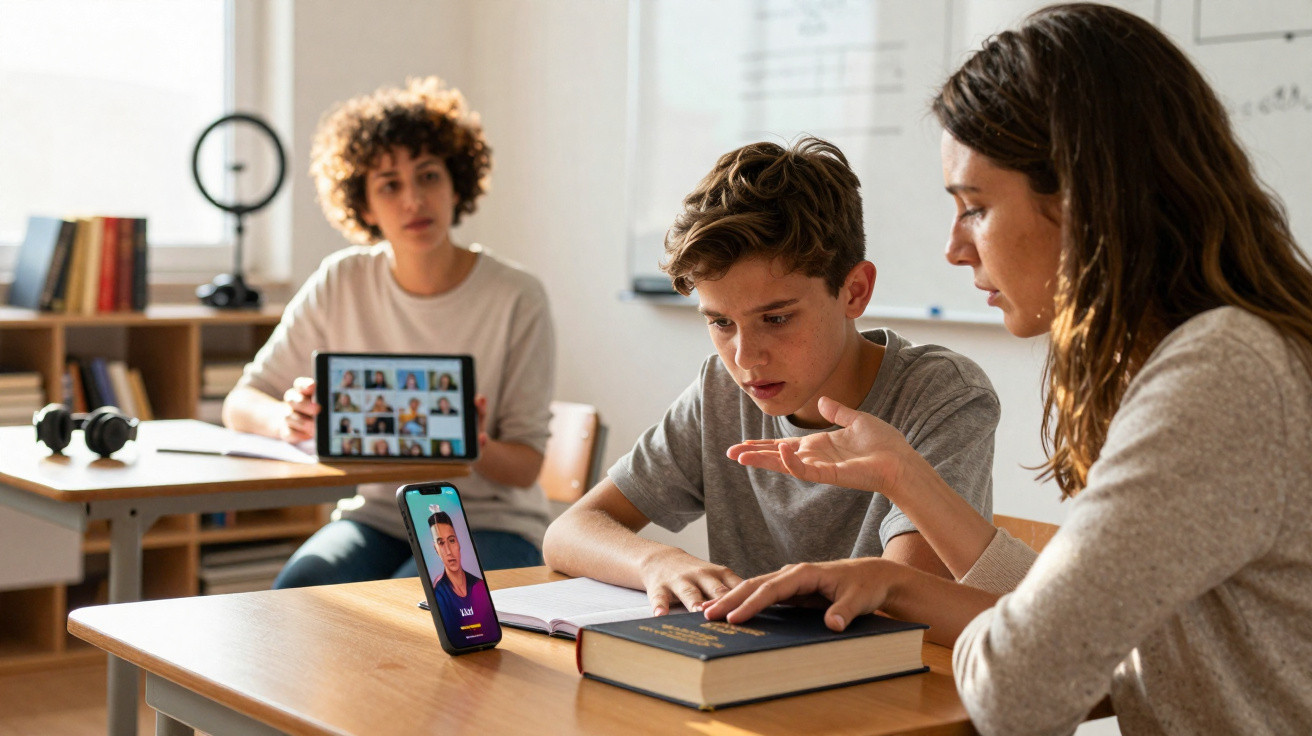
The bell goes at 8.15 a.m., as the scent of dried Expo marker ink mingles with smartphone alerts. On the whiteboard, in the spot once occupied by “Shakespeare – Act III”, a new slide shines: “How This TikTok Star Beat Anxiety (And You Can Too).” A teacher wearing trainers and a denim jacket presses play. An influencer, illuminated by a ring light, begins speaking about “staying authentic” to a class of fourteen-year-olds.
Parents at the back during open evening look on, simultaneously impressed and appalled. “Where’s the book?” one mother murmurs. Another browses the school’s new “innovative curriculum” page, her expression growing tense.
The pupils are watching, but they are not the only ones.
From Shakespeare to short-form: a classroom revolution
Throughout the country, school districts are discreetly replacing worn-out novels with viral video content. This is not simply an additional activity; it is becoming the central lesson. Rather than reading To Kill a Mockingbird, pupils examine YouTubers’ narrative “hooks” and dissect Instagram captions for “voice and tone”.
For administrators facing demands to maintain grades and reduce dropout rates, the reasoning is straightforward. Young people already spend their lives on screens, so education should meet them there. Engagement comes first, culture comes second.
The change seems rapid, untidy and oddly recognisable. It is like seeing a historic building painted in neon without anyone checking who still lives within it.
At one suburban Texas district, Year 10 pupils no longer complete a whole novel during their first term. Their revised literacy unit centres on three “high-impact digital creators”, all of whom have millions of followers and polished commercial partnerships.
Pupils write essays about how an influencer “builds authenticity”, before producing their own “personal brand pitch” in place of conventional book reports. The school proudly shares the work on TikTok and tags parents. Some applaud in the comments, while others send quiet emails to the headteacher asking why their child has never encountered George Orwell.
The subsequent school board meeting has standing room only. “Experiment” is repeated frequently. Yet no one can identify exactly who first approved it.
This is not merely nostalgia for leather-bound volumes. The issue is what we expect teenagers to grapple with during those vulnerable, charged years. Classic literature requires them to sit quietly, remain with complexity, and encounter characters they may dislike while still learning to understand them.
Influencer content is designed to generate clicks rather than reflection. Its purpose is to keep a thumb scrolling, not a mind thinking. When it takes the place of classroom reading instead of being used as a resource, it alters both the pace and the depth of learning.
Put simply, a 30-second motivational reel cannot achieve what 300 pages of difficult, unsettling ideas can do.
How schools could use influencers without throwing out the books
There is a middle ground that receives little attention at those fraught meetings. Teachers can use influencer content as an opening rather than the entire lesson. They can begin with material pupils already recognise, then guide them towards work they have never encountered.
One practical approach is “pairing”. A teacher could show a three-minute influencer account of online bullying, then read an extract from a classic novel about exclusion or shame. Pupils could identify parallels: who speaks, who remains quiet, and how power operates. The influencer acts as a mirror, while the book provides the window.
In this model, engagement does not displace depth. It creates an entry point to it.
Parents who feel caught off guard have often made an unspoken assumption: that today’s curriculum resembles the one they had as children. It does not, and the change has been swift.
Rather than protesting alone, many educators argue that the strongest response is to put highly specific questions to schools. Which texts are being taken away, and precisely what is replacing them? Are influencers being presented as literature, advertising, or a combination of the two? Who selects the creators used in class, and how are they checked for undisclosed sponsorships or political messages?
We have all experienced that point when we realise the ground has moved beneath us while we were simply trying to make it through the week.
Parents and teachers who have handled this calmly tend to share the same approach: remain curious, then become specific. One secondary-school English teacher told me that she began sending reading lists home with a brief note explaining why she was including a podcast or video alongside a poem.
“I’m not against influencers,” says Maria, a Boston teacher with 18 years in the classroom. “I’m against replacing wisdom with trending audio. My students can handle both TikTok and Toni Morrison. The system just needs to stop underestimating them.”
- Ask for the syllabus before the academic year begins, and treat it as a contract rather than a loose suggestion.
- Request one annual meeting at which parents, teachers and pupils can discuss what “literacy” ought to mean today.
- Propose pairings: for every influencer clip, include one substantial text with genuine narrative depth.
- Watch an assigned video with your child, then read a chapter together and discuss the differences in pace, feeling and nuance.
- If your school says it is “too late to change”, remember: policies are written by people, not carved in stone.
What this debate about influencers in classrooms really says about us
Beneath the anger over influencers in classrooms lies a more subdued concern: that we are bringing up a generation able to swipe endlessly yet unable to sit comfortably with themselves. Classic literature calls for patience, imagination and a form of inner resilience that no algorithm can deliver in ten seconds.
At the same time, influencer culture will not disappear. It is the atmosphere teenagers live in. Instead of acting as though it can be shut out of schools, the real issue is who holds the control. Will platforms determine the speed of learning, or will we teach young people to slow their scrolling and ask, “Who benefits if I believe this?”
Some families will campaign for the return of the old books. Others will welcome new media. Most sit in an uncomfortable middle ground, attempting to preserve attention spans as bills, homework and group chats accumulate.
The strain visible in that Texas classroom, between the illuminated slide and the missing paperback, is not only a question of education policy. It concerns the story we give young people about what merits their time, and which voices should remain in their minds long after the bell has gone.
| Key point | Detail | Value for the reader |
|---|---|---|
| Curriculum is changing quickly | Some schools are replacing complete novels with units centred on social media creators | Helps parents understand that this is not theoretical and may already be taking place locally |
| Influencers can be tools rather than replacements | “Pairing” digital material with classic texts maintains engagement without sacrificing depth | Provides a practical, balanced option rather than an all-or-nothing conflict |
| Parents can still influence the debate | Request syllabi, ask how creators are selected and press for clear criteria | Gives readers practical influence and a route from anxiety to action |
FAQ:
- Question 1 Why are schools suddenly using influencers in English and literature classes?
- Question 2 Is it always harmful when teachers introduce social media into lessons?
- Question 3 What should I ask my child’s school if I am concerned that classic books are being removed?
- Question 4 Can pupils genuinely develop critical thinking through influencer content?
- Question 5 What can I do at home if the school will not alter its approach?













Comments
No comments yet. Be the first to comment!
Leave a Comment