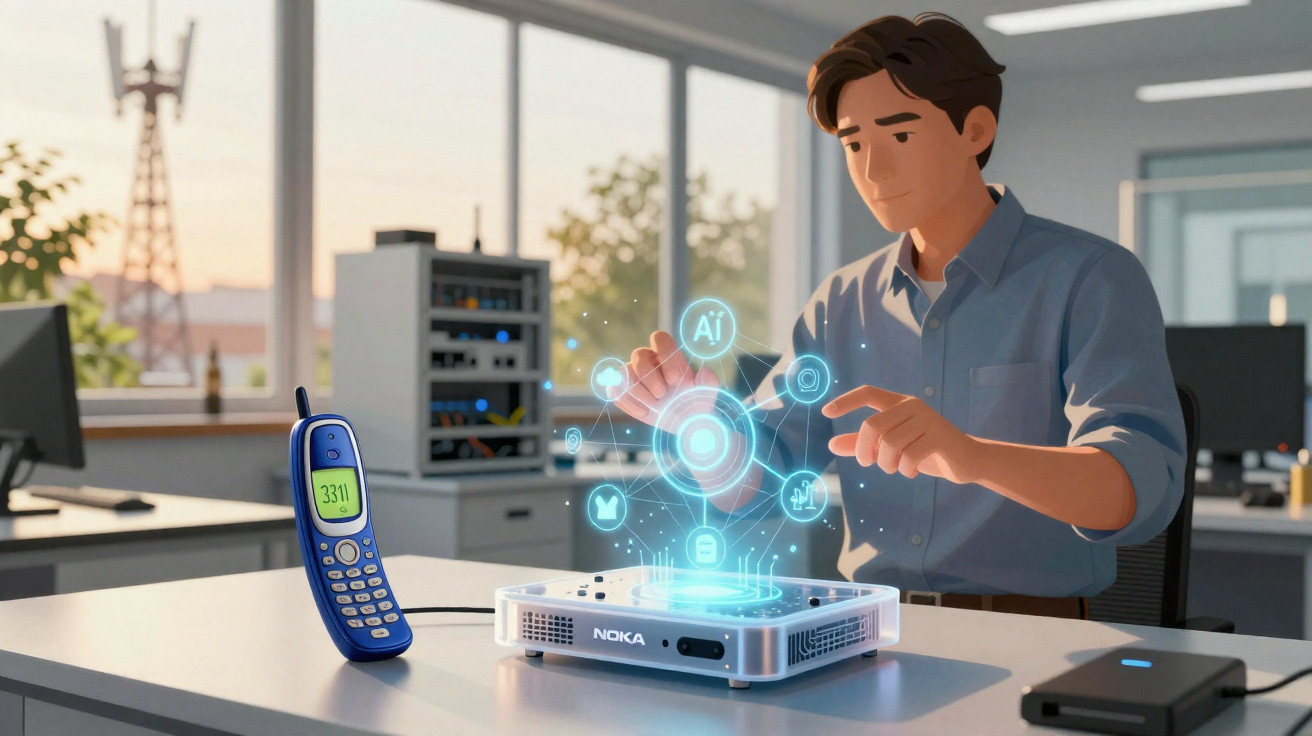
In an airport café in Helsinki, a man in a suit pulls a Nokia 3310 from his pocket and places it beside a MacBook M3 and an iPhone 15 Pro. The dark-blue handset looks as though it belongs to another era, yet it is the object drawing attention rather than the latest-generation screens. Its owner laughs and says he now works on network AI at Nokia, “the new Nokia, not the one known for polyphonic ringtones”.
On his display is a world map lit by thousands of red dots: 5G networks, subsea cables and data centres running the artificial-intelligence models behind our apps. He insists Nokia is becoming central again, well away from Apple Store displays. The scene feels almost too neat to be believable.
Yet the numbers are beginning to support it.
From roadkill to relevance: what is really happening at Nokia?
On paper, Nokia should have remained a textbook example of how to squander a ten-year lead. Gone from people’s pockets and mocked as a casualty of the iPhone era, the Finnish brand spent years in a media blind spot. While tech enthusiasts traded memes about the indestructible 3310, Nokia engineers were laying kilometres of fibre and installing antennas, far from the spotlight of product launches. That is where the story becomes interesting again.
One word now appears repeatedly in quarterly reports: AI. Not consumer chatbot AI, but the kind that keeps networks functioning. Nokia sells fewer dreams than pieces of equipment, fewer selfies than algorithms designed to optimise 5G traffic, cut energy use and prioritise the data flows used by… other companies’ AI. The brand that missed the smartphone shift has unexpectedly landed at the heart of the pipeline that enables AI. It is not glamorous. Strategically, however, it is significant.
Following Nokia’s share-price path since 2010 is rather like watching a slightly weary electrocardiogram. The Microsoft and Windows Phone years look like an uncomfortable interlude, marked by a shrinking user base and a blurred identity. The quiet turning point came with the sale of its mobile division to Microsoft in 2014, followed by a series of targeted network and 5G acquisitions. The company severed its link with consumer hardware and bet on what investors now call “critical infrastructure”.
The clearest example lies in 5G deployments in countries where Chinese supplier Huawei has become politically sensitive. Operators in Europe, India and the United States are switching to Nokia solutions for geopolitical as well as technical reasons. These are not the sort of contracts that go viral on TikTok, but they are substantial, stable, multi-year agreements in which AI has a central role: automated maintenance, predictive repairs and optimisation based on the time of day and local usage patterns. Here, Nokia is no longer the fallen hero; it is the dependable supplier.
That behind-the-scenes position is exactly what now drives the “comeback” thesis. In its official messaging, Nokia presents itself as the backbone of the new AI economy: private networks for robotic factories, platforms for telecoms operators, and software to monitor the quality of service of cloud applications and AI services. Investors see a wager that is less exciting than generative start-ups, but potentially more durable. The underlying question remains straightforward: can this move into AI infrastructure make up, in reputation and growth, for the irreversible loss of the consumer market? Nothing is certain, but the blind spot is narrowing.
How Nokia is betting its future on AI – and what the hype hides
Nokia’s genuine current shift is taking place in a highly technical field: “AI-native networking”. Behind the jargon is a simple idea. 5G networks and future 6G systems will be too complex to manage manually, so Nokia is building software that can monitor traffic in real time, forecast peaks and autonomously redirect data flows. These same software components are sold to operators that must handle the surge in video, cloud gaming and… AI services. The promise is clear: the same capacity, fewer outages, lower energy use and fewer engineers required.
In practical terms, this takes the form of dashboards where red and green bubbles represent stations, stadiums and entire neighbourhoods. Nokia’s AI flags that a particular antenna will reach capacity at 18:00 because of a match or concert, suggests an automatic redistribution of network capacity to prevent congestion, then records the outcome so it can improve next time. It is the kind of technology nobody notices, except when it fails. That is precisely where Nokia’s credibility is at stake: the fewer incidents there are, the more credible its AI-first bet becomes.
There are limits behind the storytelling, too. Margins in network equipment are tight, competition from Ericsson and Huawei remains intense, and some of the “AI” language clearly resembles fresh marketing paint applied to existing products. Let us be honest: nobody reads a financial statement filled with buzzwords from beginning to end to establish AI’s actual share of revenue. Even so, tangible signs are there: major investment in software R&D, partnerships with cloud giants, and teams being repositioned around analytics and automation. The Nokia of mobile phones will not return. The Nokia of network algorithms, though, is beginning to emerge.
How to read Nokia’s “AI comeback” like an insider
To avoid being swept along by nostalgia or marketing, begin by tracking three Nokia metrics. First, look at software’s share of total revenue: the more it rises, the more likely AI is to be more than a talking point. Next, examine the volume of multi-year contracts announced with operators and industries using private 5G networks, where AI plays a key part in automation. Finally, compare R&D spending on software platforms with spending on pure hardware. From a distance, that may seem dry. Close up, it is the compass.
Another useful approach is to compare Nokia’s claims with those of its competitors. If everyone promises “self-driving” networks, check who actually sets out concrete use cases: lower energy consumption, fewer support tickets and shorter average incident-resolution times. When Nokia publishes case studies involving an automated factory in Germany or a connected port in Asia, the narrative finally meets operational reality. This collision between slides and concrete, cloud promises and working machinery, shows whether the “comeback” is a story for analysts or a genuine industrial transformation.
The most common mistake in judging Nokia is comparing it with Apple or Samsung. The contest is no longer played out in our pockets, but in windowless server rooms. Consumers may interpret that gap as a disappearance, while operators and large companies see a brand that has never been more present. A Swiss telecoms executive puts it bluntly:
“Smartphones inspire dreams; networks pay the rent. And in networks, Nokia remains in the global top 3.”
- Look at software’s share of annual results, rather than only physical equipment sales.
- Track announcements of private 5G/6G networks for factories, ports and airports, where network AI is essential.
- Compare Nokia’s cloud partnerships with AWS, Azure and Google Cloud against those of other equipment suppliers.
- Watch margin stability in a sector that is usually under constant pressure.
| Key point | Details | Why it matters to readers |
|---|---|---|
| Nokia no longer lives in your pocket, but in the network core | Nokia sold its phone division years ago and now concentrates on 5G/6G equipment, fibre and AI-driven network software used by telecoms operators and major industrial clients. | Readers expecting a shiny “Nokia phone comeback” are missing where the real money and innovation lie: in the invisible infrastructure that allows their apps and AI tools to work. |
| AI is used to automate and stabilise mobile networks | Nokia creates software that forecasts traffic peaks, reroutes data and reduces energy consumption in real time, using machine-learning models trained on huge quantities of network data. | This has a direct effect on call quality, streaming reliability and the dependability of cloud services people use every day, even if they never see a Nokia logo on a device. |
| Geopolitics quietly fuel Nokia’s “AI comeback” narrative | Restrictions on Chinese suppliers such as Huawei have led many operators in Europe, India and North America to diversify, giving Nokia a larger role in 5G roll-outs and private industrial networks. | This explains why the brand is suddenly appearing again in financial news and AI discussions: political decisions are reshaping who builds the networks that will carry tomorrow’s AI traffic. |
So, is Nokia’s AI renaissance real or just wishful thinking?
What stands out when listening to Nokia teams is not so much a grand promise as the language of everyday operations: fewer faults, less energy, fewer vans carrying technicians on the road. Network AI is framed as intelligent plumbing rather than a lyrical revolution. For a company that experienced the glitz of consumer mobile phones, this enforced humility almost looks like a strategic decision. The “comeback” narrative is not about returning to centre stage, but about returning backstage.
Is that enough to call it a renaissance? It depends entirely on where you look. For the public, Nokia remains primarily a memory: a logo associated with phones you could drop without breaking. For operators, regulators and industrial companies planning networks over ten or fifteen years, it is a critical player that has successfully adapted to the AI-first era. Two worlds coexist, with two images that barely overlap any more.
Ultimately, the real question may not be whether Nokia is returning, but whether we accept that AI’s winners will not always be the visible ones. Infrastructure, by its nature, exists in the shadows. That is also what makes it quietly powerful. As generative models expand and usage soars, attention focuses on applications. Yet the battle determining whether all of this can stand up is being fought in the cables, antennas and data centres where Nokia is trying to redefine its role. We can keep smiling at an old 3310 sitting on a counter. Or we can look beyond it, at the network that is slowly starting to carry its name again.










Comments
No comments yet. Be the first to comment!
Leave a Comment