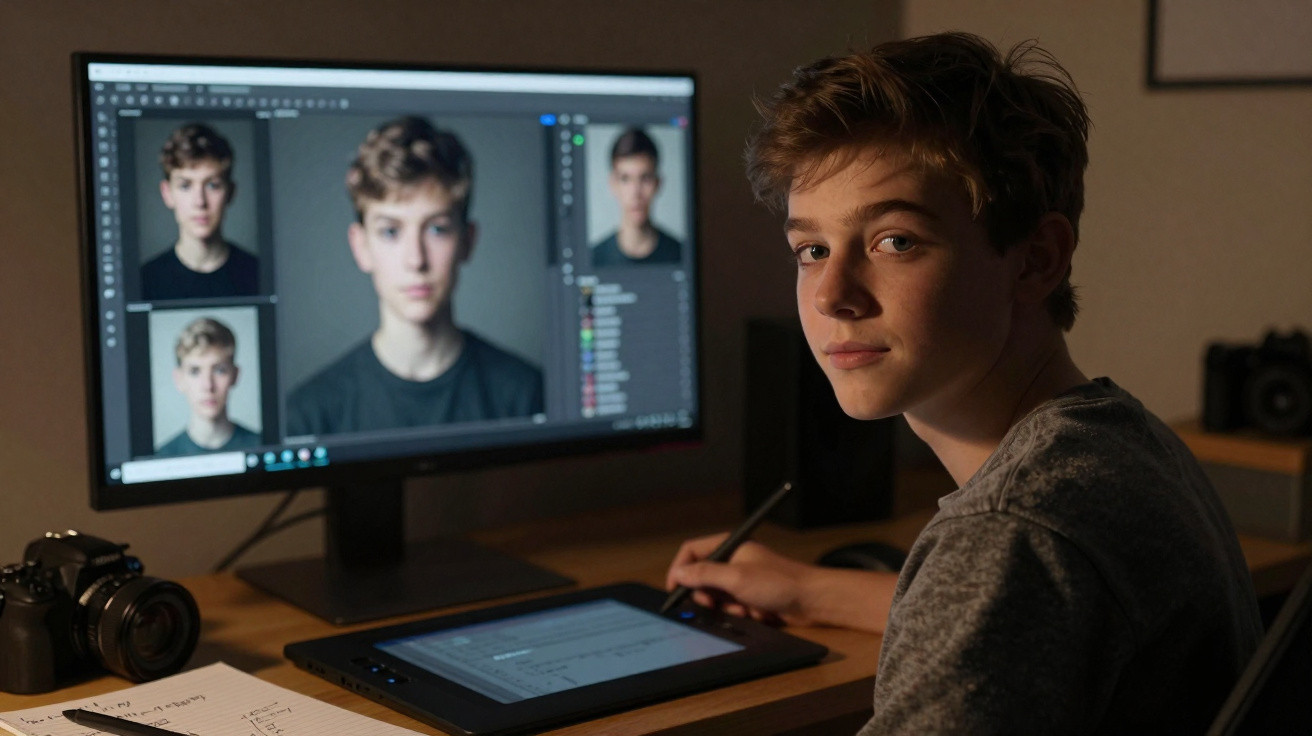
A boy’s face in semi-darkness: exceptionally clear skin, a glint in his eyes, like a still from a film that has not been made yet. This is the sort of image that takes off on Google Discover and in generative AI app feeds. Yet you find yourself at your screen, typing prompts at random and hoping for something other than a blurred or overly airbrushed face.
One night, in a tiny Manchester studio, a photographer showed me how he ‘wrote’ his portraits before even taking out his camera. He spoke about light, texture and camera angle as though he were a director. Today, those same principles are being played out in a Stable Diffusion or Midjourney text field. The gap between an ordinary portrait and a cinema-grade close-up often comes down to 15 carefully selected words. Sometimes, it comes down to only one.
Why dark, cinematic AI portraits of boys feel so powerful right now
Dark, highly detailed close-up portraits of boys are filling timelines. Their cheeks may be scattered with freckles, scars and skin pores rendered with almost uncomfortable accuracy. They are not simply attractive images: they carry weight. Without a line of text, these faces can convey adolescence, anger and uncertainty. AI does not merely draw a boy; it arranges an entire scene around him.
On Google Discover, this kind of image catches attention because people are naturally drawn to faces and micro-expressions. A slightly furrowed brow, cool light shaping the nose, a pupil catching the light as it might in a Villeneuve film: these details create a stop-scroll effect. Pair that with a strong headline about AI or photography and your chances of earning a click increase. It is no coincidence that so many creators are currently investing in this look.
These portraits feel so cinematic because they use three highly specific conventions: a tight close-up, directional lighting and visible texture. A strong prompt will mention a “35mm lens”, “cinematic lighting” and a “low-key atmosphere”, while also supplying a clear emotion. When AI understands that a boy is “thoughtful”, “brooding” or “lost in thought”, it shapes the face differently. The secret is that you are not only writing what you want to see; you are also writing what you want to feel.
How to craft cinema-grade AI close-up prompts that actually work
To move beyond a flat portrait, break your prompt into four parts: subject, framing, lighting and finish. For instance: “portrait of a teenage boy” (subject), “ultra close-up, looking into camera” (framing), “dramatic side lighting, dark background” (lighting), and “sharp focus, cinema-grade, 8k, film still” (finish). Once that foundation is in place, add the atmospheric element: “moody”, “rainy window reflections”, “subtle smoke”, “soft film grain”. That is when the portrait becomes a scene.
A useful approach is to write the portrait first as a straightforward English sentence, almost as if you were describing it to someone. Only then should you add the technical language. You might begin with: “a tired teenage boy who looks like he just walked out of a sci-fi movie, ultra close-up…” and carry on from there. AI often responds better to these natural descriptions than to a cold sequence of keywords.
Let’s be honest: nobody does this flawlessly and methodically every day. You will experiment, get it wrong and try again. However, several mistakes occur again and again. Add too many conflicting styles to a single prompt, such as “hyper-realistic”, “anime style” and “watercolor”, and the result becomes muddled. Forget to specify “sharp focus on eyes” and the gaze may be blurred. Leave out the emotion and you will get a neutral face with no story behind it.
Consistency matters too: “dark, atmospheric” does not mean making everything black. Name tangible light sources instead: “single overhead light like interrogation room”, “neon blue rim light”, “soft light from a laptop screen”. This enables AI to build a genuine mood rather than simply placing the subject against a dark backdrop. If you want to make use of shadows, include “chiaroscuro”, “Rembrandt lighting” or “low-key portrait photography”. Such terms guide the staging.
“A good portrait prompt is like the first sentence of a novel: if it is flat, you will get nowhere, even with the best AI in the world.”
To help you get started, here are 18 practical prompt ideas to adapt in your preferred tool, while following your model’s rules of use:
- “ultra close-up portrait of a teenage boy, wet hair, raindrops on eyelashes, cinematic lighting, dark blurred city background, 35mm lens, sharp focus on eyes, subtle film grain, moody atmosphere”
- “brooding teenage boy, close-up, half of face in shadow, single warm light from the side, dark room, cinema-grade, 8k, high-detail skin texture, dramatic contrast”
- “young boy sitting in a bus at night, ultra sharp close-up through rainy window, reflections of city lights in his eyes, melancholic, teal and orange color grading, film still”
- “freckled boy, intense stare into camera, low-key studio lighting, black background, high contrast, razor-sharp details, shallow depth of field, Oscar-level cinematography”
- “teen boy in hoodie, neon blue and magenta rim light, ultra close-up, dark alley atmosphere, soft smoke around him, crisp focus, cinematic bokeh in background”
- “pensive schoolboy, close-up, golden hour light from the side, classroom background blurred, cinema-grade sharpness, natural skin, subtle grain, nostalgic mood”
- “boy with messy hair, ultra-detailed pores and freckles, moody greenish light like an old hospital, dark vignette, dramatic close-up, 4k film still”
- “teenage boy lit only by a phone screen, ultra close-up, dark bedroom, cool blue light on face, tired eyes, cinematic shading, hyper sharp details”
- “young boxer boy, sweat on skin, strong side lighting, black gym background, intense close-up on eyes, atmospheric haze, bold shadows, cinema-grade realism”
- “quiet boy reading, very close portrait, face lit by warm table lamp, dark corners around him, subtle dust in light beam, filmic look, shallow focus”
- “boy in winter coat, snowflakes melting on lashes, icy blue color grade, ultra close-up, background totally blurred, sharp eyes, dramatic cinematic look”
- “teen skater boy under a bridge, harsh top light, deep shadows under eyes, ultra-sharp, gritty cinematic style, dark concrete background”
- “dreamy boy, soft focus background of city lights, lens flare, close-up, warm orange key light, gentle film grain, poetic cinematic frame”
- “boy lit from behind by sunset, face in partial silhouette, ultra close-up, fiery rim light in hair, dark foreground, moody, award-winning cinematography”
- “serious teenage boy in school corridor, close-up, fluorescent light flicker reflected in eyes, greenish tint, cinematic realism, high detail”
- “young musician boy in recording studio, dark background, single spotlight on face, ultra sharp, microphone slightly out of focus, cinema-grade depth of field”
- “boy standing near a window at night, city lights bokeh behind, raindrops on glass, ultra close portrait, soft cool light, melancholic atmosphere”
- “intense close-up of a boy’s face just after a football match, mud and sweat, stadium lights in the distance, dark, dramatic, extremely detailed”
Turning these prompts into stories people want to share
The real magic begins once you stop treating these prompts as technical recipes and start seeing them as micro-stories. Every “teen boy in hoodie, neon light” can become the image for an article about teenage anxiety, digital loneliness or sleepless nights in front of a screen. Platforms respond better when an image and its headline tell one coherent story together. You are not selling a portrait; you are opening a narrative window.
A helpful habit is to build themed series. You could create a sequence of “boys at night” portraits using different lighting sources: a phone, neon signs, a streetlamp or car headlights. Each visual then becomes a chapter. On Google Discover, this visual consistency strengthens your identity as a creator. On the AI side, you can duplicate the prompt structure while changing just a few details: location, lighting type and emotion. The workflow becomes smoother without removing spontaneity.
These portraits can also offer a more personal space for exploration. You may use them to represent internal states that are difficult to express in other ways: tiredness, shame or quiet pride. Some creators use the process almost as a visual diary, generating a different portrait each day to reflect their mood. You do not have to publish it. At times, the image is enough on its own: a distorted but useful mirror.
There is also an important ethical boundary, especially where boys’ faces are concerned. Never generate images that appear to depict a real person without consent, or that sexualise a minor subject. Stay within a cinematic aesthetic rather than questionable staging. Remember, too, that however realistic these portraits seem, they remain constructed images. They replace neither documentary photography nor a real human encounter.
This portrait style works because it relies on a tension between technical hyper-realism and implied emotion. The sharper the picture, the more heavily the unspoken elements can land. You do not need to explain why the boy looks sad or angry. The viewer projects their own story on to him. That projection is what drives clicks, comments and shares. It is also the point at which your prompts stop being simple lines on a screen and become something more alive.
The next time you type a portrait prompt, ask yourself one simple question: if this image were a shot in a film, which scene would it belong to? You will find that it changes everything. You will start thinking in terms of a moment, tension and precise light instead of a “pretty face”. That is exactly what algorithms, readers and, in a way, you are looking for.
| Key point | Detail | Benefit for the reader |
|---|---|---|
| Structure the prompt | Separate subject, framing, lighting and finish | Create consistent, controlled portraits |
| Add a clear emotion | Use adjectives such as “brooding”, “thoughtful”, “melancholic” | Give the image a genuine atmosphere |
| Think like a director | Imagine every portrait as a film shot | Produce more narrative, engaging visuals |











Comments
No comments yet. Be the first to comment!
Leave a Comment