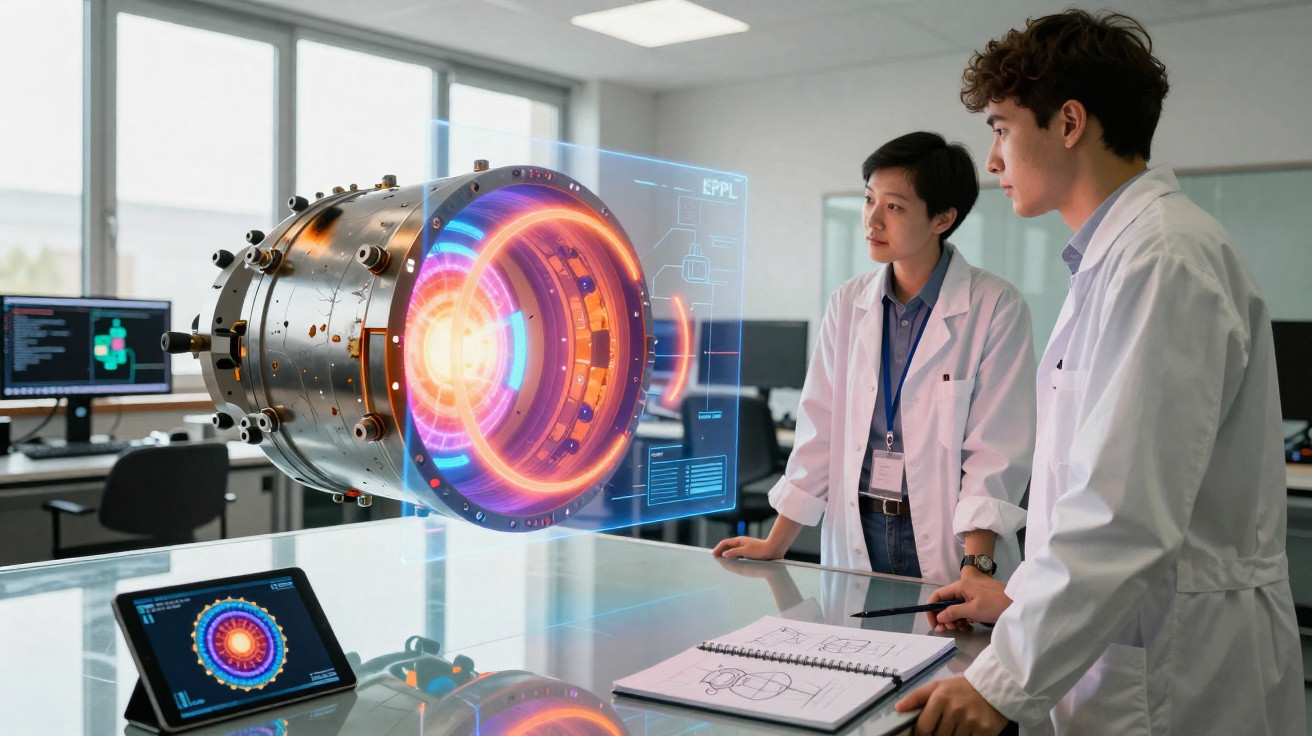
When considering promising energy technologies, nuclear fusion appears to meet every requirement: it is clean, plentiful, constant and safe.
Fusion is generated when the light nuclei of two atoms join to create a heavier nucleus, releasing substantial energy as they do so.
Controlled fusion reactions require vast ring-shaped reactors packed with magnets. These generate magnetic fields in which atomic particles whirl and move like a cloud of bees.
Exploring nuclear fusion through a virtual tokamak
Difficult to imagine? A highly realistic live 3D simulation now makes it possible to explore this type of reactor, known as a tokamak.
At EPFL, the Laboratory for Experimental Museology (EM+) specialises in this technology. It has created a programme that transforms the terabytes of data produced through tokamak simulations and tests at EPFL's Swiss Plasma Center (SPC) into an immersive 3D visualisation.
For the public, the visualisation offers a trip through a ring of fireworks representing a potential future energy source. For researchers, it is an important resource that makes the complex effects of quantum physics more tangible and supports their understanding of calculation results.
Images so precise they show wear and tear
The 3D visualisation is a panorama 4 metres high and 10 metres in diameter. It faithfully recreates the inside of EPFL's variable-configuration tokamak (TCV), with a level of detail comparable to the finest gaming experiences.
Built more than 30 years ago, this experimental reactor remains the only one of its kind worldwide.
"We used a robot to generate ultra-high-precision scans of the reactor interior, which we then compiled to produce a 3D model that replicates its components right down to their texture," says Samy Mannane, a computer scientist at EM+.
"We were even able to capture the wear and tear on the graphite tiles lining the reactor walls, which are subject to extremely high temperatures during test runs of the TCV."
SPC engineers supplied equations that determine precisely how quantum particles move at any given moment. EM+ researchers incorporated these equations and reactor data into the 3D visualisation system. The challenge is that every calculation must happen in real time.
Real-time tokamak simulation and computing power
"To produce just a single image, the system has to calculate the trajectories of thousands of moving particles at a speed of 60 times per second for each eye," says Mannane.
This demanding processing is handled by five computers, each equipped with 2 GPUs, acquired by EM+ specifically for the project. Their output is sent to the panorama's five 4K projectors.
"We were able to build our system thanks to advances in infographics technology," says Sarah Kenderdine, the professor who heads EM+. "It would've been impossible even just five years ago."
The resulting images are remarkably lifelike. They show both the injection device that introduces particles into the tokamak and the graphite tiles, which can endure temperatures above 100 million degrees Celsius.
The scale is equally striking. To help visitors understand it, the visualisation features a human figure: the reactor is approximately twice that size. As the simulation intensifies, viewers can feel small while thousands of particles rush past, rotating, twisting and pursuing one another.
Electrons appear in red, protons in green, while blue lines represent the magnetic field. Users can alter any parameter to inspect a particular area of the reactor from a selected angle, with near-perfect rendering.
SPC director Paolo Ricci explains: "Visualization techniques are fairly advanced in astrophysics, owing largely to planetariums. But in nuclear fusion, we're just starting to use this technology – thanks notably to the work we're doing with EM+."
Building on SPC's expertise in the field, EPFL participates in the International Thermonuclear Experimental Reactor (ITER) project and is an important member of the EUROfusion consortium.
EPFL was also selected to host one of the consortium's five Advanced Computing Hubs, providing researchers in this EU-funded project with an advanced way to visualise their work.
Combining output and art
Kenderdine says the principal challenge was to "extract tangible information from such a huge database to produce a visualization that's accurate, coherent and 'real' – even if it's virtual."
"The result is extraordinary, and I would even say beautiful, and it gives scientists a useful tool that opens up a range of possibilities."
"The physics behind the visualization process is extremely complicated," says Ricci.
"Tokamaks have many different moving parts: particles with heterogenous behavior, magnetic fields, waves for heating the plasma, particles injected from the outside, gases, and more.
"Even physicists have a hard time sorting everything out. The visualization developed by EM+ combines the standard output of simulation programs – basically, tables of numbers – with real-time visualization techniques that the lab uses to create a video-game-like atmosphere."
Alongside SPC and EM+, three further EPFL groups contribute to the Advanced Computing Hub: the Swiss Data Science Center, the Institute of Mathematics and the Scientific IT & Application Support Unit (SCITAS).
This article was originally published by EPFL.














Comments
No comments yet. Be the first to comment!
Leave a Comment