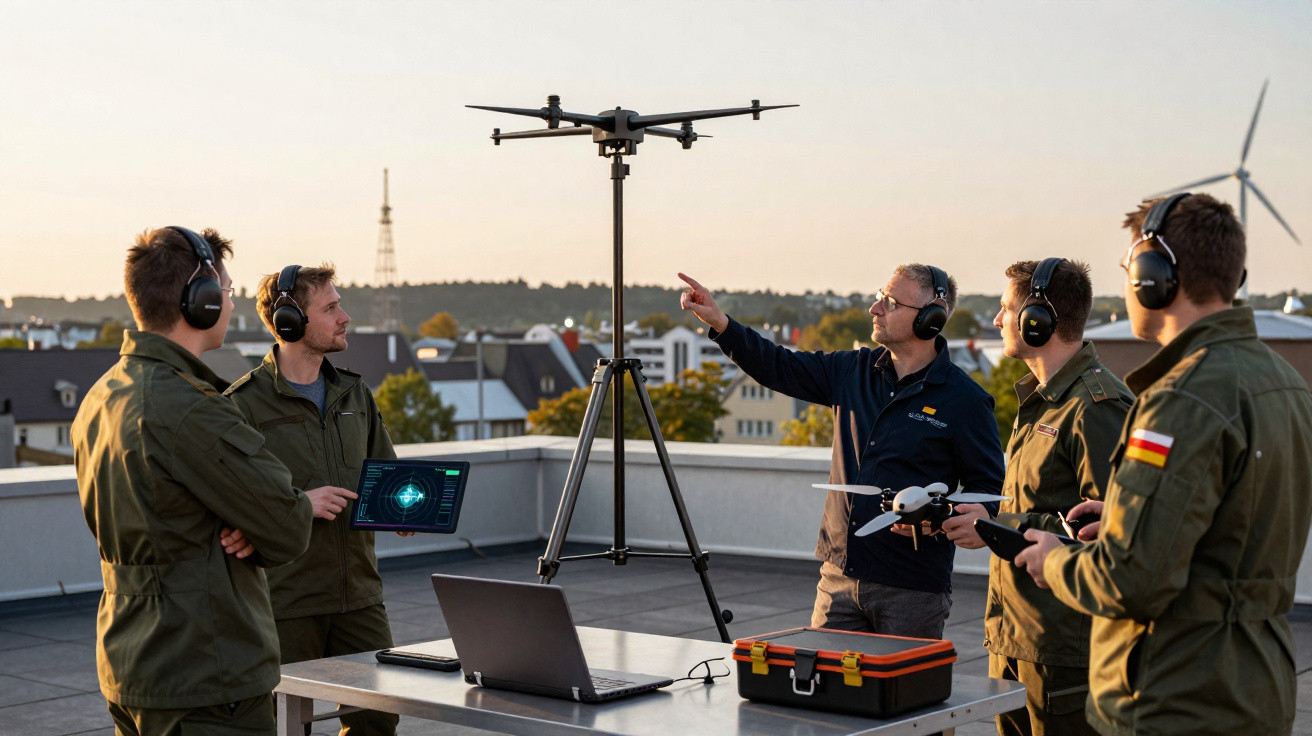
Russia’s hybrid war is taking shape across Europe through drone overflights, arson attacks and sabotage. South of Berlin, Germany has opened an anti-drone research centre as the threat grows and small aircraft are now being fitted with explosive payloads.
Europe is adapting to the Russian threat in a new way. Following higher defence budgets and more frequent exercises, infrastructure is now being developed in response to Moscow’s plans for Europe. In Germany, a former Soviet airport south of Berlin has been selected to host a research centre specialising in one of the most common tools of Russia’s current hybrid war: hostile drone incursions that can bring airports to a standstill.
Germany opens an anti-drone research centre
The centre was inaugurated on Tuesday 18 August, just days after a major incident at Leipzig Airport. During the night of 4 to 5 August, a drone carrying an explosive payload landed close to a Ukrainian cargo aircraft. The site, which is particularly important for freight transport, was paralysed for several hours before Germany secured the area by calling in bomb-disposal experts. While the incident was highly unusual, it followed a wave of more than 1,000 suspicious drones recorded in 2025, according to Germany’s Federal Criminal Police Office.
“Leipzig is part of a wider context,” German Interior Minister Alexander Dobrindt said. “The threat has worsened,” he added.
At the opening of the new centre, Alexander Dobrindt said it “will form a central element of the security architecture against the hybrid threat posed by drones”. Alongside him, Research and Space Minister Dorothee Bär stated that “new applications and technologies will be tested there, for businesses, public authorities and, more extensively, for our security”. Put more plainly, the site will be central to testing German anti-drone defence systems.
Germany also strengthens its intelligence services
Alongside the new centre, Defence Minister Alexander Dobrindt made several other announcements in the early hours, beginning with stronger intelligence capabilities. Under a full-scale reform, Germany’s intelligence agencies will no longer be restricted to analysis. Both domestic intelligence, the BfV, and foreign intelligence, the BND, will conduct field operations focused on counter-terrorism and espionage. At the European Commission, Alexander Dobrindt also wants border controls to be extended by six months.
In Poland, Europe’s “most modern” anti-drone system
Located on Europe’s eastern edge, Poland is also in Russia’s sights, although Germany is particularly targeted as Kyiv’s leading ally. At the end of January, Warsaw signed several contracts to equip its armed forces with an anti-drone system described as “the most modern in Europe” by Prime Minister Donald Tusk. European SAFE funds financed much of the programme, which will cost close to $3.6 billion, according to Defence Minister Wladyslaw Kosiniak-Kamysz.
Poland’s layered air-defence installations
In Poland, the system unveiled at the beginning of the year will complement layered installations that also include existing systems purchased from allies, including the United States’ medium-range Patriot system and the Narew programme, which is based on British anti-aircraft missiles. At the end of January 2026, the Defence Minister said that all these systems would cost €59 billion. In France, the Senate Defence Committee had warned that Paris’s arrangements for protecting its armed forces were too limited.
At the end of 2024, France had only 31 counter-drone systems, the rapporteurs noted.















Comments
No comments yet. Be the first to comment!
Leave a Comment