
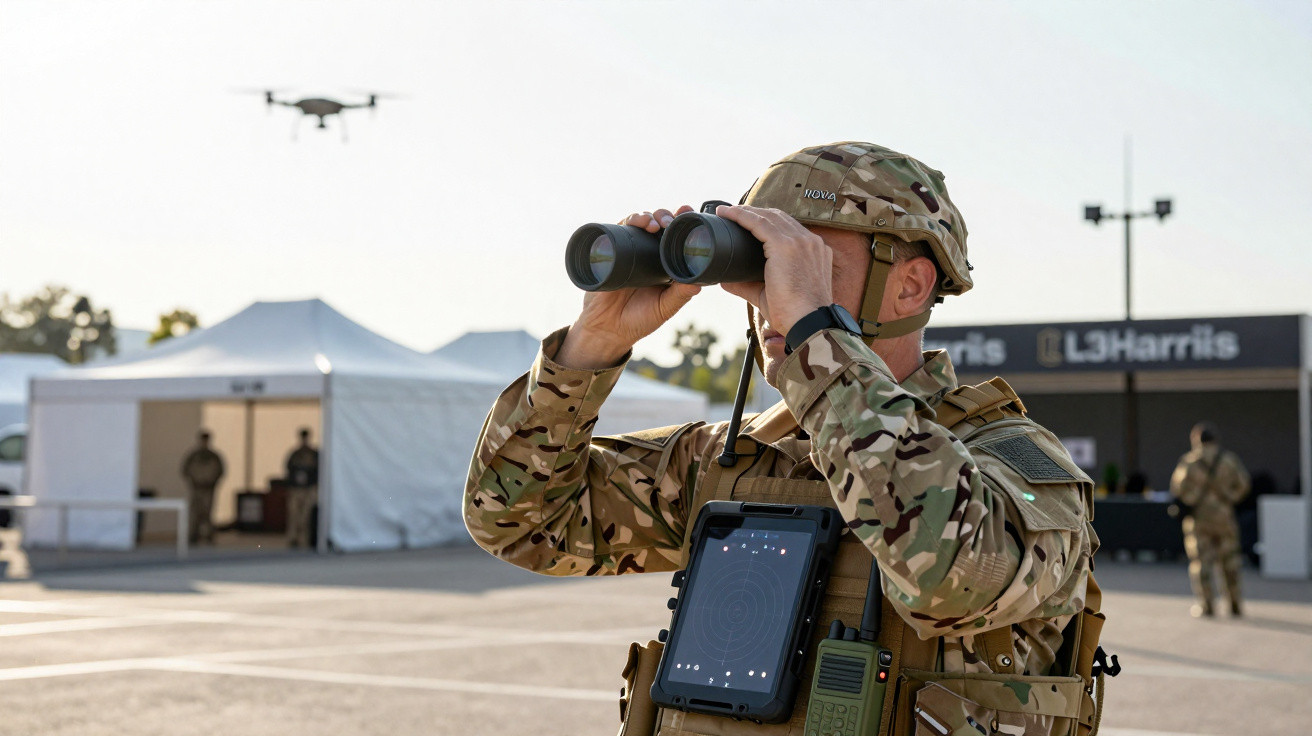
L3Harris made its presence felt at Eurosatory 2026 with a product portfolio closely aligned with the priorities of today’s battlefield: affordable night vision available at scale, and a low-cost distributed response to the drone threat. The company, a global leader in tactical communications and imaging systems, used the latest edition of the Paris defence and security exhibition to unveil NOVA, its new night-vision binocular, alongside Wraith Shield, a software upgrade that turns radios from the Falcon IV family into nodes within a portable, intelligent C-UAS system.
Zona Militar had the opportunity to interview Kevin Steubing, Vice President of International Sales and Business, and Brenna Baker, President of Integrated Vision Solutions at L3Harris Technologies. They outlined the latest developments concerning NOVA NVGs, Wraith Shield C-UAS and the company’s expectations for Eurosatory 2026.
NOVA: night-vision binoculars for the whole force
The NOVA is L3Harris’ latest night-vision goggle, commercially derived from the company’s work on the United States Army’s BiNOD (Binocular Night Observation Device) programme. Development began in 2021 with a clear purpose: to replace legacy monocular systems with a cost-effective binocular platform capable of large-scale fielding. In April 2026, the United States Army selected NOVA under that programme, awarding L3Harris a seven-year production contract worth up to USD 465 million.
At the centre of the NOVA design is an integrated tube architecture intended to simplify maintenance and increase the system’s service life. It employs high-gain Gen 3 unfilmed image-intensifier tubes, with an anti-bloom function on the lower-gain variants. Its housing meets the IP68 immersion-resistance standard, while the system automatically switches off when folded into either monocular or binocular configuration.
Its binocular layout improves depth perception, enabling soldiers to move more effectively across terrain. Equally importantly, the built-in illuminator ensures threats can be detected in ultra-low-light conditions, all within a lighter package-an important consideration for personnel required to remain in the field for several hours.
NOVA design reduces maintenance demands
NOVA was also designed to reduce the logistical and maintenance burden, offering a configuration that can be adapted to operational conditions during set-up work. In addition, L3Harris has simplified certain elements of the NOVA design, reducing the need for highly specialised personnel to carry out its maintenance.
L3Harris presents NOVA as a complement to its higher-end systems-the GPNG, ENVG-B and BNVD-which are reserved for special operations troops and units specialising in direct-action missions. By adding NOVA to its portfolio, L3Harris is targeting the remaining elements of the force structure: soldiers, border-patrol agents and tactical officers who currently lack quality night vision.
Having delivered more than 20,000 ENVG-B units to the United States Army, and with the first NOVA deliveries scheduled for the fourth quarter of 2026, L3Harris is strengthening and further expanding its standing as the benchmark supplier of night vision for Western forces.
Wraith Shield: tactical C-UAS protection
Wraith Shield is built around a disruptive premise: transforming the Falcon IV family of tactical radios-with more than 100,000 units fielded by forces from the United States, NATO, Five Eyes and allied countries-into nodes in a portable C-UAS system, without requiring any additional hardware. This capability is enabled through a software update to the Wraith waveform, developed between 2022 and 2023 with substantial involvement from Ukraine.
The system operates in partnership with DataShapes AI, whose GlobalEdge platform converts radio-frequency (RF) data captured by the radios into real-time actionable intelligence, directly at the tactical edge and without relying on cloud servers or centralised processing. The process works as follows: the radio already scans the spectrum to identify other friendly radios using Wraith, creating a local ad hoc network. Wraith Shield adds the ability to identify the signals used by an adversary to control its drones, shares that information across the local network, and coordinates every radio in the network to transmit white noise on the same channel, disrupting the control signal.
Falcon IV radios as distributed anti-drone nodes
The current version of Wraith Shield can coordinate simultaneous jamming from 40 Falcon radios-enough to equip an infantry platoon-with the aim of increasing this to 100 radios in a future update. Its first deployment platform is the compact RF-9820S (AN/PRC-171) radio, while an embedded version for the RF-9820S-ER is expected later in 2026. The system will also be offered as an upgrade for other Wraith-compatible radios, including the AN/PRC-158C, AN/PRC-163 and AN/PRC-167 models.
Wraith Shield is intended to form part of a layered defence: while it neutralises small drones using commercial command links, larger systems such as L3Harris’ own VAMPIRE and Drone Guardian focus on bigger threats.





Comments
No comments yet. Be the first to comment!
Leave a Comment