
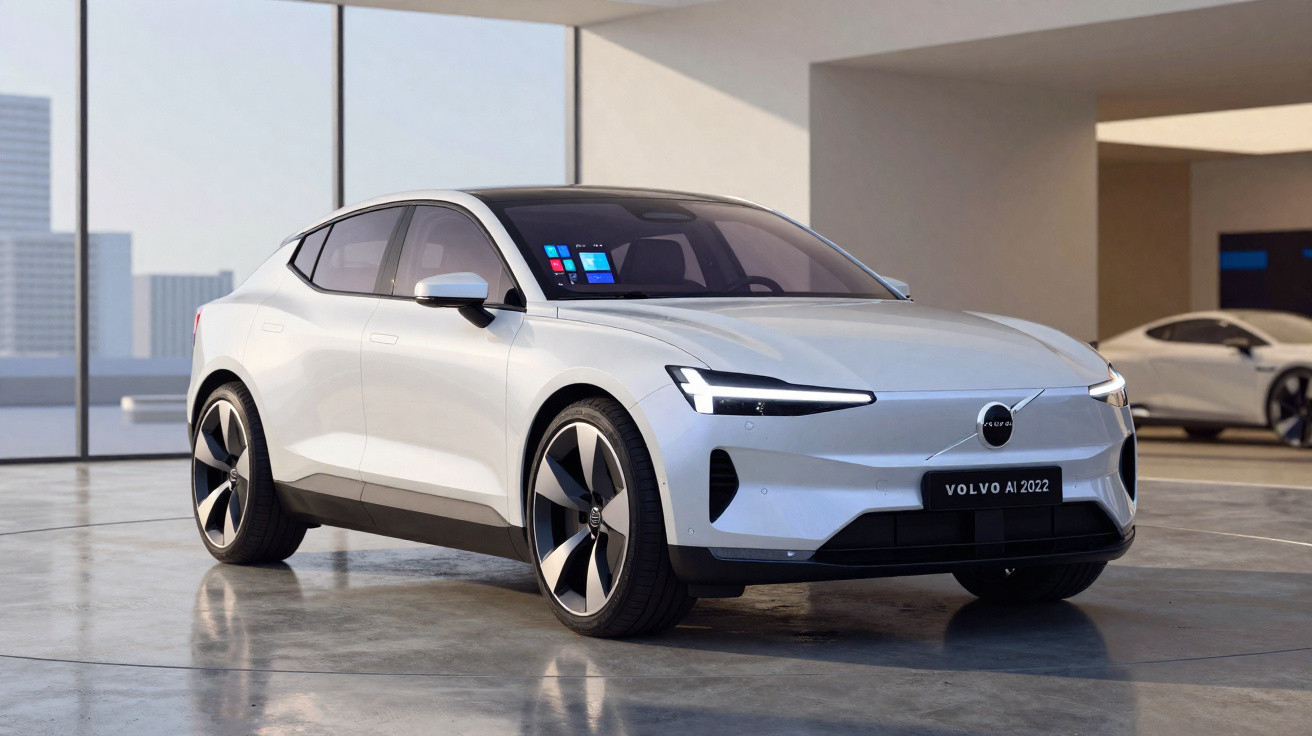
As well as unveiling a partnership with Qualcomm to supply the Snapdragon Cockpit platform for its next infotainment system, Volvo used CES 2022 in Las Vegas, US, to underline its relationship with Google. In doing so, it became the first car manufacturer to launch direct integration with the Google Home ecosystem.
This new feature will enable customers to control their Volvo using voice commands via Google Assistant. The Swedish manufacturer also confirmed that YouTube access will soon be introduced across every car fitted with its Android infotainment system.
For Volvo, this marks the beginning of a transformation that will turn the car into something akin to an extension of the living room. It is part of a broader revolution that will require fundamental changes within the automotive industry.
To understand how these developments will affect Volvo customers and, in part, to assess the direction in which the industry is heading, we spoke exclusively in Portugal with Thomas Stovicek, Volvo Cars’ Head of User Experience (UX), and David Holecek, the Swedish brand’s Director of Digital Experience.
Future infotainment with just two screens
When it announced its Qualcomm partnership, Volvo pledged to take the infotainment systems in its future cars to the “next level”. We will see this first in the brand’s next all-electric SUV and in the Polestar 3, both of which are due to be unveiled later this year.
Until then, however, the Swedish marque has already provided an outline of its next-generation infotainment system. Interestingly - or perhaps not - it will retain a vertically mounted central display, accompanied by a smaller horizontal screen serving as the instrument cluster.
It is interesting because, over the past year, a trend has emerged that gives the front passenger greater consideration, fitting a dedicated screen in front of them that only they can operate. The Mercedes-Benz EQS is just one example.
Volvo is well aware of this approach and, as Thomas Stovicek told us, it is “definitely something we are considering”. However, he was keen to clarify the brand’s present stance: “We believe that, in this version of our vision, the centre screen is large enough and visible to every occupant in the car. But it is something we will continue to pay attention to.”
The value of technology partnerships
While the new Qualcomm hardware-based infotainment system remains a future development, the Google Home, Google Assistant and YouTube features are imminent. They will soon benefit a considerable number of Volvo drivers.
Volvo has no doubt that its partnership with Google delivers substantial added value in the product ultimately placed in customers’ hands. It also allows the company to concentrate on other priorities.
“We are leveraging that expertise and bringing it to our customers, enabling all these possibilities inside the car. And we, as a car manufacturer, can focus on things such as creating the best possible experience for our customers through the product,” he added.
Even though the underlying technology bears Google’s name, it must still be adapted to Volvo’s requirements and the profile of its customers: “I think we have managed to do a good job of creating a distinctive usability. The partners we work with have enabled us to create the right level of customisation for the elements we want to personalise. We have been able to design a system for our customers that can address their day-to-day issues and what they want to see,” Volvo Cars’ UX chief explained.
Is artificial intelligence the future?
“We want to give the car some intelligence. But this is one of those things that will improve and grow over time. It is definitely part of our vision to enable the system to give users some kind of contextual knowledge, based on how they use the car and what they do when they use it,” Thomas Stovicek said.
The overriding aim will always be to strike a balance that improves and simplifies the driver experience: “we are trying to understand, for the future, which areas need to be more manual and, on the other hand, where we can use artificial intelligence or predictive technology to make solutions simpler for people,” Stovicek said.
In a sense, though, so-called “predictive technology” will already be available to Volvo drivers through the latest Google features. Google Assistant can identify habits and interpret usage patterns over time.
“What Google brings to the table through the partnership is greater knowledge of users, their everyday lives and their daily behaviour, through Google Assistant and all its other Artificial Intelligence capabilities. Google is much better at that than we could ever be, not least because it is not our field of work,” David Holecek stressed.
YouTube now, other platforms later?
Naturally, one of the brand’s most significant announcements was the option to access YouTube through the infotainment system in every Volvo equipped with the Android operating system.
From now on, watching YouTube videos while waiting for somebody or during a charging stop will become a reality.
Other streaming platforms will also be available in the future. As Volvo’s Director of Digital Experience told us, this is an “open framework, so that any video service provider can make a few small modifications and adaptations, allowing it to work properly in the car environment and then be published in the Google Play Store”.
“Although YouTube is the launch partner for this, it is not a one-off thing done with YouTube; it will open the ecosystem to a new category of services developed by third parties,” he added.
Unlimited data with a digital SIM card
Through a package called “Digital Services”, which generally includes four years free when purchasing a new Volvo, all connected Google services can be used without restrictions because mobile data is unlimited. At the end of this period, the service - consisting of a digital SIM card - can be extended by paying a subscription.
“We are working with some of the world’s largest mobile network operators to look at this on a regional basis, across an entire fleet of cars, rather than arranging separate subscriptions for every car,” David Holecek explained.
“That alone enables us to secure much better data rates, of course, while also balancing data consumption. That is how we can provide this type of offer, where you can genuinely listen to as much music as you want, watch as much video as you want, and so on. All data is included,” he added.
Where is the automotive industry heading?
With Volvos now able to receive remote updates without physically visiting a dealership, and with platforms such as Google Android Automotive allowing Volvo to continually pursue new and improved features, one question was unavoidable: can we expect a car’s lifespan to increase in the future because it will be continually updated?
“We need to move towards an evolving experience, where the car gets better every day, where we always have new updates and additions throughout the vehicle’s lifecycle, meaning that it will keep improving. In the same way that a smartphone or a tablet does,” he said, before pointing the finger at the automotive industry.
“The automotive industry has not been good at this. We put everything into the launch of the car, and that is basically what the customer receives. Now, with the strength of our partners, we can move into this new era, this new world of experiences where customers expect something that evolves over time,” he explained.
“The electronics industry, and the entire communications and infotainment systems sector, do not stand still. What was true when the car was designed several years ago may no longer be true today. This is a fundamental change that we are very happy to be part of,” he said, before concluding: “knowing that the car will always be up to date removes some anxiety for people. Rather than thinking that the car will simply keep getting older.”



Comments
No comments yet. Be the first to comment!
Leave a Comment