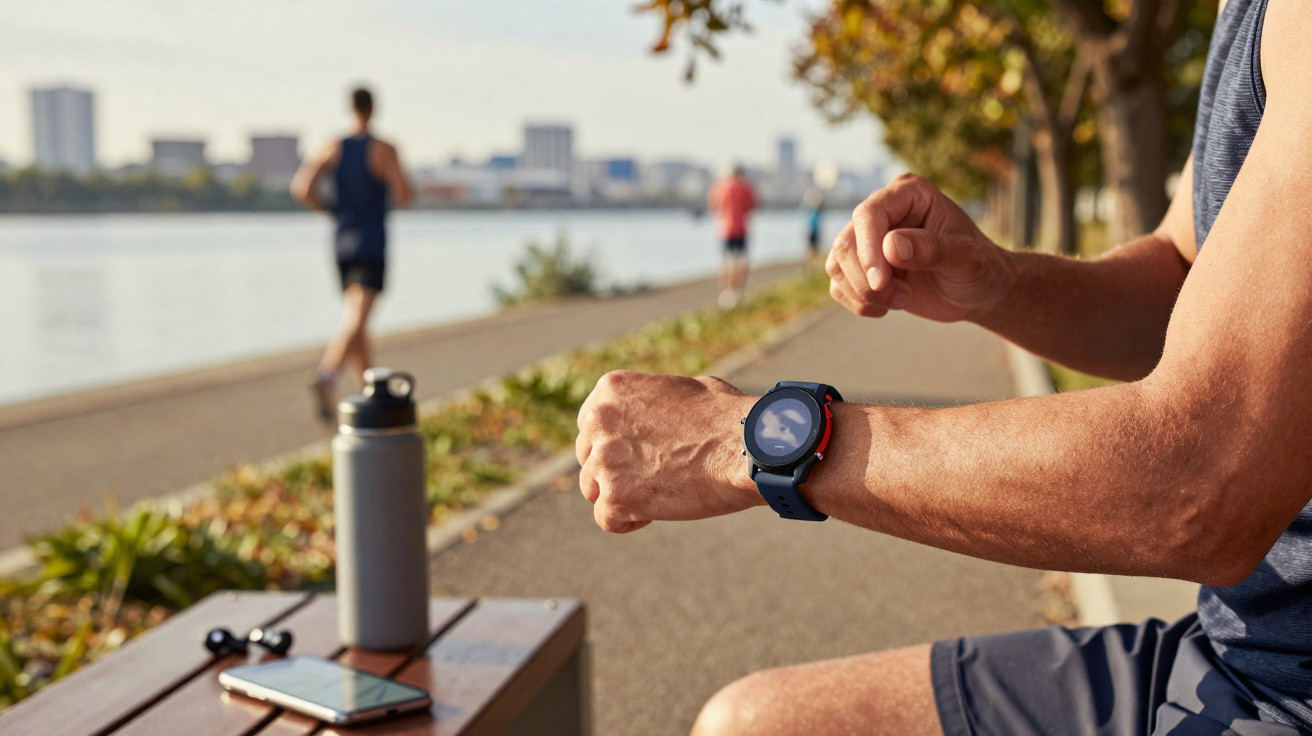
Garmin has skipped two generations of entry-level GPS sports watches with the launch of the Forerunner 70, arriving five years after the previous Forerunner 55. The biggest advance is largely inherited from its algorithms, bringing in new features already available elsewhere in the range. However, several hardware omissions hold the watch back and mean it will not suit every athlete.
Garmin released the Forerunner 70 alongside the Forerunner 170 on 12 May 2026. The two watches are closely related, although the Forerunner 70 has a more restricted feature set and a sharper €249 price point (€50 less). As its name suggests, it belongs to a line aimed at runners, primarily those who run on roads.
At €249, it is more expensive than the Forerunner 55 it replaces, yet it means Garmin customers on tighter budgets no longer have to choose an older-generation watch. The Forerunner 70 was therefore anticipated, at least in that respect. That said, several years have passed and rival brands have made considerable progress. Coros, for instance, has shown with the Pace 4 that an entry-level GPS sports watch can remain technologically advanced without compromises.
Indeed, the sub-€300 sports-watch market has created demand among athletes who are sometimes already experienced. These more affordable watches are also lighter, a crucial consideration for running. Models weighing just 40 grams can therefore offer the essentials: GPS, an accurate heart-rate sensor, a more legible AMOLED display and formidable battery life. Does the new Garmin Forerunner 70 deliver on that promise?
Garmin Forerunner 70 design, build and dimensions
A 43 mm watch weighing 40 grams
Still compact and lightweight, the Garmin Forerunner 70 gains 1 mm in diameter, measuring 43 mm rather than the Forerunner 55's 42 mm. At 40 grams, it is 3 grams heavier than its predecessor, but receives a larger 1.2-inch display, up from 1.04 inches on the Forerunner 55. It also swaps transflective MIP technology for a colour AMOLED panel with a 390 x 390-pixel resolution. The screen now supports touch input, although Garmin has retained physical controls too: five buttons cover every available command.
We used the watch both through its touch controls and its physical buttons. Its settings let users disable touch operation only while an activity is in progress, preventing unwanted inputs. The AMOLED screen does, however, wake unnecessarily often: if the watch is resting on a table, for example, even a slight vibration can activate the display and waste battery power. Aside from that, the build has little to criticise: the watch is light enough and well put together.
Watch colours, materials and accessories
The Garmin Forerunner 70 comes in four colour options. Alongside conventional black and white versions, there are lemon and lavender finishes. The black model has a yellow primary button, while the other colours use a light-blue primary button; it is a shame that an entirely understated version is not available. A silicone strap, with numerous adjustment holes, is supplied as standard. Further straps are offered as accessories in a range of colours and materials, including fabric and Milanese mesh.
The Forerunner 70 takes clear styling cues from Garmin's more premium models. Garmin has not attempted to make it look markedly different from its pricier watches. Compared with a model such as the Forerunner 570, the main distinction is that its bezel is not aluminium and the entire watch is made from plastic. Otherwise, the familiar elements are all present, resulting in a relatively understated and practical design; labels around the bezel identify the purpose of each physical button.
Other available accessories for the Garmin Forerunner 70 include a bike mount, a power meter for cycling or running, and a heart-rate monitor offered in two versions, the HRM 200 and HRM 600, and two sizes, XS-S and M-XL. The remaining options relate to the Garmin+ subscription, available with monthly or annual billing. The Forerunner 70 includes a USB-C charging cable on the plug end, with Garmin's proprietary connector at the watch end, as used on the brand's other models.
Garmin Forerunner 70 sensors
Positioned at the entry point of Garmin's running-focused sports-watch range, the Forerunner 70 is somewhat modest in its sensor provision. There are strengths and weaknesses, beginning with the positive points.
Improved measurement accuracy
The new Garmin Forerunner 70 benefits from a fourth-generation optical heart-rate sensor, immediately distinguishing it from the older Forerunner 55. Designed to measure and track heart rate during exercise, this sensor is more accurate and reacts more quickly to sudden changes, such as those encountered in interval sessions. The Forerunner 70 also gains its first pulse oximeter for measuring blood-oxygen saturation (SpO2), data that can help identify sleep apnoea overnight.
Its heart-rate readings appeared entirely consistent with those taken using a chest strap, which is considered among the most accurate types of equipment available. The only caveat, which applies more or less to all GPS sports watches at this price, concerns interval training: the sensor is not reactive enough to accurately capture sudden, frequent pace changes.
GPS and altitude/elevation measurement limitations
On the downside, the Forerunner 70 does not include dual-frequency multi-GNSS. GPS tracking therefore relies on a less accurate system, which is a significant drawback when many GPS sports watches at this price offer dual frequency. This feature is particularly valuable in cities and forests, where it helps maintain accurate data. The other notable sensor omission is a barometric altimeter, which would provide altitude readings and measure elevation gain. Hikers and trail runners cannot add this data to the watch, as it also lacks GPS altitude calculations based on GPS data.
As a consequence, the Garmin Forerunner 70 cannot provide precise distance measurements at the end of every outing, particularly when running through narrow city streets or in woodland and mountains. Hikers and trail runners should look elsewhere, as the Garmin Forerunner 70 lacks a barometric altimeter. It also has no mapping, a point covered again in the section on the watch's features.
To finish with the sensors, the Forerunner 70 also has no NFC chip, meaning contactless Garmin Pay payments are unavailable. This is not a sensor that matters for sport itself, but it is important within Garmin's range because it makes life easier for athletes, who need not take a smartphone or bank card with them if they want to pay for something such as a coffee or a transport ticket.
Watch features
Having considered these hardware constraints, it is worth looking at the new Forerunner 70's features, where it scores some points. Bear in mind, however, that every feature listed here is also available elsewhere in Garmin's Forerunner line: the FR70 remains a basic model with no exclusive functionality unavailable on other watches.
For sport
Starting with sport-focused tools, the new watch can display up to 8 metrics on screen, compared with 4 on the previous Forerunner 55. Battery consumption varies depending on whether the display is set to stay on permanently or activate only when the wrist is raised. Note, though, that the “Always-On” display is not fully illuminated at all times, as brightness drops after a few seconds. This is not a problem, except when using the watch on a bike.
Around 60 sport profiles are available, though the watch will mainly be used for running, cycling, swimming, yoga, Pilates, HIIT and strength training. Crucially, the Forerunner 70 has no multisport mode, so it does not offer triathlon or swimrun modes. Open-water swimming is absent too. As a result, it is not a watch to recommend to triathletes or swimmers.
On the other hand, it includes Garmin's useful suite for assessing fitness, covering VO2 max, training status, HRV status, training readiness score and sleep tracking, as well as training tools such as running power and dynamics, workout suggestions, quick workouts, training load, Garmin Coach programmes and PacePro. The addition of quick workouts deserves a mention: this feature lets users create a workout directly from the watch by selecting the time they want to dedicate to it and the session type. It is useful for beginners.
As noted earlier, mapping is not available on the Garmin Forerunner 70. You cannot therefore set off on an adventure with a route map on your wrist, unless you follow it using a breadcrumb trail with directional prompts. The competition, including the Coros Pace 4, does no better. It is useful as a backup, but cannot replace a proper map. Even Garmin's €549 Forerunner 570 lacks mapping; Coros offers it from €350, while Amazfit remains the leader in this respect, starting at €150.
For everyday use
Moving to daily features and data, Garmin equips the Forerunner 70 with the essentials: sleep and stress tracking, HRV status and menstrual-cycle tracking, although the latter is manual. During the day, users can receive phone notifications, weather updates, calendar alerts, plus morning and evening reports. Music cannot be played from the Garmin Forerunner 70. Only the Forerunner 170 adds this capability, provided buyers pay for the €349 Forerunner 170 Music.
There are therefore many omissions, including in the feature set. Garmin need not worry about contactless payments, as it is the only brand to offer the function against specialist rivals such as Coros. A Coros Pace 4 does, however, let users carry music without paying extra. The brand has also just added an equivalent to Garmin's LiveTrack, which shows the real-time location of people recording a GPS activity. The Garmin Forerunner 70 does include this feature, along with Garmin Messenger.
Garmin Forerunner 70 battery life
Charged using the same proprietary cable as Garmin's other watches, the Forerunner 70 stands out for its battery life. With no barometric altimeter, dual-frequency GPS or more extensive watch functions, it requires fewer resources and posts highly respectable figures for a GPS sports watch. Garmin quotes average battery life of 13 days for daily use, which was very close to reality in our test. During continuous activity using GPS alone, battery life is 20 hours. In multi-GNSS mode, 16 hours are available.
The watch should therefore comfortably last a week, or longer if its GPS is not used to measure sporting activities such as strength training and other indoor sports. Battery life also varies greatly depending on whether “Always-On”, which keeps the AMOLED screen active, is enabled. This setting can be configured to work only during activities, when a quick glance at the watch is useful. Battery life will then be around 6-8 days. With “Always-On” permanently enabled, it will last no more than 4 days.
Conclusion: our verdict on the Garmin Forerunner 70
At €249, the Garmin Forerunner 70 fulfils its entry-level role by replacing the ageing Forerunner 55. Customers determined to buy a Garmin can now do so without spending more than €300 or settling for a watch based on technology from several years ago. It offers AMOLED, good battery life and a very low weight. Its new heart-rate sensor and new GPS also make it more accurate.
However, Garmin has restricted the Forerunner 70. For sport, it lacks dual-frequency GPS and a barometric altimeter. In daily use, it offers neither Garmin Pay nor music storage. Finally, its software does not provide multisport profiles such as triathlon or open-water swimming. More comprehensive alternatives exist, notably from Amazfit for people who want to take part in Hyrox or access an affordable watch with built-in mapping, and from Coros for those seeking a dual-frequency GPS sports watch with an AMOLED display and the same lightweight build as the Forerunner 70.
As with the Forerunner 265, Garmin appears chiefly to be steering customers towards the Forerunner 170, available for €50 more, to get more from the watch, notably the barometric altimeter. But buyers must make another choice: the standard FR 170 does not include music. They will once again need to pay an additional €50 for the FR 170 Music.
Garmin Forerunner 70
€249
7.9
| Category | Score |
|---|---|
| Design | 9.0/10 |
| Battery life | 10.0/10 |
| Features | 6.0/10 |
| Equipment | 7.5/10 |
| Overall rating | 7.0/10 |
What we like
- Lightweight sports watch
- At last, a replacement for the FR55
- AMOLED display showing up to 8 metrics
- Good battery life
- The cheapest Garmin Forerunner
What we like less
- No dual-frequency GPS
- No elevation-gain or altitude measurement because there is no barometric altimeter
- Some sport profiles are missing, including triathlon and open-water swimming
- No Garmin Pay payments
- No music storage








Comments
No comments yet. Be the first to comment!
Leave a Comment