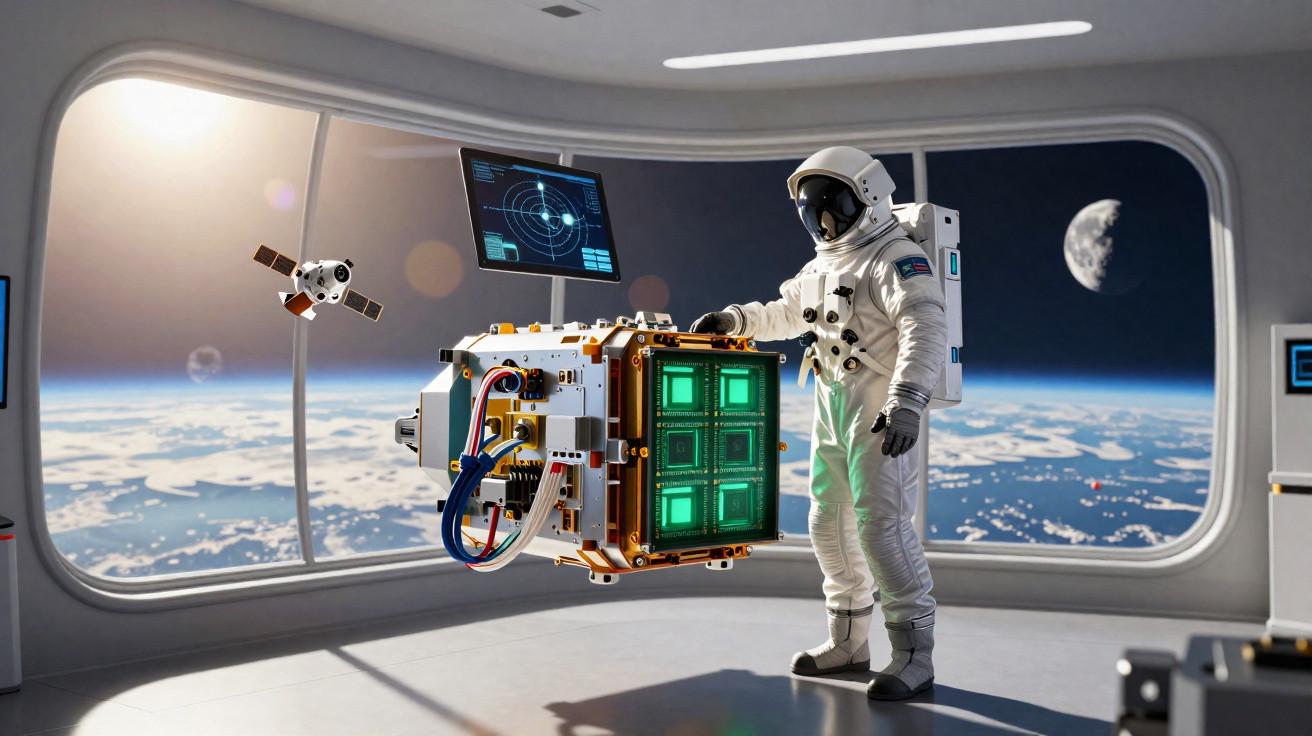
Elon Musk intends to begin his SpaceX space data centre project in 2027. The company will rely on Nvidia components specially optimised for orbital data centres.
Following its merger with xAI, now known as SpaceXAI, SpaceX has become more than an AI laboratory offering Grok models. Elon Musk’s company is also steadily moving into the business of supplying AI computing capacity through data centres to other firms, including Anthropic and Google. This new activity is already highly profitable for SpaceX. While the company currently operates only ground-based data centres, like every other business, Musk also plans to place satellites carrying AI components in orbit to process our prompts in space.
If this still sounds like a far-off venture from the American billionaire, that may not be the case. Earlier this year, Musk filed an application with the FCC, the US telecommunications regulator, to launch one million satellites to build an orbital data centre. This week, the CPU intended for Elon Musk’s AI satellites was also announced. In a blog post, chip giant Nvidia said SpaceX will use a space-optimised version of its Vera Rubin platform. The Vera CPU will be central to the scheme, orchestrating AI agent tasks from orbit.
“Vera gives AI agents the compute power needed to act in real time: running code, processing data and coordinating complex tasks. SpaceXAI is taking this architecture from vast AI computing centres to the next frontier of computing in orbit,” explained Ian Buck, Nvidia’s vice-president of hyperscale and high-performance computing.
SpaceX orbital data centres face unique conditions
The benefit of sending data centres into space is that satellites can harness solar energy without the constraints encountered on Earth. However, AI chips deployed in space will also face new challenges, particularly radiation, which can disrupt data processing by changing 0s into 1s, or vice versa, on the chips. Nvidia is therefore likely to alter its components to make them better suited to this environment. Elon Musk, for his part, has referred to a design that “is dramatically simpler, lower cost, more compact and lighter than a traditional rack.”
Nvidia Vera Rubin deployment planned from 2027
It should not take too long to get an indication of how these Nvidia chips perform in space. Elon Musk plans to send Vera Rubin NVL72 systems into orbit from the fourth quarter of 2027, with large-scale deployment beginning as early as 2028.
Elon Musk wants future satellites built on the Moon
For now, Elon Musk’s AI satellites will be manufactured on Earth before being launched by rocket. However, the American billionaire is already looking further ahead. His plan is to build proper robot-operated factories on the Moon, where future satellites would be assembled before being placed into orbit using a catapult system.
It is also worth noting that, although SpaceX currently uses Nvidia components, the company has launched the Terrafab project, which will enable it to manufacture its own artificial intelligence chips.
















Comments
No comments yet. Be the first to comment!
Leave a Comment