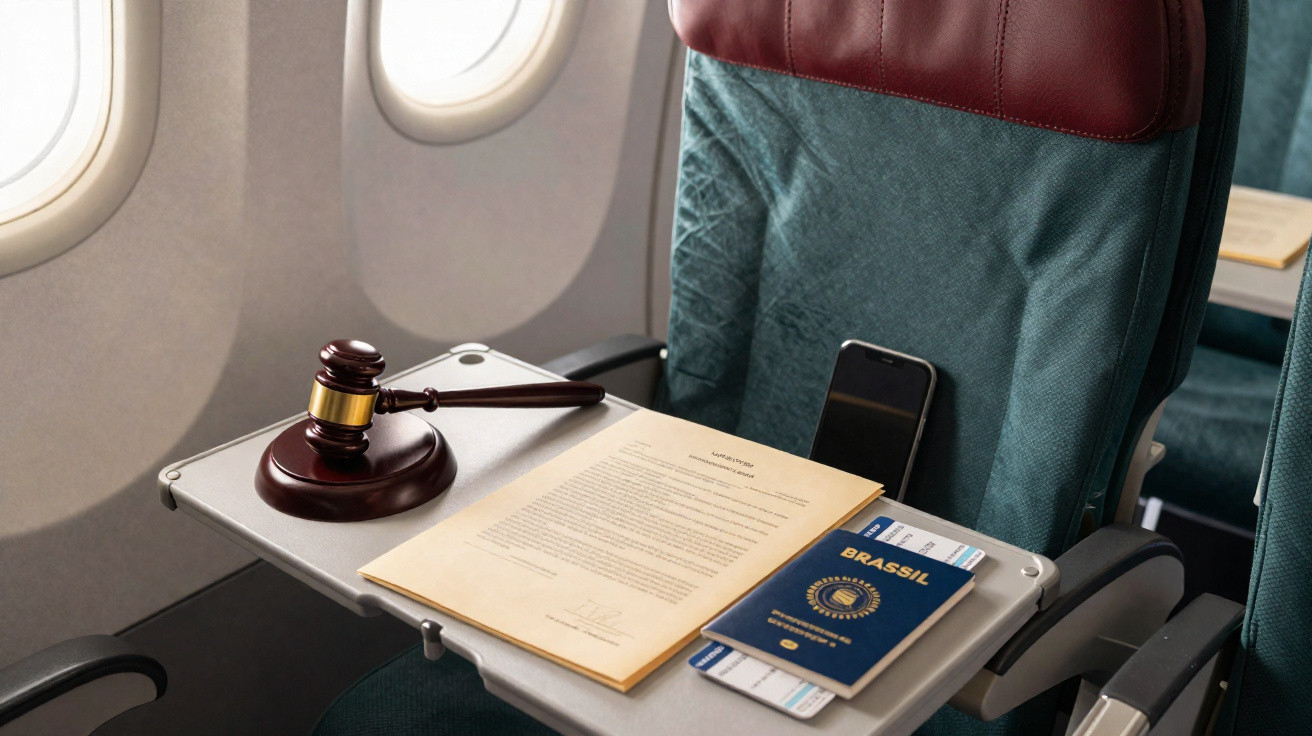
TAP Air Portugal case over a mobile phone lost on board
Judge Paulo Barone Rosa, of the 3rd Civil Jurisdictional Unit – 9th JD of the Belo Horizonte District Court, Minas Gerais, dismissed a passenger’s claim for material and non-material damages after she lost her mobile phone in the structure of a seat during an international TAP Air Portugal flight.
In his ruling, the judge found that the device remained in the consumer’s own custody. He also held that there was insufficient evidence either that the phone had fallen into the seat structure, as alleged, or that the airline had failed in its provision of services.
The claimant stated that her Samsung S23 slipped from the pocket of her coat and fell into a gap between the frame and upholstery of the seat on a flight from Lisbon, Portugal, to Belo Horizonte, Minas Gerais.
Passenger’s account of the missing Samsung S23
Travelling in business class, the passenger said she asked a flight attendant for assistance. According to her account, the employee told her that, once the aircraft had landed and passengers had disembarked, a mechanic would dismantle the seat to retrieve and return the device.
At Tancredo Neves International Airport in Confins, Minas Gerais, the passenger was instructed to disembark and wait in a designated area to receive the phone, as she could not remain on the aircraft while the procedure was carried out. However, when she reached the indicated location, she was told that the device had not been found.
The consumer then made an administrative complaint and provided the details needed to identify the mobile phone. The airline said it had searched with the teams responsible for the flight, baggage services and aircraft maintenance, but had been unable to locate the device.
Following the loss, the passenger brought legal proceedings seeking compensation for material and non-material damages.
Airline responsibility for cabin items
In its defence, the airline maintained that items carried in the cabin remain the passenger’s responsibility. TAP Air Portugal argued that the consumer was solely at fault and that there had been neither a service failure nor any infringement of personality rights.
When examining the case, the judge acknowledged that the relationship between the parties was governed by the Consumer Protection Code and that, as a general rule, carriers are strictly liable for damage arising from failures in service provision, under Article 14 of the CDC.
However, he stressed that such liability is not absolute and may be excluded where the loss results from the consumer’s sole fault, as provided for in Article 14, paragraph 3, item II, of the same legislation.
In the judgment, the judge noted that objects taken into the cabin or carried in hand luggage remain under the passenger’s care and supervision. This differs from checked baggage, for which custody passes to the airline.
“To accept a different interpretation would be to impose strict liability on the carrier for every personal item whose location was requested by the passenger, even where it had never been handed over or entrusted to it.”
The judge further observed that the claimant had not produced even basic evidence that the mobile phone had in fact fallen into the seat structure. According to the ruling, the invoice established only ownership of the device, while the messages exchanged with the company showed that a complaint had been made and searches conducted, but did not confirm how the device disappeared or establish any failure by the carrier.
Court rejects compensation claim
The judge also dismissed the argument that the flight attendant’s statement that the seat would be dismantled after disembarkation had transferred responsibility for the phone’s safekeeping to the airline. In his view, the information merely explained the operational procedure used to try to recover items lodged in the seat structure.
“The attempt to locate and recover the object is merely a measure of courtesy and assistance to the consumer. Such conduct does not make the airline the custodian of the property, nor does it impose an obligation to achieve its recovery.”
Lastly, the judgment found it legitimate to require the passenger to disembark before the seat was dismantled, since the technical procedure is limited to the maintenance team and is subject to civil aviation safety protocols.
Accordingly, as no defect in the service or causal link between the airline’s conduct and the disappearance of the device was identified, the judge concluded that the consumer was solely at fault and refused the claims for material and non-material damages.
Information from legal website Migalhas
















Comments
No comments yet. Be the first to comment!
Leave a Comment