
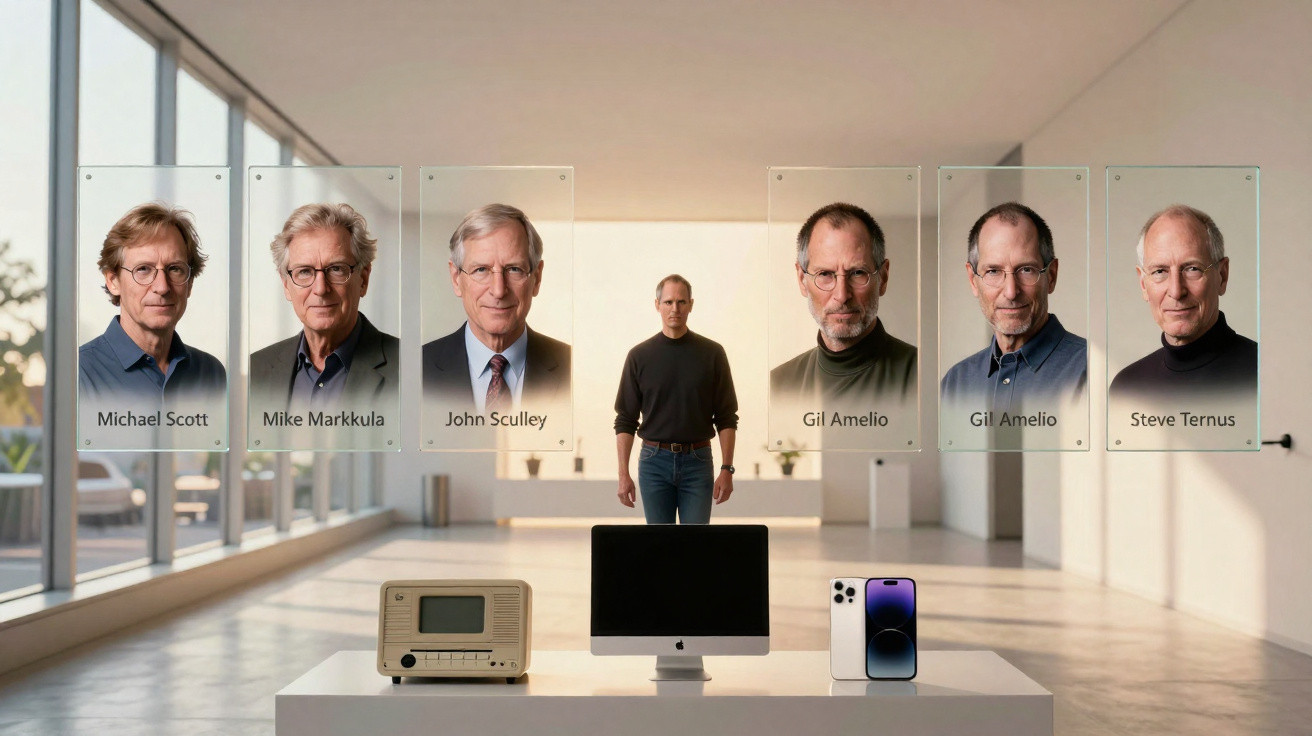
John Ternus is the eighth man to take charge of Apple. Here is a look at the seven leaders who came before him.
After fifteen years of dedicated service, Tim Cook has left Apple and handed the reins to John Ternus. The new chief faces a major task if he is to keep the company at the top. He also inherits a long line of CEOs: some iconic, others almost entirely forgotten.
Who led Apple before Ternus? Which executives shaped the company? And which of them truly left their mark on the brand’s history? Here is the full picture.
Michael Scott (no relation): 1977–1981
Steve Jobs and Steve Wozniak founded Apple in 1977, as their young company began to take off. Mike Markkula, the often-overlooked third key figure and an investor in the business, brought in a former colleague, Michael Scott, to run the fledgling company.
The aim was to give the business structure and oversee the two Steves, who were still considered too young to manage it themselves. Scott helped Apple grow by placing a strong bet on the personal computer-far from an obvious choice at the time-and by driving the Macintosh project forward. However, he made a strategic mistake in 1981 when he dismissed 40 employees at once, many of them from the Apple II team. This led to him being sidelined in favour of Markkula.
Michael Scott later worked in the rocket industry and became known in the world of gemmology, a field he was passionate about. He died in 2025.
Mike Markkula: 1981–1983
Mike Markkula was Apple’s third major founding figure. He invested in the very young company, even contributing his own personal funds. Once Scott had been removed, Markkula took over as acting CEO, a role he ultimately held for two years. He steadied the company after the 1981 crisis and backed its ongoing projects.
He then remained on Apple’s board of directors until 1997.
John Sculley: 1983–1993
Under John Sculley, Apple reached a new scale, though it lost part of its identity along the way. Before joining Apple, Sculley had led another giant: Pepsi. Legend has it that Steve Jobs recruited him with the famous line: “Do you want to sell sugared water for the rest of your life, or do you want to change the world with me?”
Sculley organised Apple, transforming it from a nerdy start-up into an international company. Over ten years, sales surged from 800 million to 8 billion dollars. He also placed marketing at the heart of the business, an area that would become one of Apple’s real strengths. He is equally known for bringing about Steve Jobs’s departure. While Jobs wanted to innovate, Sculley took a more pragmatic, capitalist approach. The tension between them built over time until 1985, when Sculley, supported by the board of directors-including Markkula-forced Jobs out.
Sculley left Apple in 1993, taking 10 million dollars in bonuses, as sales began to weaken against competition from the PC.
Michael Spindler: 1993–1996
Michael Spindler was the only non-American to lead Apple. Born in Berlin, he first served within the company’s European division before succeeding Sculley. Yet he inherited an extremely difficult situation, with the company losing momentum and becoming bogged down in restructurings. He nevertheless made his mark by introducing the PowerPC architecture to the Mac. Unable to turn the business around, he was removed after three years. He died in France in 2016.
Gil Amelio: 1996–1997
Gil Amelio spent only a year at the helm, but his tenure had enormous consequences for Apple’s history. A member of the board of directors since 1984, he took over after Spindler and attempted to restore the company through mass redundancies and cancelled projects. The financial situation, however, did not improve.
He also acquired NeXT, a company founded by a certain Steve Jobs. Jobs returned to Apple and persuaded the board to let him run his former company when Apple’s share price was at its lowest point.
Steve Jobs: 1997–2011
Does Steve Jobs really need an introduction? He not only rescued a struggling Apple, but also helped turn it into an innovation machine. The iPod, iPhone and iPad were among his many creations. His return was a blessing for Apple, which would almost certainly no longer exist today without his work. More than a Silicon Valley executive, Steve Jobs was unquestionably the most influential entrepreneur in technology history, putting design and user experience before technology itself.
He died in 2011 from cancer, which he had fought for years. Two months before his death, he named Tim Cook as his successor.
Tim Cook: 2011–2026
Tim Cook did not overhaul the Apple formula, instead following directly in Steve Jobs’s footsteps. During his leadership, the brand became more powerful than ever, with its market valuation increasing tenfold to more than 3,000 billion dollars. He continued to rely on its flagship products-the iPhone, iPad and MacBook-while adding his own touch through the Apple Watch, AirPods and Vision Pro. His final achievement was the MacBook Neo, a MacBook priced at just 699 euros. One last flourish before his departure.
John Ternus: 2026–????
Ternus was the logical choice to succeed Cook. Having joined Apple in 2001, during its revival, he has contributed to every major engineering project at the company. He is a steady, hard-working and discreet figure, but also remarkably effective. It is now up to him to keep Apple growing by continuing to build on its successes while also innovating.
You can find his brief biography in this article.






Comments
No comments yet. Be the first to comment!
Leave a Comment