
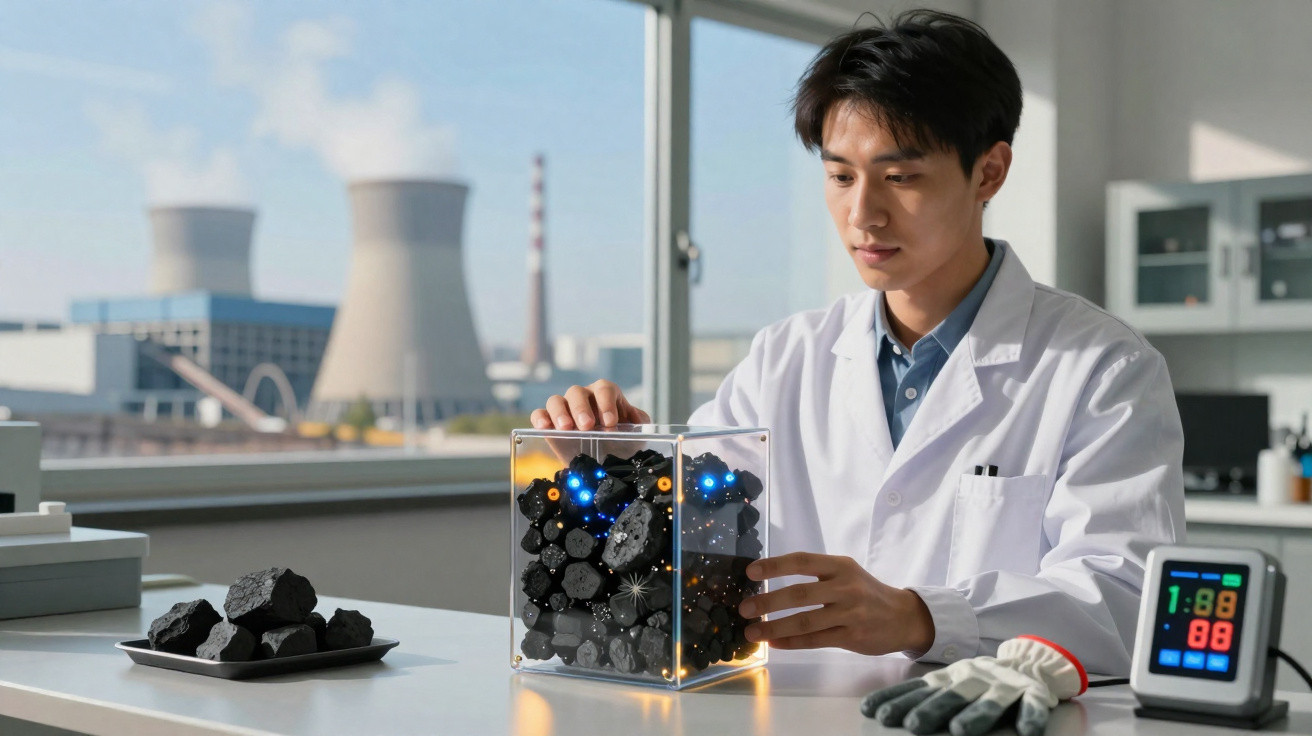
A recent study suggests coal could produce electricity without being burnt. In a “coal battery”, carbon from coal passes through a sealed electrical cell.
The research casts coal-fired generation as a challenge of containment: the most polluting fuel could potentially create electricity without releasing exhaust into the atmosphere.
How the coal battery works
Within a sealed direct coal fuel cell battery, the carbon in coal serves as an electricity-generating fuel instead of being burnt to heat a boiler.
Heping Xie of Shenzhen University (SZU) demonstrated that, through this sealed process, carbon can generate usable electrical current without open combustion.
The concept does not show that a completed power station is already available, but it takes the approach beyond merely replacing a furnace.
This distinction is important, as the proposal now relies on durable engineering rather than simply an attractive chemical reaction.
China’s coal challenge
China still obtained almost 60% of its electricity from coal in 2024, according to the International Energy Agency (IEA), an intergovernmental energy organisation based in Paris.
Despite rapid growth in solar and wind power, a 2026 review reported that China brought 78 gigawatts, large units used to measure generating capacity, of coal capacity online in 2025.
In this context, engineers describe the zero-carbon-emission direct coal fuel cell, or ZC-DCFC, as a cell designed to capture or reuse its carbon output.
The assertion remains limited: coal still becomes carbon dioxide, the heat-trapping gas produced by fossil fuels, unless the system stores it or converts it.
Electricity without combustion
Carbon is positioned at the anode, the fuel-side electrode, inside the cell, while air provides oxygen nearby.
Chemical reactions remove electrons from the carbon, with those electrons then moving along an external wire as useful electrical current.
At the cathode, the oxygen-side electrode, electrons returning to the system enable oxygen to create charged particles that travel back towards the carbon.
This closed cycle produces electricity directly from chemistry, avoiding the boiler, steam turbine and many associated heat losses.
Keeping carbon dioxide contained
Containment strengthens the coal cell’s climate case because it produces carbon dioxide in a concentrated stream.
Conventional power stations with chimneys must separate a diluted gas from nitrogen, water vapour, ash and other emissions.
Under this design, comparatively pure carbon dioxide can be directed to storage, carbon mineralisation, a process that fixes gas in stable solids, or chemical reuse.
However, this benefit is lost if equipment downstream uses excessive power or allows carbon to leak back into the environment.
Coal requires preparation
Untreated coal cannot simply be placed in the cell, since solid pieces react too slowly and contain harmful minerals.
Engineers would mill it into a fine powder, dry it, remove ash and eliminate sulfur that could poison active surfaces.
The suggested particle size may be below 10 micrometres, or 0.01 mm, exposing a much larger reactive surface area.
Because this preparation consumes energy, improved cell efficiency must offset the energy required for milling, drying and cleaning.
The trade-offs of high temperatures
In this system, heat is both useful and costly, as coal reactions accelerate only at elevated temperatures.
The proposed operating temperature range is around 593 to 899°C before the reactions can continue on their own.
After operation begins, the cell generates heat, yet its materials must still withstand sealing challenges, corrosion and thermal stress.
Targets of close to 80% at cell level decline to approximately 55% to 60% once pumps, heaters and cleaning processes are included.
Obstacles to scaling up
Individual small cells may perform well in trials, but commercial power stations require stacks that operate dependably for years.
A stack, meaning a group of connected cells, needs to distribute coal evenly while clearing ash before it blocks pores.
The materials must also withstand sulfur, chlorine and alkali metals, all of which can damage electrodes and degrade seals.
Unless fuel feeding and ash removal remain consistent, ZC-DCFC could reproduce the failures of earlier solid-fuel cells on a larger scale.
Mines as generation sites
Locating the technology underground could alter the economics by converting deep coal into electricity before it is brought to the surface.
The SZU proposal envisages future cells installed in mines at depths of roughly 1 to 2 km.
Cables would transmit electricity upwards, while managed carbon could be stored close to the coal seam, an underground layer of coal.
Deep locations could eliminate some fuel transport, although they would also increase requirements for safety, maintenance and monitoring.
Problems facing the coal battery
Commercial viability will depend on demonstrating that carbon management does not, over time, remove the proposed efficiency advantage.
Turning carbon dioxide into fuels, chemicals or minerals requires energy, equipment and dependable supplies of local materials.
Extended operation would further require sensors, automated controls and emergency systems for continuously operating hot, sealed equipment.
“ZC-DCFC is expected to open up a new pathway for near-zero-emission coal utilization, transforming coal from a traditional fossil fuel into a feasible clean energy source in the global low-carbon transition,” wrote Xie and colleagues.
A narrow opportunity
The coal cell concept combines chemistry, mining and carbon storage in one demanding proposition: generating more power from coal without an open flame.
Its immediate role may be not as a replacement power plant, but as a test of whether fossil fuel can be contained before its use is phased out.






Comments
No comments yet. Be the first to comment!
Leave a Comment