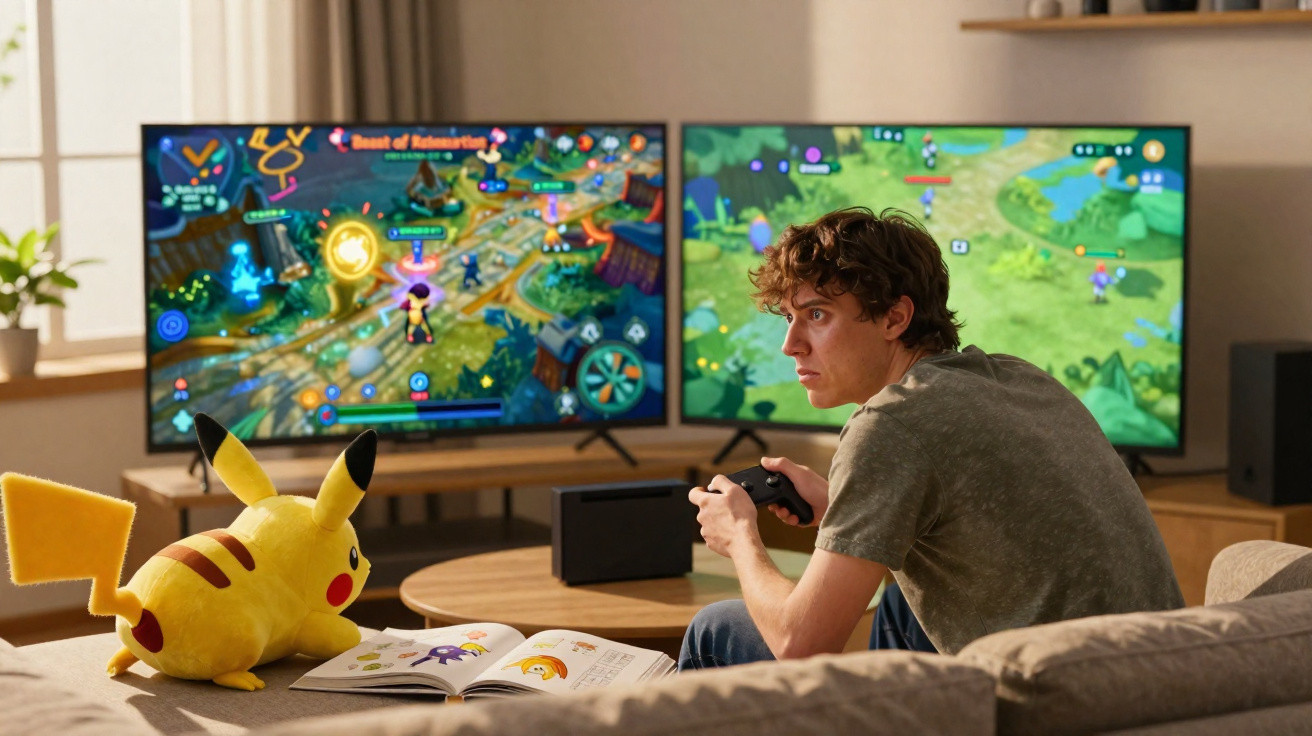
Game Freak has been associated almost exclusively with Pokémon for decades, but the studio is quietly developing a project that has unsettled its fanbase. The action role-playing game Beast of Reincarnation appears technically far more ambitious than the latest pocket-monster adventures, raising an uncomfortable question: why are the main games in this hugely profitable franchise not given the same treatment?
A new action RPG raises eyebrows
Game Freak has stood for Pokémon since 1996. The franchise is now regarded as one of entertainment's most lucrative series. Even so, the Japanese studio has repeatedly ventured into other genres and properties, though these projects have generally passed beneath the radar.
Beast of Reincarnation feels different. Revealed during the Xbox Games Showcase, the game is a clear indication that Microsoft and Game Freak intend to position it as a major release. Its trailers present a dark action RPG featuring rapid combat, striking creatures and environments with considerably more detail than players usually associate with Pokémon.
“Beast of Reincarnation” often looks more like a game from the current console generation, while many players still place Pokémon in the graphical era of the early Switch.
It is precisely this contrast that has fuelled the debate. The same studio criticised for years over Pokémon's weak visuals is suddenly demonstrating that it can compete visually after all - when the right conditions are in place.
How Beast of Reincarnation is being made: a small core team and many partners
Speaking to Eurogamer, Game Director Kota Furushima outlined how development on the new project is structured. Game Freak retains creative control and project management internally. Its in-house team remains small, but it brings in support at crucial points.
Game Freak guides the concept and decisions, while “several dozen” external partners contribute to the graphics, technology and specialist modules.
The statement makes clear that Game Freak increasingly sees itself as the creative lead coordinating a network of specialist studios. According to Furushima, these external partners enable the ambitious action RPG to look technically current without overwhelming the core team.
What external partners actually contribute
Such collaborations have become standard practice in AAA development. Work commonly outsourced includes:
- High-end 3D models for characters and monsters
- Animations and effects such as particles, lighting and shadows
- Technical optimisation for different platforms
- Engine modifications and tools that let designers work faster
- Cutscenes and cinematics
Game Freak presents Beast of Reincarnation as a project that benefits from exactly this approach: a small, focused core team supported by a wide circle of service providers that fill gaps while maintaining production speed and quality.
Why does Pokémon then look so dated?
This is where many fans' frustration begins. Since the move to 3D, Pokémon games have repeatedly faced criticism for lagging behind other Nintendo hits graphically. On the same console that runs The Legend of Zelda: Breath of the Wild, Super Mario Odyssey and Xenoblade Chronicles 3, the pocket monsters can look technically surprisingly basic.
The expectation is straightforward: a franchise that generates so much money should make its main games showcases for Nintendo hardware. Instead, players encounter stuttering open worlds, weak textures, sparse landscapes and obvious compromises in animation.
Many players are asking: if Game Freak employs dozens of external specialists for an Xbox action RPG, why not use them to the same extent for the studio's most famous franchise?
The release schedule as a brake
One central issue is the pace of releases. Pokémon mainline games and spin-offs arrive at very short intervals. Delivering one major project each year is regarded as almost essential to keep television series, anime, trading cards, merchandise and events in sync.
At its core, Game Freak is still a relatively small studio. Many industry observers believe that the combination of intense expectations, tight schedules and limited resources explains a substantial share of the quality shortcomings. A developer that must deliver continuously can scarcely risk lengthy, expensive pre-production phases or radical changes in technology.
Does Beast of Reincarnation show what could really be possible?
The new action RPG suddenly puts evidence on the table: Game Freak can match modern visual standards when enough time and external support are available. The questions now being asked are:
- Are fewer external resources used for Pokémon?
- Is reliability prioritised over major technical advances?
- Are experiments being constrained by those responsible for the franchise?
There are no official answers. What is clear is that, according to Furushima, the team behind Beast of Reincarnation receives support from “several dozen” external partners - a scale of involvement that has not previously been communicated openly for Pokémon.
Fan reactions: between fascination and anger
Since the game's reveal, similar comments have repeatedly appeared in communities. Many welcome Game Freak expanding beyond Pokémon and trying new genres. At the same time, quite a few fans of the main series feel plainly slighted.
The underlying message is this: for years, players were told that the technology was difficult, the hardware was limited and the studio was small. Now it seems as though none of this is an unavoidable law of nature, but rather a management choice. Those who love the franchise are left wondering: could a comparable network of partners have saved Pokémon Scarlet & Violet too?
What this case reveals about modern game production
The difference between Pokémon and Beast of Reincarnation illustrates just how strongly organisation shapes a game's visual presentation. Budget and talent are not the only factors that matter; so do the following:
| Factor | Effect |
|---|---|
| Release schedule | Little time for technical leaps, with an emphasis on safe solutions |
| Partner network | More specialist expertise and greater production capacity |
| Franchise risk | Major series are often modernised more cautiously |
| Platform strategy | Multi-platform titles are more likely to aim for state-of-the-art visuals |
Beast of Reincarnation occupies a particular position here. As a new project for Xbox and probably PC, the property is not subject to the same merchandise pressure as Pokémon. That allows bolder technical approaches and a clearer focus on presentation.
What players can learn from the comparison
For many fans, it is worth looking closely at these production details. Understanding how studios and publishers organise projects makes it easier to judge the quality of finished games and adjust expectations.
Several points are particularly worth watching in future:
- How frequently do new entries in a series release?
- Does the studio communicate its work with co-developers openly?
- Are there visible technological leaps between instalments, or only incremental changes?
- How extensive is the surrounding franchise, from anime to merchandise?
Game Freak's case in particular shows that a studio can have very different faces. On one side is a long-established flagship series managed with extreme caution. On the other is a new action RPG that looks markedly more modern, where everything suddenly appears possible. How strongly that pressure will ultimately feed back into Pokémon development will only become clear in the years ahead.













Comments
No comments yet. Be the first to comment!
Leave a Comment