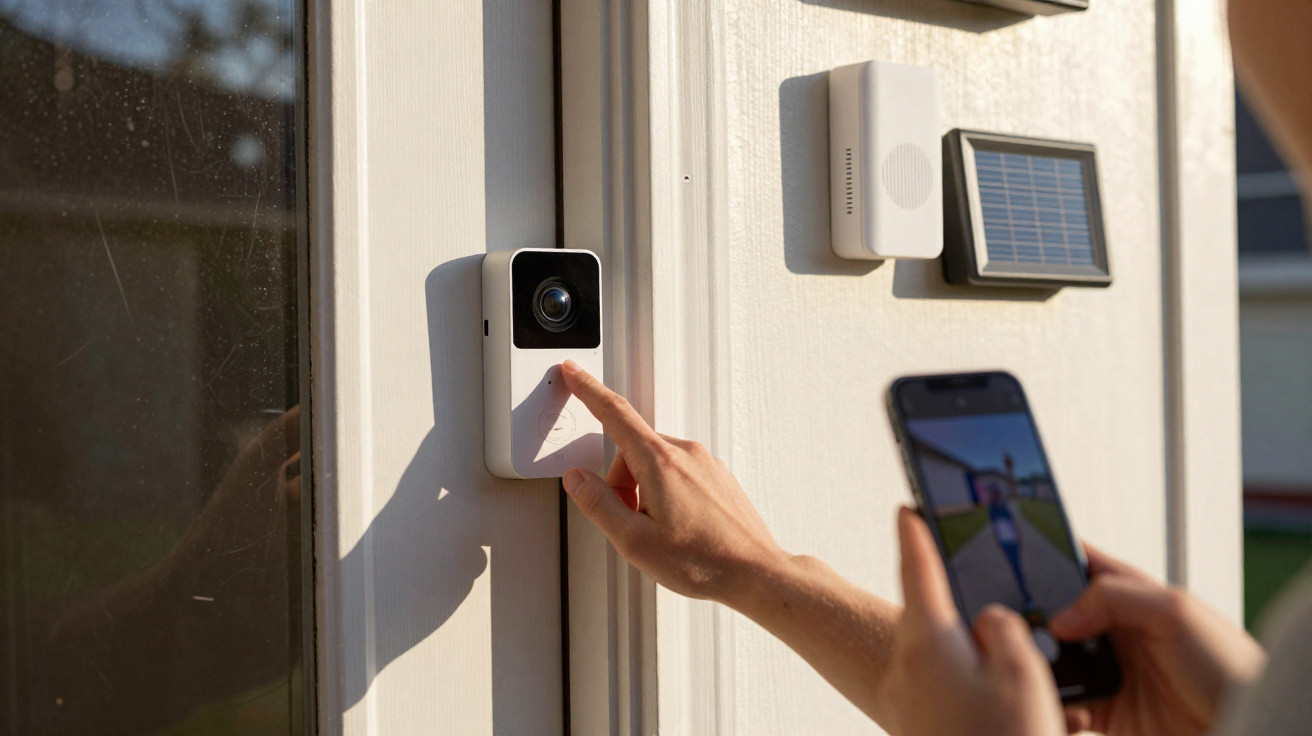
Ring, Amazon’s smart-home brand, is substantially raising image quality across its video doorbell range. For the first time, wireless models are available with 4K resolution, alongside new 2K options, a professional PoE flagship and accessories including solar chargers and a Chime. Ring is therefore targeting almost every budget and type of home, from a compact terraced house to a connected villa.
4K at the front door: Ring’s latest additions
The centrepiece of the new line-up is the second-generation Ring Battery Video Doorbell Pro. This wireless video doorbell captures in 4K, providing four times the resolution of Full HD. In the right field of view, that delivers finer detail, clearer faces and package labels or number plates that are easier to read.
According to Ring, the Pro model includes several technical improvements:
- 4K video with substantially greater image detail
- Digital zoom of up to 10x
- Revised sensors intended to improve night vision
- A new internal architecture that provides more performance
- A fast-charging battery, reducing the need to keep plugging in the doorbell
“The purpose of the 4K push is to ensure visitors, delivery drivers and suspicious people remain clearly recognisable even in low light and at greater distances.”
Resolution is particularly important for driveways, blocks of flats and homes with long front gardens, where it can determine how reliably people or vehicle registration plates can be identified afterwards. Ring aims to put this model clearly ahead of its existing Full HD and 1536p doorbells.
Elite version with Power over Ethernet for professionals
Alongside the battery-powered Pro model, Ring is introducing a new Wired Video Doorbell Elite. It also records in 4K, but does away with both batteries and Wi-Fi altogether. Instead, it uses Power over Ethernet (PoE), with a single network cable carrying both power and data to the doorbell.
This is clearly aimed at buyers with more demanding requirements:
- A highly stable network connection without Wi-Fi dropouts
- Permanent power, removing concerns about charging cycles
- Suitable for new-build properties or refurbishments with existing network infrastructure
- More capacity for processing features such as motion detection and remote access
The Elite version sits at the top end of the price range and is primarily intended for smart new-build homes, larger properties and small commercial premises. Installation is more involved because a PoE cable has to be run, but under ideal conditions the system can operate for years with little maintenance.
Solar charger and Chime make the doorbell more practical
Ring is also launching a new solar panel for its wireless models. Mounted directly behind the video doorbell, it continuously tops up the battery when sufficient daylight is available.
“In everyday use, the solar panel can significantly cut the number of charging sessions, especially on house fronts with good sun exposure.”
One point matters: a solar module will achieve little in dark porches or beneath deep canopies. Anyone intending to rely on the technology should aim for the clearest possible south-facing position.
Indoors, the new Chime Plus ensures doorbell alerts are not limited to a smartphone. The compact speaker plugs into a mains socket and plays alerts loudly and clearly, which is useful when a phone is in another room or when other family members do not have access to the app.
Prices of the key new devices
| Product | Type | Resolution | Manufacturer’s price |
|---|---|---|---|
| Battery Video Doorbell Pro (2nd Gen) | wireless | 4K | approx. €250 |
| Wired Video Doorbell Elite (new) | PoE, wired | 4K | approx. €500 |
| Solar charger | accessory | – | approx. €50 |
| Chime Plus (2nd Gen) | indoor alert | – | approx. €60 |
Three new 2K models: the same platform, fewer pixels
In addition to its 4K flagships, Ring is adding three 2K video doorbells. They are designed as more affordable entry points while using the same underlying platform.
The range includes:
- Battery Video Doorbell Plus (2nd Gen) – wireless, 2K, improved battery, priced at around €180
- Battery Video Doorbell (2nd Gen) – a straightforward wireless 2K doorbell with up to 6x zoom, just under €100
- Video Doorbell Wired (2nd Gen) – 2K, wired for existing doorbell cabling, at around €80
“This gives Ring a range extending from an entry-level model below €100 to the €500 Elite doorbell, always with app connectivity and cloud features.”
The 2K devices are mainly intended for people who want a sharp image without necessarily needing 4K. Typical examples include narrow entrance halls or a flat door in an apartment block, where distances are short.
What does 4K genuinely add at the front door?
While 4K sounds appealing, its benefits depend heavily on the installation. To make worthwhile use of 4K, several factors should be considered:
- Distance from the door: The further away visitors stand from the camera, the more useful the additional resolution becomes.
- Lighting: Good outdoor lighting combined with improved night vision can create sharper footage at dusk.
- Network connection: 4K video streams require dependable Wi-Fi or PoE connections. Older routers and weak repeaters can become a bottleneck.
- Storage & data usage: Higher resolution produces more data that must be saved in the cloud or locally.
Many UK households still install their first smart doorbell in Full HD. 4K is likely to appeal to people who already have experience with the technology and specifically want better detail recognition, for example because of repeated late-night visitors, vandalism or valuable deliveries.
Data protection, subscriptions and legal pitfalls
Installing a connected doorbell can quickly create a tension between security and privacy. In the UK, the camera should not continuously record public areas or neighbouring property. Its viewing angle should be set, wherever possible, to cover only the owner’s property and the immediate entrance area.
As usual, Ring relies heavily on its cloud service. Without a paid subscription, many convenience features are restricted, including longer-term recording storage and enhanced notifications. Anyone seeking maximum control should check in advance which features are actually available without a subscription, and whether the added sense of security justifies the ongoing cost.
Practical everyday uses
In day-to-day life, a 4K doorbell can do more than simply show that somebody is at the door. Some common examples include:
- A parcel courier leaves a delivery in a designated place, and the camera records its condition on arrival.
- Working parents can see on their smartphone when their children return from school.
- Holiday-home owners can keep an eye on the entrance without needing to be there.
- Older people can check visitors in the app before opening the door.
Detailed footage can be especially helpful in poor weather, during the darker months or when disturbances repeatedly occur in a shared hallway. It makes it easier to review events later, whether when dealing with a property manager or in the event of a dispute.
Where the investment is most worthwhile
Households with frequent deliveries, openly accessible entrances or recessed front doors benefit most, as visitors may not be standing directly in front of the camera. This is where 4K, powerful zoom and upgraded night vision have the greatest advantage.
By contrast, those living in a small city flat with the building entrance immediately outside their door and only occasional deliveries will often find a good 2K model sufficient. In either situation, battery versions and solar chargers make installation much easier because there is no need for an electrician to work on the doorbell wiring.
It remains to be seen how strongly competing manufacturers respond. What is already clear is that video doorbells are moving from being a novelty to a standard smart-home component, and Ring’s current generation brings the technology considerably closer to conventional surveillance cameras.













Comments
No comments yet. Be the first to comment!
Leave a Comment