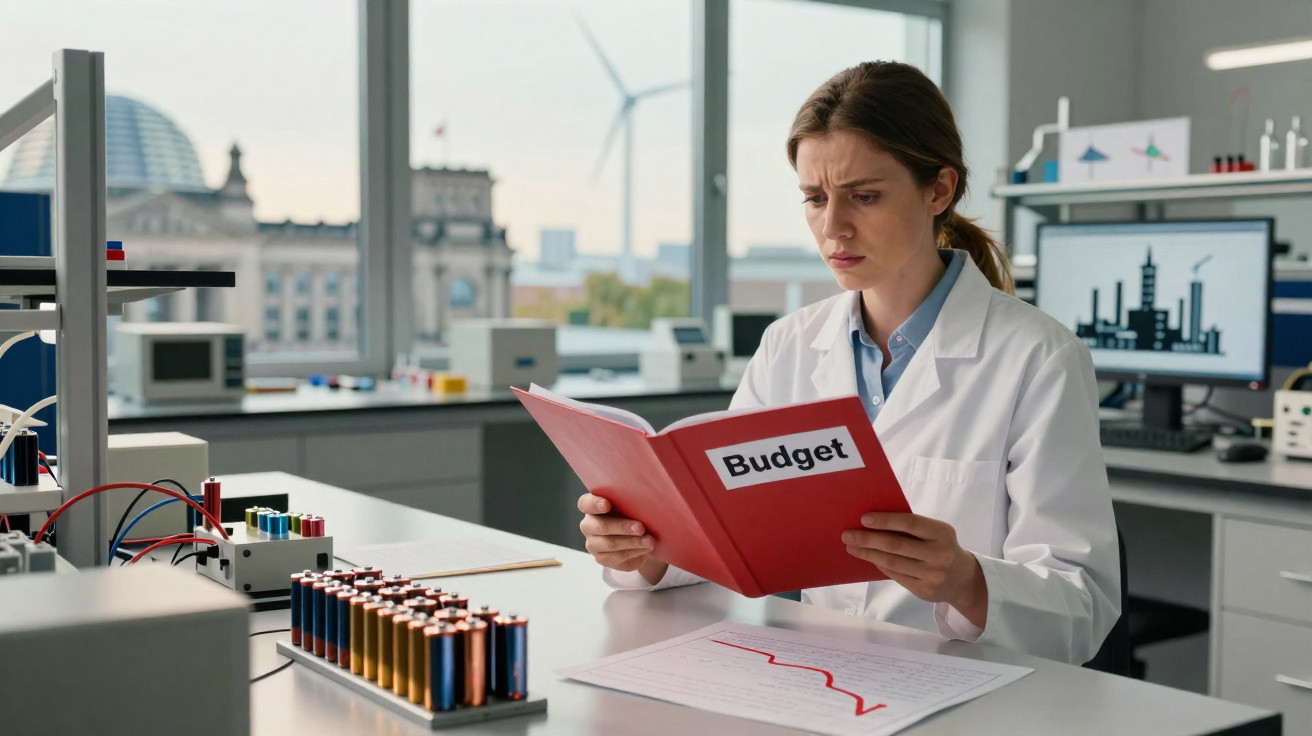
The German government is preparing to reduce funding for battery research and development in 2024, following wider cuts announced for Germany’s Climate and Transformation Fund.
According to German publication Wirtschaftswoche, the fund faces a shortfall of around €60 billion, an expenditure gap the German administration intends to narrow.
As a result, it is set to withdraw a substantial share of the investment previously earmarked for the research and development of new batteries.
What is at stake for Germany’s battery research?
The German government is dealing with a major budget crisis that is affecting numerous German energy-transition policies.
Citing Wirtschaftswoche, a business-focused publication, cuts to Germany’s development ministry could reach €156 million in 2024. This could affect as much as 75% of the funding allocated to battery research and development.
KLiB (Kompetenznetzwerk Lithium-Ionen-Batterien), an alliance representing Germany’s battery industry, has already responded to the decision with a warning: “The cuts being planned will bring an end to German battery research, with dramatic consequences for Germany as a leading technology location,” reads the letter sent by the alliance to German Chancellor Olaf Scholz, seen by Wirtschaftswoche.
KLiB warns of dependence on non-European companies
KLiB also warns that, without funding, Germany’s energy transition will become reliant on “non-European companies”, while the foundations for a sovereign German battery ecosystem will be “destroyed”.
In the letter, addressed not only to Olaf Scholz but also to Economy Minister Robert Habeck, Finance Minister Christian Lindner and Education and Development Minister Bettina Stark-Watzinger, KLiB states that the planned government cuts would affect “around 75% of the funding (…) for battery research planned for 2024 and the following years”.
For KLiB, there is no doubt that “without batteries, the transformation of the economy and society towards carbon neutrality cannot be achieved”, as high-performance batteries are vital to “the competitiveness of electric vehicles, stationary storage systems, buses, lorries, drones, machinery and electric bicycles”.
Funding cuts alongside support for Intel and Northvolt
The German government’s continued commitment to support technology giant Intel and Swedish battery company Northvolt with several billion euros is also prompting criticism within the scientific community.
This comes as it announces a reduction in investment for German universities, research institutes and start-ups directly involved in research into battery development.
Source: Wirtschaftswoche
















Comments
No comments yet. Be the first to comment!
Leave a Comment