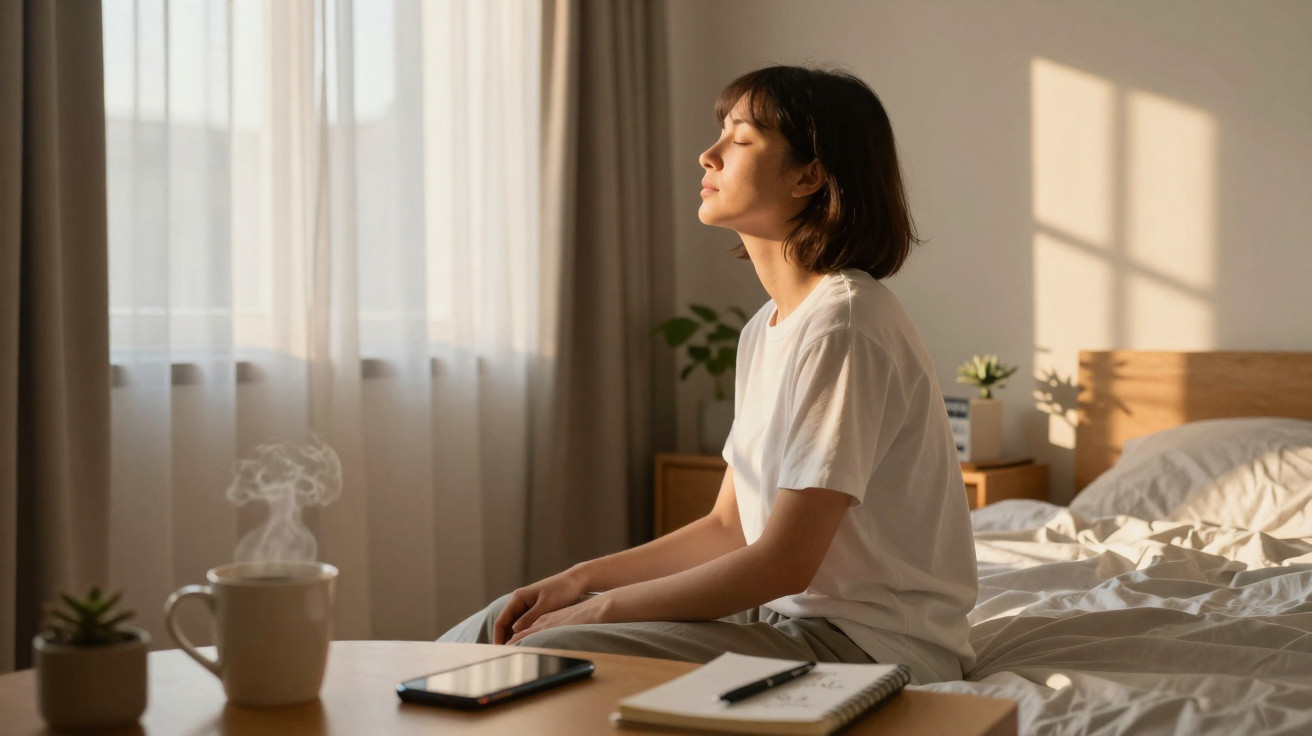
The alarm goes off, the refuse lorry is already rumbling somewhere outside, and before your mind has properly woken up, your hand has found your smartphone. Cold light, emails, push notifications, someone posted something in the group at 6.42 am. Your day starts not with a breath, but with a stream of data. Suddenly, you feel rushed inside, even though you are still lying in bed. Imagine if that very first moment of the morning belonged to you again. No screen, no sensory overload, just a few minutes of quiet emptiness. It sounds minor. Yet it changes more than you might think.
The quiet moment before the first swipe
In the morning, while it is still half-dark, your mind is like a newly stretched canvas. Nothing has been put on it yet; the colours are ready, but no one has scribbled across it. Yet these are often exactly the minutes when we fill our heads with the loudest images: breaking news, dramatic headlines, emails marked “urgent”, a message from the boss. We bring the day’s chaos into our most sensitive state: the first moment of being awake. It is little wonder that so many people feel tired before their feet even touch the floor.
Leave your phone alone for the first ten minutes after waking and something unexpected happens: your body remains in night mode a little longer, while your nervous system does not immediately accelerate. Your heartbeat, breathing and thoughts can all stay slower for a while. It is like the silence before a concert starts, when you take one deep breath. If you do not plaster over that moment with scrolling, you enter the day more gently. That is where things become interesting.
A friend of mine, a graphic designer, spent years opening Instagram as soon as he woke up. “Just having a quick look,” he would say. More often than not, he then lay in bed for 20 minutes, his eyes already tired before the coffee machine had even started. His head was full of strangers’ holiday photos, design trends, opinions and Reels. One morning, he had left his phone in the living room. It was pure chance: he had forgotten it there while charging it the previous evening. He woke up, reached out and found nothing – then simply stayed where he was. First he heard the neighbours, then the water moving through the heating, and eventually his own breathing. Five minutes of nothing.
Later that day, he noticed that he reacted much more calmly to a critical email from a client. No internal jolt, no racing pulse. After trying this for a few weeks, he recognised an effect that felt like an invisible shield: the first wave of impressions did not arrive until he was already a little more mentally settled. Not every statistic aimed at “Digital Detox” gets it right. But research into sleep and cortisol makes one thing fairly clear: anyone consuming intense stimuli immediately after waking puts their inner system into turbo mode – long before their body is ready.
From a neurobiological perspective, something rather straightforward takes place: the moment you check your smartphone, the reward system and the alarm centre activate at the same time. A like, positive news or an engaging clip creates a small burst of dopamine. A negative headline, a demanding email or reminders about unfinished tasks provide a subtle hit of stress. Your brain begins linking “waking up in the morning” with “an avalanche of stimuli”. Replace that pattern with a few smartphone-free minutes and you send a different message: body first, world second. Your internal rhythm starts following you again rather than apps that keep pinging. It may sound unremarkable, but in everyday life it can feel like finally sitting in the driver’s seat again.
How to claim 5 smartphone-free minutes in the morning
The answer is not heroic self-discipline, but a small detour. At night, place your phone somewhere other than beside the bed: in the hallway or living room, for example. Buy a simple alarm clock – yes, one of those old-fashioned devices with numbers on it. When it rings in the morning, you will automatically have a few steps between yourself and the screen. Those steps are often enough to pause briefly. Sit up, breathe, open the window a crack, take a sip of water. Only after these small actions should the smartphone enter the picture.
Many people set themselves a fixed mini-routine: three deep breaths, a quick shoulder roll, a look out of the window, perhaps a sentence such as: “Today I want to respond more calmly.” Even people with children or shift work can often carve out two minutes. Let us be honest: no one manages it every single day. But even on the days when it works, the difference is noticeable: the internal volume is lower during the morning. The emails look the same, yet your reaction to them is less anxious. You feel less as though you are being remote-controlled.
The most common obstacle is the excuse, “I need my phone as an alarm clock,” together with the fear of missing something important. Naturally, people with caring responsibilities, on-call emergency duties or shift patterns operate differently. Even so, there is often some room for adjustment. Keep it on aeroplane mode until after your first coffee. Silence notifications and allow only genuine calls through. Another mistake is leaving the phone untouched but starting immediately on emails from a laptop instead. The stimuli are the same; only the device has changed. The calm morning moment is lost just as easily.
“The way we handle our first conscious moment is like a note that quietly resonates throughout the entire day,” a psychologist who works with people affected by burnout once told me.
To keep that note as gentle as possible, it helps to have a short list of things you can do instead of scrolling:
- Stretch briefly, right through to your fingertips, for three breaths.
- Drink a glass of water and genuinely notice its taste.
- Scribble two sentences in a notebook: fragments of a dream, thoughts or the day’s task.
- Stand by the window, whether it looks onto a courtyard or the sky, and look consciously for a moment.
- Think a sentence such as: “The day does not yet have the right to overwhelm me.”
What happens when the day does not begin with a screen
People who spend a few minutes without their smartphone in the morning often describe a similar feeling: the day seems to have more room in it. The tasks remain the same, the children may still shout just as much, and the boss’s emails are no less demanding. Yet beneath everything is a thin layer of calm. It is as if someone has turned down the background volume slightly. A colleague once called it “those two extra centimetres of air between me and stress”. You no longer react reflexively to every message; instead, there is a tiny space in which you can breathe first.
Some people do not notice the effect immediately. The first days without morning scrolling can even feel unfamiliar. There is suddenly an emptiness that news would normally fill. Out of habit, some people reach ten times for a phone that is not even there. Those who stick with it may find after a few weeks that their internal starting point has shifted: less tightness in the chest and fewer thoughts of “I am already behind” as soon as they get up. The first impression of the day belongs to their own body again, rather than someone else’s timelines.
This small adjustment also has a quiet side effect: you start noticing how you actually feel in the morning. Tired, irritable, relaxed, sad. Without an immediate glance at a screen, your own inner weather becomes visible. That is not always pleasant, but it is honest. Better decisions can grow from that honesty: perhaps one extra glass of water, saying no to an appointment, or taking a short walk during the lunch break. No grand miracles – rather, many tiny corrections. By the end of a month, they can make the difference between “constantly overwhelmed” and “somehow manageable”.
| Key point | Detail | Benefit for the reader |
|---|---|---|
| Smartphone-free first minutes | Keep the phone physically away from the bed, use an alarm clock, body before screen | A noticeably calmer start and less sensory overload immediately after waking |
| Small morning routine | Breathe, stretch, drink water and look out of the window instead of scrolling | Straightforward, realistic rituals that can be introduced without time pressure |
| Inner distance from daily stress | A conscious first moment creates a “buffer” against emails, news and social media | More calm under the same pressures and less feeling of being overwhelmed |











Comments
No comments yet. Be the first to comment!
Leave a Comment