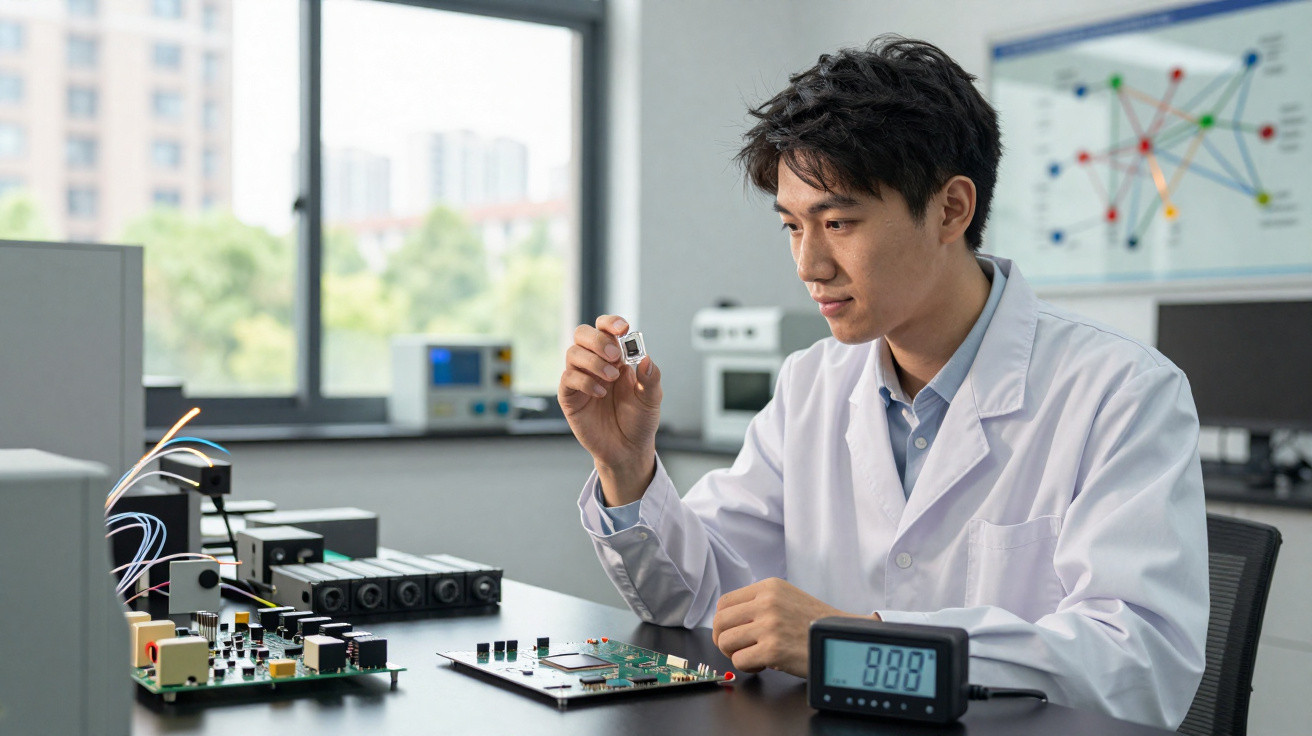
As data centres run hotter and electricity networks come under greater pressure, a low-key change is taking shape in Chinese research laboratories.
Engineers are revisiting analogue technology developed in the 1970s, updating it with lasers and advanced chips, and presenting it as a potentially dramatic means of reducing computing’s energy footprint.
Why China is backing low-energy analogue technology
China’s demand for computing capacity is rising rapidly. Training AI, cryptocurrency mining, streaming platforms and cloud services all require enormous server farms. These sites already use vast quantities of electricity and cooling water.
Digital electronics, which rely on transistors switching between 0 and 1, have undergone decades of optimisation. Although chips continue to become smaller and faster, improvements in energy efficiency are decelerating. At the same time, AI models are expanding while data traffic continues to increase.
China’s researchers are turning to analogue computing, an older approach that can, for some tasks, use up to 200 times less energy than conventional digital chips.
This “resurrected” approach is not simply an obsolete device being brought back. It processes information through continuous electrical or optical signals rather than separate digital bits. The underlying idea dates back over 50 years, when early analogue computers were used to solve equations in engineering and aerospace applications.
Such machines disappeared after inexpensive digital microprocessors became dominant. Today, however, comparable principles are being revived using contemporary hardware and in response to AI-related requirements.
What this 50-year-old technology actually is
Analogue computing operates unlike a typical desktop or laptop computer. Rather than storing numbers as lengthy binary sequences, it expresses values through voltages, currents or intensities of light. The components’ physical properties carry out mathematical operations naturally.
During the 1970s, systems of this kind consisted of racks filled with operational amplifiers, capacitors and resistors. Chinese research teams are now exploring:
- Analogue AI accelerators using memory-cell arrays
- Optical chips that rely on light instead of electrons
- Mixed-signal processors combining analogue and digital sections
The fundamental principle is unchanged: rather than carrying out billions of exact digital calculations, the hardware completes approximate calculations in a single physical operation. That can offer a major advantage for machine learning, where small errors are inherently acceptable.
By allowing “good enough” calculations in hardware, analogue chips can drastically cut the number of operations and the energy each one requires.
From op-amps to AI accelerators
In the past, analogue computers solved differential equations in real time for tasks including aircraft control, missile guidance and nuclear simulation. Engineers configured circuits to physically correspond with the equations they needed to address.
Current systems in China and other countries instead employ memory-cell arrays, including resistive RAM, in which each cell’s conductance represents a number. Matrix multiplication-the main computational work within neural networks-can then be performed through straightforward current flows governed by Ohm’s law.
Rather than processing every multiplication digitally in sequence, the circuit completes the entire matrix calculation simultaneously. This is why energy savings of more than 100 times can be credible for certain AI workloads.
Why 200 times less energy matters now
AI’s energy challenge is tangible rather than theoretical. Training one frontier model can use the same amount of electricity that a small town consumes over a year. Even routine services, including video recommendations and voice assistants, depend on huge clusters of servers.
China, the US and EU member states are increasingly concerned that data centres could conflict with climate targets and put pressure on local electricity grids. Energy-intensive AI chips intensify that problem.
| Technology | Typical energy use per AI operation | Key trade-off |
|---|---|---|
| Conventional digital GPU | High | Very accurate, mature ecosystem |
| Digital low-precision AI chip | Medium | Reduced accuracy, still software-friendly |
| Analogue/mixed-signal accelerator | Very low (up to 200× less) | More noise, harder to program and calibrate |
With its extensive manufacturing sector and centralised industrial policy, China wants to address this constraint early. More energy-efficient computing also supports Beijing’s stated climate pledges and its aim to lessen dependence on overseas chip technology.
How Chinese laboratories are updating analogue computing
Several research directions are coming together within China’s approach.
Optical and photonic chips
Photonic computing is one prominent area, with information moving as light through on-chip waveguides and interferometers. Light can complete linear algebra operations extremely rapidly while losing relatively little energy.
Chinese universities and start-ups are developing optical accelerators capable of handling elements of neural-network inference. The ambition is to install these modules in data centres, where they could take on energy-demanding work such as recommendation engines and image classification.
Analogue-in-memory computing
A separate line of work centres on “in-memory” computing. In conventional digital machines, data repeatedly travels between memory and processors, consuming both energy and time. In analogue-in-memory designs, calculations are performed directly by the memory array.
Chinese chip initiatives use resistive RAM and phase-change memory to record neural-network weights as conductance values. Applying a voltage produces a current that intrinsically performs the multiplication and accumulation required for every neuron.
By collapsing storage and calculation into the same tiny devices, in-memory analogue chips slash data movement, which is one of the biggest energy drains in AI hardware.
The obstacles: noise, precision and software
Analogue systems are not a magic answer and bring substantial engineering difficulties.
- Noise: Minor changes in temperature or manufacturing processes can interfere with analogue signals.
- Limited precision: Producing more than a small number of accurate bits from an analogue circuit is difficult.
- Calibration: Individual chips may require bespoke adjustment to achieve performance goals.
- Programming: Developers are familiar with digital abstractions rather than the physics of continuous values.
Chinese teams are seeking to address these problems through error-correction methods, hybrid digital-analogue architectures and AI models designed for noisy hardware. The goal is not to eliminate digital chips, but to combine them with analogue components where doing so is appropriate.
Where this technology may appear first
The earliest commercial uses are more likely to emerge in tightly managed settings than in consumer devices.
Data centres and telecoms networks
Cloud providers could install analogue accelerators as specialist cards within server racks. Such cards would be aimed at jobs that can accept approximate outputs, including search-result ranking and spam filtering.
Telecoms operators, including Chinese suppliers of 5G networks, are also examining analogue signal processing as a way to lower base-station power consumption. Since these systems already use analogue components for radio signals, incorporating analogue AI processing is a logical progression.
Edge devices and sensors
At a later stage, extremely low-power analogue chips could be used in cameras, drones and industrial sensors. Carrying out AI tasks locally, without continual access to cloud services, would increase battery life and lower data-transmission costs.
Consider smart cameras that identify objects or spot safety problems directly on the device, operating with milliseconds and milliwatts rather than seconds and watts.
Why a 50-year-old concept suits an AI-driven future
Analogue computing’s return forms part of a wider movement towards using physics more directly for computation, instead of putting every process through conventional digital logic. Quantum computers, neuromorphic chips and photonic processors all occupy positions along that same spectrum.
China’s approach suggests that the supposedly “old” analogue toolkit still offers new possibilities when it is paired with modern manufacturing techniques and AI algorithms. Researchers are learning to exploit the untidiness of analogue signals rather than trying to overcome it.
For people accustomed to ones and zeros, a helpful way to view this is that analogue computing gives up some precision in exchange for very large efficiency gains. Many AI applications do not require 15 perfectly accurate decimal places; they require rapid, low-energy pattern recognition that is generally correct.
That compromise brings advantages as well as risks. Undetected bias in hardware or signal drift could, for instance, quietly influence decisions involving credit scoring or medical analysis. Conversely, reducing energy consumption by a factor of 100 or more for widespread workloads could cut the carbon footprint of digital services and make grid capacity available for other purposes.
As Chinese laboratories advance this hybrid analogue-digital frontier, the debate around “green AI” and chip geopolitics is likely to evolve. The next major efficiency improvement may result not from ever-smaller transistors, but from returning to an idea that existed before the microprocessor boom.
















Comments
LarryScase
Если кратко, то специфика работы брокером заключается в том, что специалист должен учесть все обстоятельства, увидеть все подводные камни сделок, чтобы клиент приобрел недвижимость, с которой в дальнейшем не возникнет никаких проблем https://белый.москва/cookie-policy
Риелтор работает преимущественно с недвижимостью вторичного рынка https://белый.москва/cookie-policy
Он занимается покупкой, продажей и арендой объектов, проводит показы, готовит документы для регистрации сделок и контролирует расчеты https://белый.москва/projects
Риелтор работает исключительно в интересах одной из сторон (покупателя или продавца), и его услуги оплачивает клиент https://белый.москва/zhk-champine
Заработок риелтора может включать комиссию от суммы сделки (1–5%), фиксированную оплату или комбинированную форму оплаты https://белый.москва/cookie-policy
Также брокеры занимаются хранением документов клиента, выполнением других поручений по сделке, учетом суммы, полученной от сторон сделки, так как она должна храниться на отдельном брокерском счете https://белый.москва/zhk-very
Кроме того, они занимаются составлением договоров на оказание услуг, при этом условия такие, как стоимость и сроки оплаты, оговариваются заранее https://белый.москва/zhk-champine
Брокеры обязательно должны обеспечивать сохранность тайны сделок https://белый.москва/zhk-ever
Где может работать брокер?
Из этого становится понятно, что риэлтор имеет больше полномочий, чем агент по недвижимости https://белый.москва/cookie-policy
Например, у него есть возможность заниматься юридическими вопросами, делать запросы в государственные органы, то есть он может досконально проверить квартиру на ее юридическую “чистоту” https://белый.москва/
Это зачастую помогает избегать неприятных ситуаций, связанных с наследниками и другими людьми, которые могут претендовать на приобретенное жилье https://белый.москва/zhk-lunar
Зарплата брокера
Также можно обратиться в агентство недвижимости https://белый.москва/projects
Лучше всего обращать внимание на те, которые уже лет 10-20 находятся на рынке https://белый.москва/projects
Такой большой период - это огромный срок для агентства, потому что этот рынок сложный и неустойчивый, и компании с некачественными услугами вряд ли смогут надолго задержаться https://белый.москва/
Leave a Comment