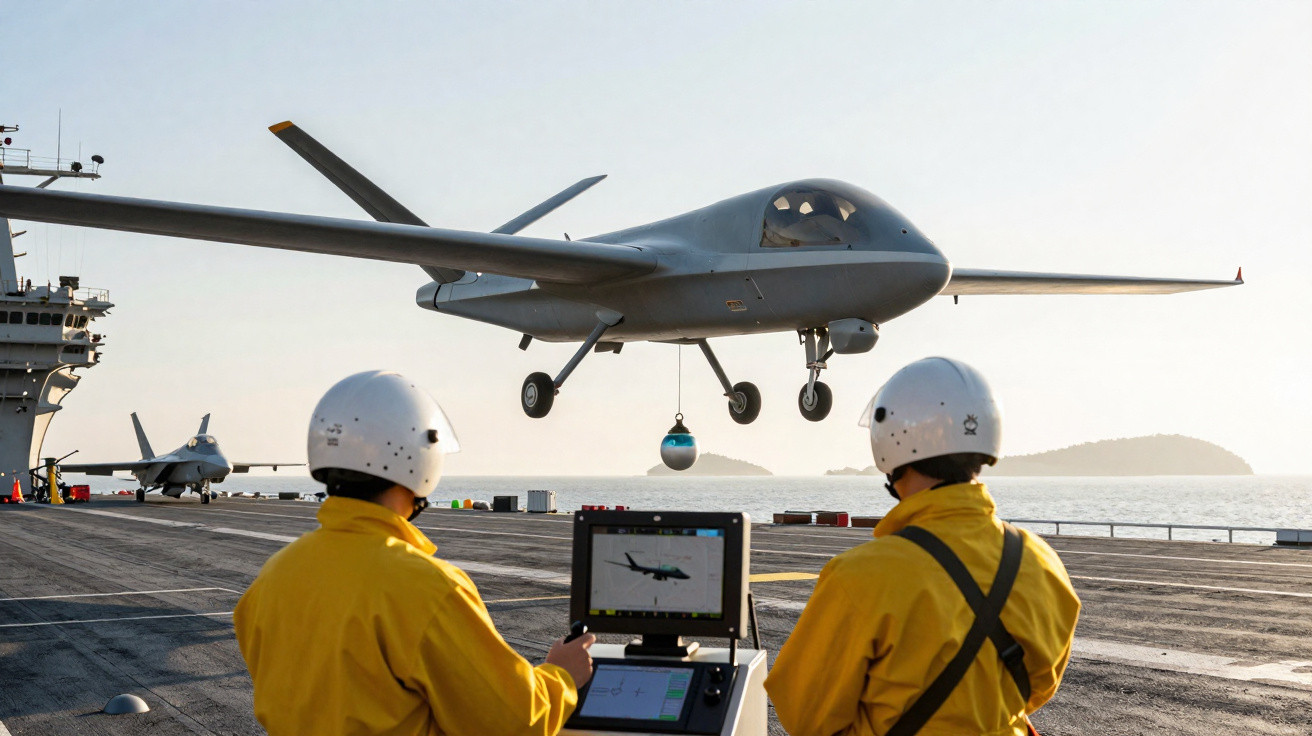
The US Navy’s new MQ-25A Stingray refuelling drone has completed its first successful flight, marking a historic milestone in the development of uncrewed capabilities for aircraft-carrier operations. Following a series of delays during 2025, the joint test involving the naval service and Boeing confirmed critical control systems, bringing the programme closer to its eventual integration into the US fleet’s carrier air wing.
MQ-25A Stingray completes its first flight
The flight test lasted approximately two hours, during which the MQ-25A Stingray autonomously carried out essential taxiing, take-off, navigation and landing manoeuvres. These activities were directed by the MD-5 Unmanned Carrier Aviation Mission Control System (UMCS MD-5), operated from a ground control station (GCS) at MidAmerica St. Louis Airport in Mascoutah, Illinois.
Throughout the mission, Boeing operators and US Navy air vehicle pilots monitored the aircraft’s performance in real time and issued commands to the system. Once airborne, the drone followed a pre-planned mission profile, validating the safety of its navigation systems and its reliable integration with the ground-control infrastructure, while confirming stable communications between the platform and its operators.
Dan Gillian, Boeing Air Dominance vice-president and general manager, underlined the significance of the event for the project’s technological maturity. According to the executive, “today’s successful flight builds on years of learning from our MQ-25A T1 prototype and represents a significant maturation of the programme, as the most complex autonomous system ever developed for the aircraft-carrier environment”.
Rear Admiral Tony Rossi, head of the Programme Executive Office for Unmanned Aviation and Strike Weapons (PEO U&W), likewise stressed the new system’s strategic importance for naval power projection. Rossi stated that “this test demonstrates progress in delivering a refuelling capability that will substantially extend the fleet’s range and operational capacity, representing a critical step for the future of the carrier air wing”.
Extending the carrier air wing’s operational reach
The MQ-25A Stingray was designed to serve as a central element in cooperation between crewed and uncrewed systems at sea. By taking on the aerial refuelling role, the drone will extend the operating radius of aircraft launched from the carrier and reduce the workload placed on F/A-18 Super Hornet fighters, which currently perform this mission, allowing them to focus exclusively on strike and combat operations.
It is worth noting that the programme’s original timetable was altered in 2025 because of challenges integrating certified software and outstanding engine testing. Additional factors, including the need for Lockheed Martin to complete command programming and labour issues at Boeing facilities, contributed to the first flight being postponed until early 2026.
With this phase complete, Boeing and the Navy will continue with further test flights in Illinois before moving the prototype to Naval Air Station Patuxent River (NAS Patuxent River) in Maryland. During the next stage, the technical and operational assessments required for final certification will be conducted, with the aim of fully deploying the Stingray on real missions aboard the fleet’s aircraft carriers.
















Comments
No comments yet. Be the first to comment!
Leave a Comment