The cable lies there like a tired strand of spaghetti: partly stretched out, its sheath already slightly split near the connector, its white finish dulled to a dirty grey. Beside it sits your smartphone, silently begging for help at 9 per cent battery, as it does every evening. Without thinking, you coil up the charging cable tightly so it will fit in your bag. Pull, twist, one small knot - done. Yet there is always that faint thought at the back of your mind: “Is this actually a good idea?”
We have all experienced the moment when that very cable gives up after a few months. It no longer charges, the connection cuts in and out, and the frustration is real. All because of a few centimetres of plastic and copper.
The quiet reality is that your cable does not fail all at once. It is gradually bent, squeezed and abused. Very often, the damage begins with winding it too tightly.
Why tight coils quietly damage your cable
Look closely and you can usually spot the problem in the familiar place: right next to the connector, where the cable bends slightly. There may be a small kink, a section that has lost its shape, or sometimes even a hint of the wires inside. Most of us simply shrug and keep winding it tightly around our hand, rubber against rubber, until we have a neat bundle of cable.
In day-to-day life, that seems practical. Your bag stays tidy, there are no knots in your rucksack, and everything remains compact. The catch is that every time you roll a cable up so tightly, invisible micro-cracks can form inside it. Eventually - usually at the worst possible moment - it catches up with you.
Picture a train journey: you are standing on the commuter train in the morning, your battery is already at 18 per cent and your meeting is about to begin. You take your charging cable from your bag, neatly looped and held together with a hair tie. You plug it in - nothing. You wiggle the connector, turn the cable slightly and hold it at a particular angle. One per cent appears. Then nothing again.
Many manufacturers do not say it openly, but similar figures regularly circulate internally: a cable that is sharply bent or tightly coiled every day often lasts only half of its intended cycles. There is no scandal and no major outcry. It is simply gradual wear that goes unnoticed in daily life - until it is too late.
From a technical perspective, a charging cable is a rather delicate combination of fine copper cores, often arranged in several strands, thin insulation, and an outer covering made from plastic or textile. Winding it tightly forces those strands into a bend radius that they cannot tolerate indefinitely. Every tight loop places stress on the material.
That stress builds up repeatedly in the same areas, usually near the connector or wherever you bend the cable most often. First the connection becomes unreliable, then one wire breaks, followed by another. Your cable may then charge only slowly or intermittently - and you blame your phone. In fact, your cable has already given up internally while you are still doubting the percentage on the display.
How to coil your charging cable so it genuinely lasts longer
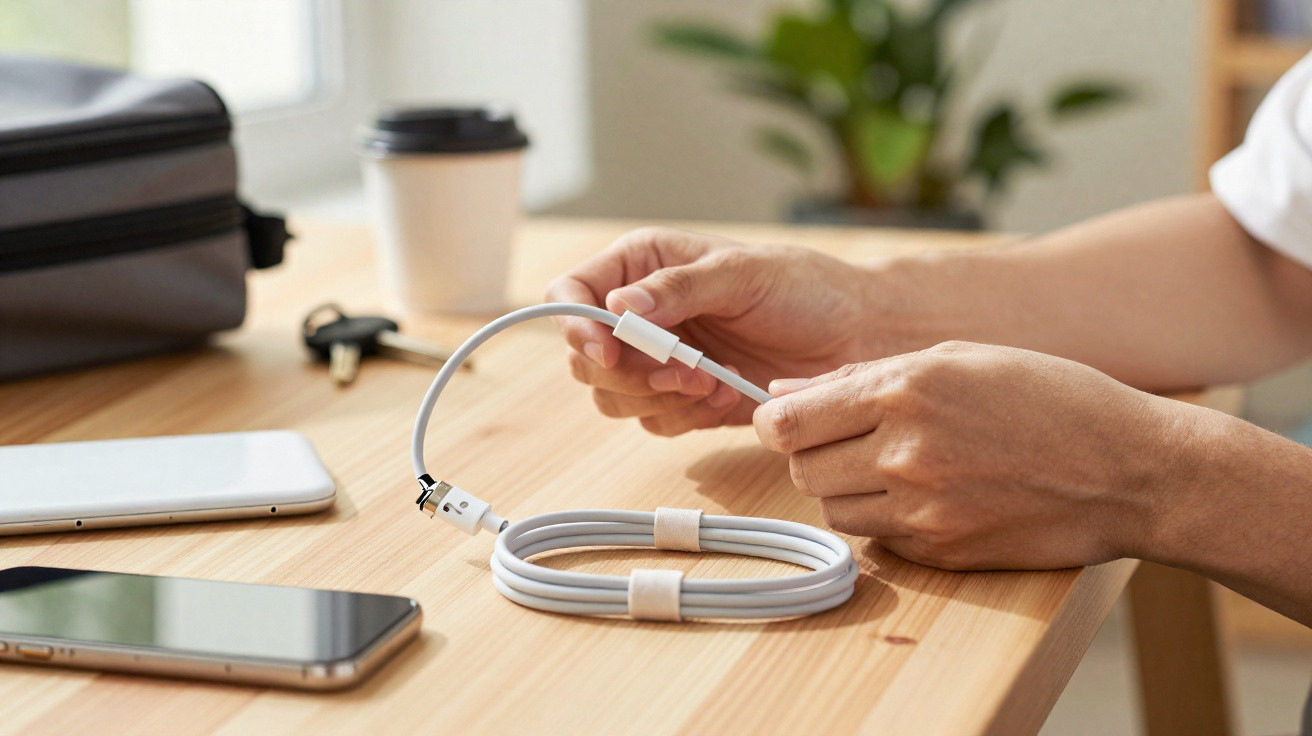
The answer is not to stop coiling your cable altogether, but to handle it more gently - as though you expect to keep using it for years. Rather than pulling it taut around your hand, arrange it in soft loops. No tension and no tugging; more like a rope laid out on a deck.
Event technicians use the so-called “Over-Under” method for this: one loop goes in one direction and the next in the opposite direction, preventing twists from building up. Your phone charging cable does not need to be coiled perfectly this way. Simply placing it in a loose, large circle about 10 to 15 centimetres in diameter is enough to stop the wires inside from being put under strain.
What many people underestimate is that the biggest cable killers are not dramatic drops, but small everyday habits. Pulling the cable rather than the connector. Trapping it in a drawer. Leaving it hanging permanently beneath a table leg. We do these things automatically, without giving them any thought.
Let us be honest: no one lovingly coils their charging cable every evening like a studio guitar cable. Nor do they need to. You only need to adopt two or three small new habits. Pull from the connector, not the cable. Do not create a permanent kink in the same spot. Avoid extremely tight coils simply to make it look “neat”. Small actions can make a major difference.
A seasoned technician from the live-events world once told me backstage:
“Cables do not die in use; they die in the bag.”
That line stayed with me because it sounds so matter-of-fact and true. If you want your charging cable to keep going for longer, a few simple daily reminders will help:
- Use a cable organiser or a small pouch instead of stuffing it in somewhere.
- Coil it only loosely enough that you can pull it apart again without effort.
- Avoid hair ties or tight cable ties directly against the outer sheath.
- Do not leave the cable permanently plugged in and hanging under tension.
- Replace cables with visible splits early, particularly close to the connector.
These tips may sound insignificant. Over a year, however, they can mean buying a cable twice instead of only once - and not suddenly being left in the dark with 3 per cent battery.
What your charging cable reveals about your everyday life
A charging cable is a quiet reflection of your routine: it shows whether your day has been frantic or careful. A twisted, kinked, half-shredded cable tells a story of last-minute meetings, standing train journeys and “Just need to charge quickly”. A well-kept, loosely coiled cable with a gentle curve suggests that someone has learnt not to treat their tech as disposable. That may sound grand, but it starts with something as ordinary as a USB-C connector.
When we stop wrapping our cable brutally tightly and give it a little room instead, we also subtly change our approach. Less stress, less “it will work somehow”, and more: I will take five extra seconds now - and avoid trouble for months.
| Key point | Detail | Benefit for the reader |
|---|---|---|
| Tight coils harm the internal components | Sharp bends create material stress and micro-cracks in the copper cores | Longer cable life and fewer unexpected failures |
| Loose coiling protects connector areas | Large loops and gentle curves relieve stress, especially at the connector transitions | More reliable charging, fewer loose connections and less frustration |
| Small habits make a big difference | Pull from the connector, use an organiser and avoid sharp kinks | Saves money, reduces electronic waste and brings a little more calm to everyday life |

















Comments
No comments yet. Be the first to comment!
Leave a Comment