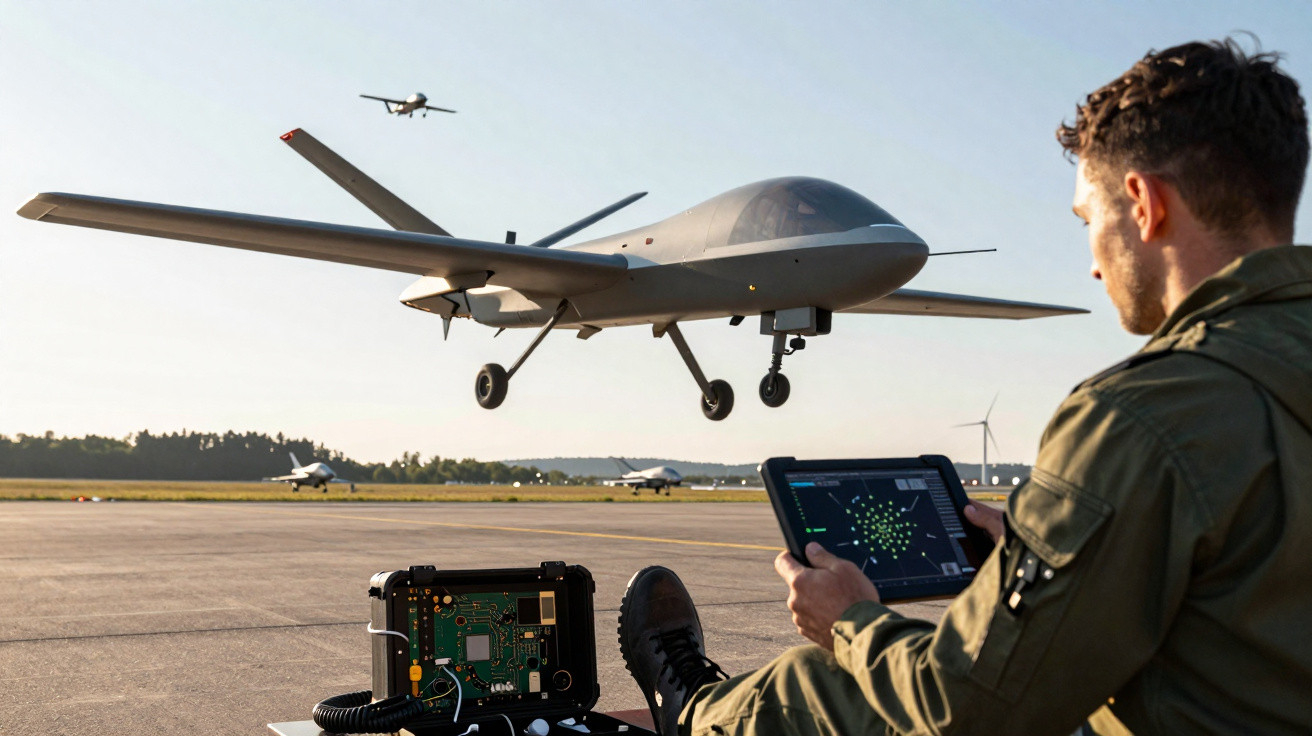
The unveiling points to a major change: rather than leaving the United States and China to shape the future of aerial warfare, Europe is at last bringing its own radical combat drone to the runway.
A European start-up enters the combat drone race
Founded in 2021, defence technology start-up Helsing has revealed its first autonomous combat drone, the CA‑1 “Europa”, in Germany. The aircraft has been conceived to fly beside crewed fighter jets or conduct operations independently, using onboard artificial intelligence to make real-time tactical choices.
Now valued at approximately €12 billion, the company has expanded at remarkable speed. Having started as a developer of military AI software, it has moved into hardware and recast itself as what its executives describe as a “combat drone factory”. Russia’s war in Ukraine hastened this transition, persuading European governments and investors that AI-led systems were no longer futuristic speculation, but an immediate necessity.
Europa is Europe’s bid to field a native, AI-enabled combat drone that can fight with humans, in a swarm, or completely alone.
With its V-tail configuration and focus on autonomous operation, the drone belongs to the same developing category as the “collaborative combat aircraft” under development in the United States. The crucial distinction is that Europa is, at least in principle, wholly European, from its industrial foundations to the export markets it is expected to serve.
An ambition that appeared almost from nowhere
Helsing’s ascent has been exceptionally swift for Europe’s traditionally slow-moving defence industry. Supported by investors including Swedish defence company Saab and Spotify chief executive Daniel Ek, it has used its software expertise as a route into manufacturing hardware.
Prior to Europa, Helsing developed algorithms for targeting, sensor fusion and battlefield awareness. It subsequently started making strike drones including the HF‑1 and HX‑2, with some reportedly supplied to Ukraine. These platforms are comparatively small, frequently based on locally sourced airframes and modified for use at the front line.
Europa operates on an entirely different level: it is a large, jet-powered combat drone intended for deep-strike missions, contested airspace and sophisticated coordination with crewed fighters.
A combat drone designed to operate in packs
The CA‑1 Europa is not merely an intelligence, surveillance and reconnaissance platform intended to watch events unfold. Helsing describes it as a complete combat asset. At the heart of its design is an embedded AI “brain” able to plot routes, allocate tasks among other drones and respond to threats without continuous human direction.
The idea matches what air forces term a “loyal wingman”: an unmanned aircraft flying alongside a fighter such as a Eurofighter Typhoon or Rafale, increasing its reach while supplying additional weapons, sensors or electronic warfare functions.
- One Europa could disrupt or deceive hostile radar.
- Another could serve as a sensor node, detecting and tracking targets.
- A third could carry weapons and carry out the strike itself.
The drones would be linked through encrypted connections, enabling swift coordination while removing the human pilot from direct danger. Commanders would define objectives and rules of engagement, with the drones managing detailed actions in fractions of a second.
The aim is not to remove humans from war, but to shift them from the cockpit to the command console, further away from enemy fire.
From mock-up to frontline: an ambitious timetable
Helsing selected an industrial facility in Tussenhausen, southern Germany, for the unveiling of a full-scale Europa mock-up. The choice of location was deliberate. Earlier in 2025, the start-up acquired Grob Aircraft, an established producer of light training aircraft operated by 14 air forces around the world.
The takeover provides Helsing with an established factory, supply chains and certification expertise. From this site, Europa is expected to progress from a concept to series production before the decade ends.
Planned milestones for the Europa programme
| Phase | Target date |
|---|---|
| Full-scale mock-up presentation | 2025 |
| First flight | 2027 |
| Advanced operational testing | 2028 |
| Initial military availability | 2029 |
Helsing has not confirmed a fixed per-unit price, although executives suggest Europa will cost far less than a modern crewed fighter, falling within the “tens of millions of euros” range. That pricing could permit air forces to procure drones in sufficient quantities to alter tactics rather than simply create a token capability.
A direct response to US drone programmes
Its timing is deliberate. The US Air Force has already chosen General Atomics and Anduril to develop the next generation of its collaborative combat drones. The programmes aim to produce expendable, or “attritable”, aircraft that can accompany the F‑35 and future fighters into contested airspace.
European initiatives have so far been slower and more disjointed. Airbus has outlined concepts for a Typhoon drone companion, while France and Germany are developing the Future Combat Air System (FCAS), yet most of these projects remain on paper or at an early research-and-development stage.
By showing hardware, a factory and a schedule, Helsing is sending a pointed signal to Europe’s traditional defence giants: agility beats endless studies.
A number of analysts regard Europa as an opportunity for Europe to avoid complete reliance on American unmanned systems. For governments concerned about export controls and political conditions, a domestically developed alternative, even one produced by a start-up, carries clear appeal.
Technology has yet to prove itself
For all the publicity, the most difficult work remains ahead. Moving from algorithms and small drones to a large, high-speed combat aircraft represents an enormous technical jump. Key obstacles include dependable aerodynamics, advanced materials, redundant flight-control systems and cybersecurity hardened against jamming and hacking.
Helsing has not previously delivered a platform of this scale. This is where Grob’s experience becomes important: its propeller-driven aircraft have accumulated millions of flying hours in training service. Combining this knowledge with Helsing’s AI stack is the central wager behind the Europa programme.
On the software front, Europa will need to comply with NATO interoperability and safety requirements. Armed forces will seek firm assurances that the AI follows established restrictions, particularly concerning weapons use and target selection.
Uncertain orders and questions over capacity
At present, Helsing’s order book generates as many uncertainties as it resolves. The business says it has supplied roughly 2,000 HF‑1 drones to Ukraine from an order for 4,000 units, using locally sourced hardware. Independent evidence of their impact on the battlefield remains limited, in part because of operational secrecy.
Helsing has also referred to an internal target to produce 6,000 HX‑2 drones, but has not disclosed confirmed delivery timelines or customer lists. This shortage of transparency has prompted doubts over the speed at which it can genuinely expand manufacturing.
No government has publicly signed a Europa contract at this point. Industry sources say that at least two European countries are discussing early acquisition positions, probably linked to testing and evaluation campaigns towards the end of the decade.
Without early anchor customers, Europa risks becoming a technological demonstrator rather than a backbone of European air power.
A high-risk wager for Europe’s defence industry
By advancing Europa, Helsing is accepting political as well as technical risk. Established defence primes may regard the start-up as an interloper, while governments are still cautious about relying on such a young company for an asset of this strategic importance.
However, the pressure created by the war in Ukraine, alongside the rapid growth of US and Chinese drone fleets, leaves little scope for delay. European air forces must contend with ageing fighter fleets, constrained budgets and rapidly rising prices for next-generation jets. A lower-cost unmanned companion aircraft is increasingly viewed as a means of extending available capabilities.
Should Europa perform as promised, Helsing could become Europe’s equivalent of General Atomics, manufacturer of the US Predator and Reaper. If the project falters, it may nevertheless encourage established companies to speed up their own autonomous drone programmes.
Key concepts and real-world scenarios
What “autonomous” actually means here
Autonomy in military drones exists on a range of levels. Europa is expected to function under what specialists call “human on the loop” control. Under this model, a human operator establishes mission aims and limits, and keeps the power to authorise or halt lethal actions, while the drone handles flight routes, threat avoidance and routine choices.
Fully “human out of the loop” operations, in which a system could independently choose and engage targets, remain a political red line for most European countries. Consequently, discussion of explicit rules of engagement and technical safeguards will determine the extent to which Europa’s AI may operate.
What a future mission could look like
During a hypothetical Baltic operation in the early 2030s, two crewed fighters could launch alongside four Europa drones. Two would operate ahead as a sensor barrier, charting hostile radar and air-defence systems. One would carry electronic warfare pods intended to blind or confuse enemy tracking systems. The remaining drone would transport precision-guided munitions.
As human pilots concentrate on wider mission goals and political limitations, the drones would continually determine among themselves which platform is best positioned to jam, observe or strike. If one drone suffered damage, the remainder would adjust their routes and duties, behaviour that depends heavily on resilient AI coordination.
Risks, benefits and the next arms race
Platforms such as Europa offer several potential benefits: reduced danger for pilots, a lower airframe cost than crewed fighters, and the capacity to overwhelm enemy defences with multiple unmanned targets. They also create new fears about escalation, as less expensive platforms may make high-intensity operations more politically acceptable.
Cybersecurity is another consideration. Any combat drone heavily reliant on data links and AI presents an attractive target for electronic warfare and hacking. Breached algorithms or disrupted communications could turn an advantage into a weakness, particularly in dense electronic environments.
For the moment, Europa stands at the meeting point of these possibilities and dangers. It is both an effort by Europe to catch up technologically and an indication that the next major contest in air power will be decided not only by the fastest jet, but also by the most intelligent swarm of machines operating beside it.
















Comments
No comments yet. Be the first to comment!
Leave a Comment