
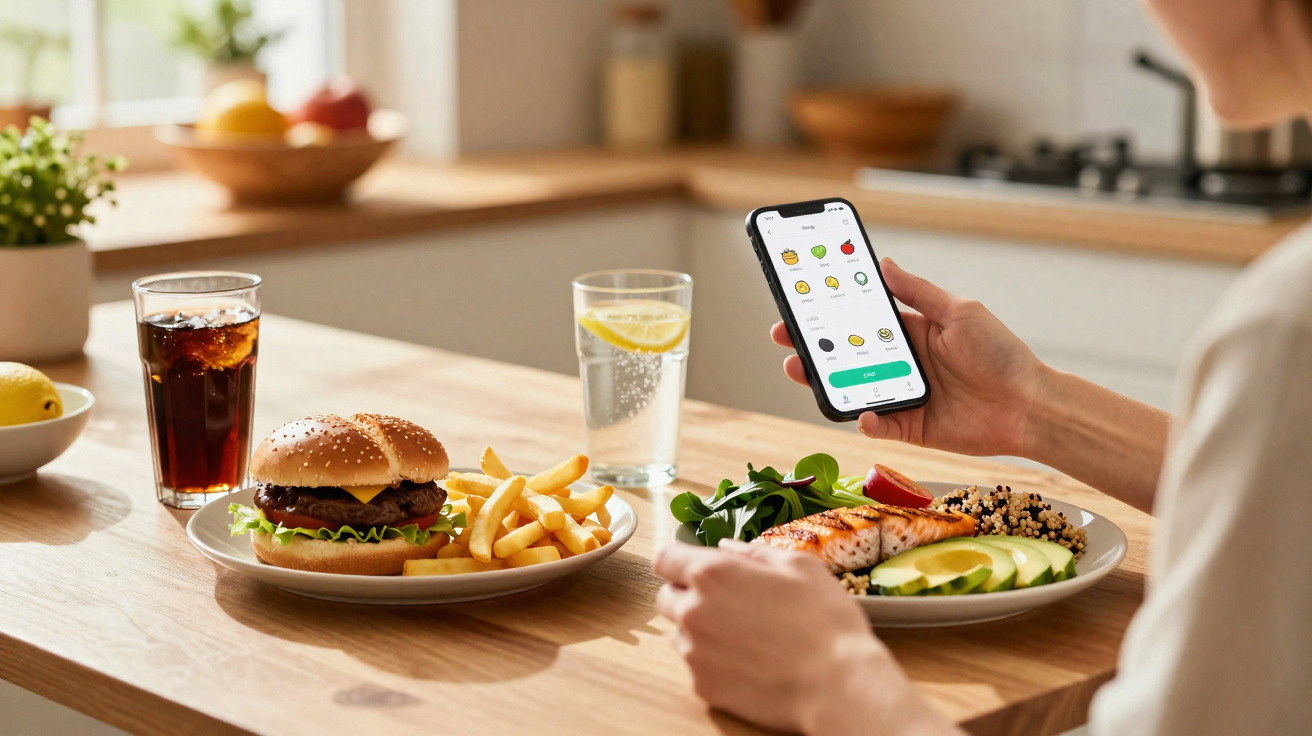
Nutrition apps have been prescribing what people should eat for a long time. Typically, they design an “ideal” plate from the ground up-hitting nutrient targets and cutting ultra-processed foods to a minimum.
In practice, that often describes the dinner someone ought to have, not the one they realistically prepare.
That mismatch helps explain why many of these tools fail to gain real momentum. A new study took another route: begin with the meals people already eat, then identify the smallest tweak that still produces a meaningful improvement.
The advice gap
The stakes are well established. One large-scale analysis spanning nearly 200 countries showed that unhealthy diets sit among the biggest drivers of diabetes, heart disease and other long-term conditions.
Turning that knowledge into action at the evening meal, however, is much harder.
Trevor Chan and Ilias Tagkopoulos, computer scientists at the University of California, Davis (UC Davis), thought the central barrier might be the scale of change being demanded.
Many diet apps effectively require a complete reset-and that full overhaul is often where people give up.
So the researchers set out with a deliberately modest aim.
Instead of drafting a perfect plate from scratch, they started with familiar foods and tried to steer them towards healthier eating using as few changes as possible.
Learning from meals
To understand what Americans actually eat day to day, the team drew on a long-running US federal survey, What We Eat in America.
Across the dataset were more than 135,000 meals reported by over 55,000 adults.
After sifting through the records, the model clustered meals into 34 common meal patterns-for example, a cereal-and-milk breakfast, a delicatessen-style sandwich lunch, and a pizza-based dinner.
A generative AI system then learned how to create new meals that still fit each pattern.
It was designed to do two things at once: select foods that sensibly go together, and then adjust portion sizes so each meal moved closer to US federal nutrition guidelines while still looking like something a person might genuinely choose.
Closer to healthy targets
When the researchers compared their generated meals with real meals from the same pattern, the AI-built versions were nutritionally stronger. On average, they narrowed the distance to federal nutrition targets by about 47 percent.
These weren’t just theoretical improvements. In the generated meals, fibre, protein and potassium rose, and gaps in vitamin intake were reduced, while the meals kept broadly similar flavours and overall appearance to the originals.
There was one clear downside: sodium increased in some lunches and dinners-an obvious sign that improving one part of a meal does not automatically fix every nutrient at the same time.
A few simple swaps
Previous tools could assemble a healthy day’s eating from the ground up. What they hadn’t done as well was pinpoint the smallest adjustment to a meal someone already eats-just a couple of carefully chosen substitutions.
The researchers tested meal edits involving one, two, or three item changes. The most frequent strategies were straightforward: add vegetables or legumes, and remove the saltiest or most heavily processed components.
As expected, more effort delivered bigger gains. With only one swap, meal quality improved by around 5% and the modelled cost fell by roughly a fifth.
With three swaps permitted, meals ended up about 10% healthier while costing nearly a third less.
Importantly, the revised meals remained recognisable. A swap could mean replacing a richer side with beans or adding extra leafy greens.
The point isn’t to reinvent what’s on the table-it’s to produce a lighter version of the same meal.
Better than chatbot guidance
Any AI-driven food tool faces an obvious question: why not simply ask a chatbot?
The team tested that directly, comparing their purpose-built model with GPT-4o, described as the most capable general chatbot available at the time.
On the measures that mattered, the specialist model performed better. It hit US federal targets for protein, fat and carbohydrate balance much more reliably.
By contrast, the chatbot often veered towards meals that were higher in fat and lower in carbohydrates. That weakness aligns with broader evidence.
A recent review of chatbots providing dietary advice found that their recommendations can be inconsistent and sometimes incorrect, implying that embedding nutrition rules within the model itself may outperform free-form conversation.
Limitations of the study
A key caveat is that the findings exist entirely within a computer model.
No one has cooked these proposed meals, eaten them, or assessed whether the suggested swaps are workable and sustainable in everyday life.
The underlying data also carry known biases. Diets were self-reported, and people commonly understate less healthy foods while exaggerating healthier choices.
Likewise, the projected savings come from modelled menus rather than real supermarket receipts.
The authors are careful not to overclaim. They point to a straightforward message that emerges across the results.
“Healthier eating does not have to mean giving up the meals people already enjoy,” the researchers noted.
What could change
The novel element here is the size of the intervention. A meal doesn’t have to be redesigned.
Even one or two smart substitutions can shift it closer to the guidelines while lowering the overall cost.
The practical implications are easy to imagine. A supermarket app could recommend a single swap at the till rather than pushing an entirely new diet, and a public health initiative could promote cheaper, healthier versions of meals people already cook.
In time, the same approach could be built into the tools dietitians use, offering suggestions a patient is more likely to stick with.
The wider takeaway is simple: improving diet may depend less on willpower and more on making the right small change.






Comments
No comments yet. Be the first to comment!
Leave a Comment