
Football and my first World Cup (1982)
My earliest World Cup memories go back to 1982. We only had two television channels, and the matches I managed to catch now and then still reached me in black and white. I can still picture the Soviet Union with Dasaev, England with Peter Shilton, Italy with Paolo Rossi, Spain with Camacho-and above all that mesmerising Brazilian side featuring Zico, Sócrates, Cerezo, Falcão and so many other footballing magicians.
Not long afterwards, thanks to my cousin Luís, I started playing with bottle tops, staging our own World Cup. We recreated every national team-well, he did, really. With a patience that felt almost ritualistic, he cut each team’s shirts out of glossy paper. The numbers came from wall calendars. Each bottle top stopped being just a bottle top and became a player.
Somewhere in that game, without realising it, I learnt that football was never only football. It was play, imagination, rivalry and theatre. It was the final score, but it was also the story that led to it. It was colour, even when the television still wasn’t.
Why football is never just a rational pastime
Children make up games as a way of practising how to master the world. Adults, it seems to me, fall for football so they don’t forget they will never master it completely. That is how football came into my life: not as a rational discipline, but as a training ground for emotion, belonging and fantasy.
Perhaps that is why I still find it odd how grown, capable and usually sensible people shout at a television, argue over decisions they cannot influence, and ache over defeats that, strictly speaking, do not belong to them-something that happens to me as well, at times.
Some people see that as mere childishness, or even as a hint of barbarism. I also see it as a socially permitted form of catharsis.
Control, data and the limits of passion in football
We live in a period obsessed with control. We count steps, track hours of sleep, measure productivity, calories, performance, risk and probability. Before deciding, we hunt for data; before trusting, we demand metrics; before acting, we ask for forecasts. We map almost everything, as if life could be reduced to a set of variables measured well enough.
And then we sit down in front of a match whose greatest appeal depends precisely on our inability to control almost anything. Football may be the only activity where we pay to watch our predictions collapse. Which, for me, is hard to take…
We declare one team the favourite; we say the other lacks the tools; we claim history carries weight; we insist the statistics point one way. Then a deflection, a penalty, a shot off the post, an inspired goalkeeper or a sending-off is enough to flip the entire script.
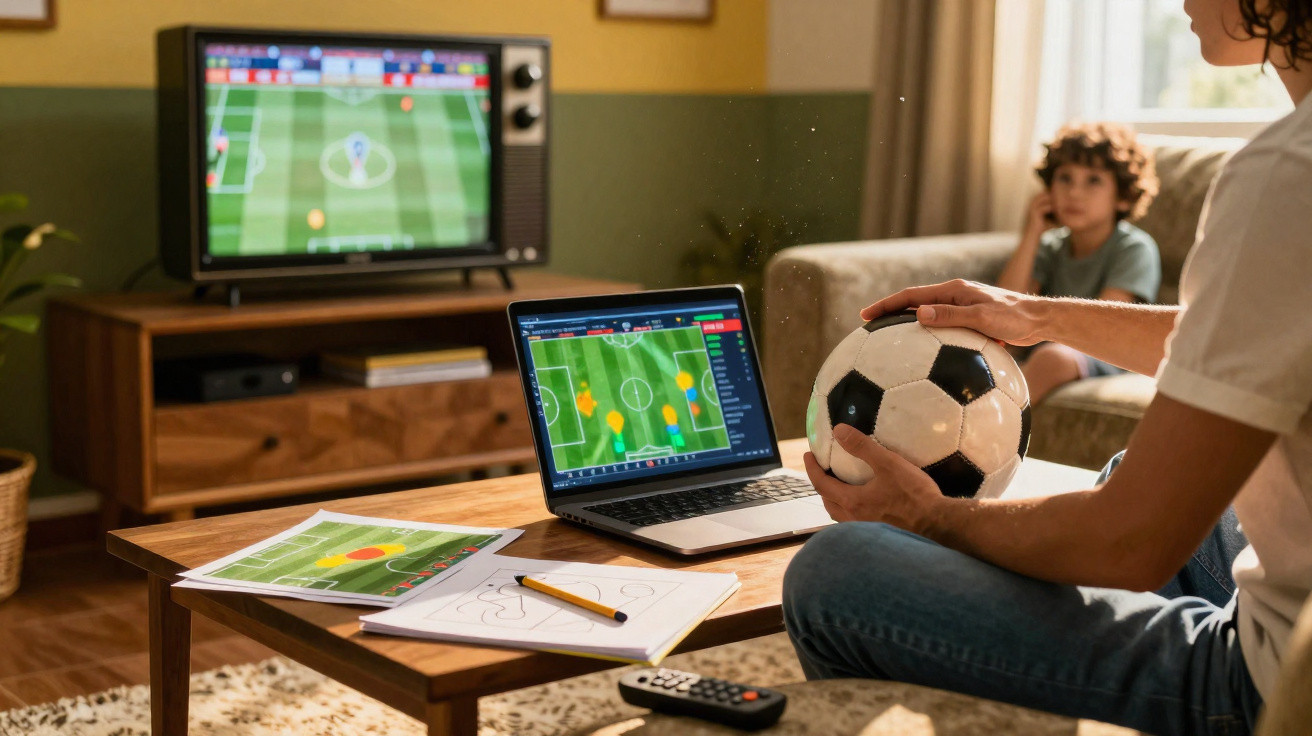
That may be why football is theorised about so heavily today. There have never been so many data points, so many metrics, so many models, and so much specialist vocabulary. We talk about high pressing, mid-blocks, expected goals, space occupation, controlling depth, attacking mechanisms, interior dynamics, or off-the-ball behaviour.
Yet there is a curious illusion at work too: the belief that, by discussing football the way an engineer describes a bridge, we will finally tame chance. Analysis can sharpen understanding, but it does not remove uncertainty. And that is a good thing. If the favourite always won, football would lose part of its beauty. If every model got it right, the spectacle would be stripped of one of its essential raw materials: surprise.
For that reason, the issue was never feeling football intensely. The issue is forgetting that intensity does not cancel responsibility.
There is a difference between yelling for a goal and humiliating the player who misses. Between disagreeing with a referee and denying their humanity. Between criticising a tactical choice and turning a player, a manager or an opposing supporter into an enemy. Football makes room for emotional irrationality; it should not make room for dehumanisation.
That is why demanding total cool-headedness from supporters misses the point. Nobody buys a ticket, pulls on a shirt or meets friends to watch a live statistical analysis. People go to football to feel, to hope, to fear and to believe against the evidence. But that emotional licence has limits.
Football loses some of its greatness when passion turns into cruelty-when criticism stops evaluating performances and starts attacking people; when the spectacle stops being a shared experience and becomes a pretext for releasing resentment.
A supporter does not need to be neutral, measured in everything, or perfectly rational. But they can be intense without being brutal. They can suffer without hurling insults. They can celebrate without humiliating. They can lose their head for ninety minutes without losing sight of the fact that, in the end, there are still people there.
Because football without emotion would be nothing more than exercise. And football where everything could be predicted would be nothing more than a technical demonstration. We keep coming back because, despite all the theories, statistics and models, there are still ninety minutes that can remind us the world remains larger than our need to control it.





Comments
No comments yet. Be the first to comment!
Leave a Comment