
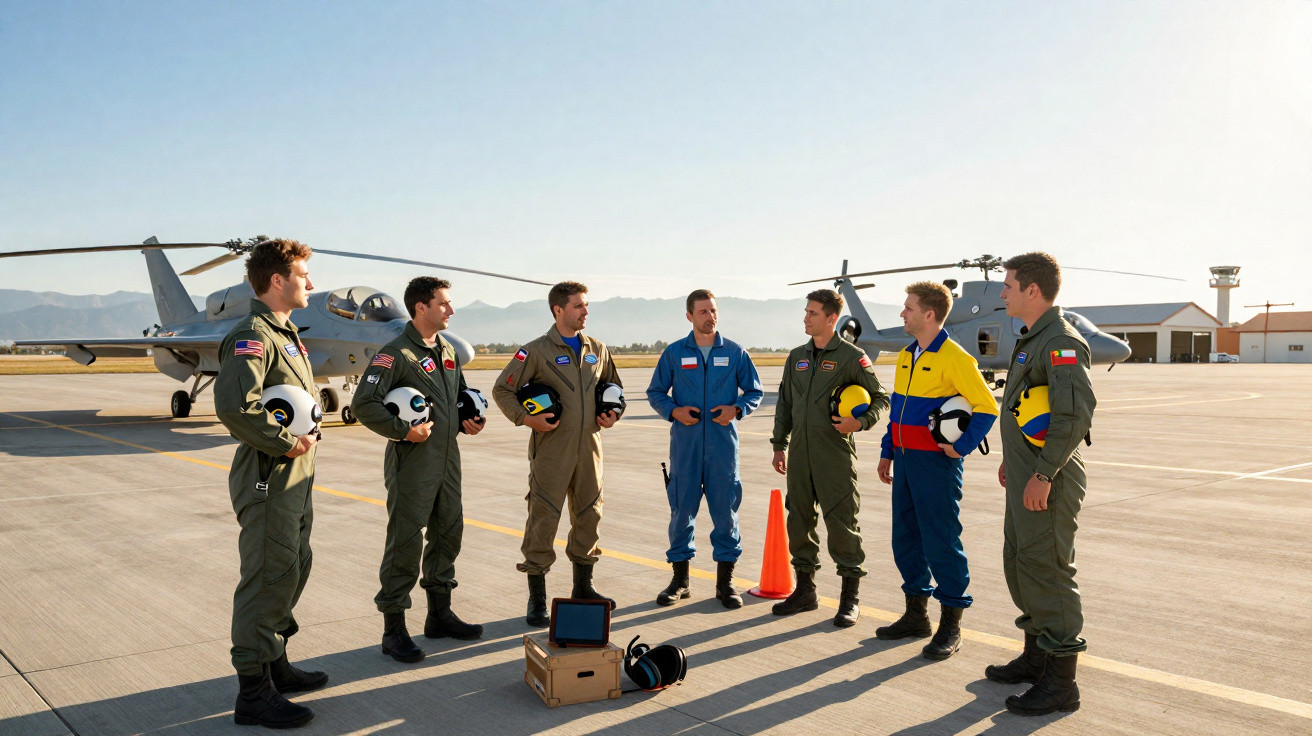
With only days to go until one of South America’s most significant exercises begins, the outline deployment of the fighter aircraft, helicopters and drones set to take part in Multinational Exercise Salitre 2026 is now taking shape. From 29 June to 10 July, the Antofagasta Region will host an environment in which several of the continent’s leading air forces will test interoperability and combined-response capacity in a demanding, multi-domain setting.
Run under NATO standards, the operations aim to strengthen cooperation among the participating nations through complex missions designed to synchronise action across the land, maritime, air, space and cyber domains. To achieve this, aircrews will form a multinational coalition tasked with ensuring the passage of humanitarian assistance and restoring peace in a fictional scenario involving inter-state conflict. The exercise will also feature simulations covering strikes, escorts, suppression of enemy air defences, close air support, cyber-attacks and rescue operations. Below is an overview of the principal systems that will form part of the exercise:
Chilean Air Force
The host nation’s air component will be led by F-16 Fighting Falcon and F-5 Tigre III fighters, the Chilean Air Force’s main combat assets. They will be joined by C-130 Hércules tactical transport aircraft, MH-60M Black Hawk helicopters, A-29 Super Tucano light attack aircraft and KC-135 Stratotanker aerial refuelling aircraft-together creating a force able to conduct air superiority, transport, rescue and tactical support missions. Although there have been reports of a possible appearance by E-3 Sentry airborne early warning aircraft, Chilean authorities have not officially confirmed their participation.
Chile’s F-16s and F-5s will make up the backbone of the national combat element, supported by airlift, air-to-air refuelling and tactically employed helicopters.
Brazilian Air Force
Brazil will deliver one of Salitre 2026’s standout milestones with the deployment of its F-39 Gripen fighters, which will undertake their first international operation outside Brazilian territory. The presence of these new-generation aircraft is among the exercise’s biggest draws and marks a meaningful step in the Brazilian Air Force’s regional projection.
United States Air Force
The United States will contribute a mix of air-combat capability, special operations and aerospace surveillance through the deployment of F-16 aircraft, U-28 Draco aircraft and MQ-9 Reaper drones. The Reaper detachment is, so far, the only confirmed participation by unmanned aerial systems within Salitre 2026.
Argentine Air Force
The Argentine Air Force will take part with IA-63 Pampa advanced trainers and C-130 Hércules tactical transport aircraft, reaffirming its presence in one of South America’s most important combined exercises and providing experience in both air operations and logistics support tasks.
Colombian Aerospace Force
Colombia will field one of the exercise’s most varied contingents, made up of A-29 Super Tucano aircraft, UH-60 Black Hawk helicopters and AH-60L Arpía IV attack helicopters. This mix of platforms will allow it to contribute to close air support, tactical mobility and force protection missions.
Paraguayan Air Force
Paraguay’s participation will consist of A-29 Super Tucano aircraft on their first international deployment, strengthening the exercise’s light-attack component.
Beyond the air element, Salitre 2026 will also bring together Chilean and foreign special forces to carry out rescue tasks, non-combatant evacuation and protection of the multinational force. This renewed humanitarian and multi-domain focus highlights how the exercise has evolved from earlier editions, reinforcing its status as one of the continent’s leading combined training events.






Comments
No comments yet. Be the first to comment!
Leave a Comment