
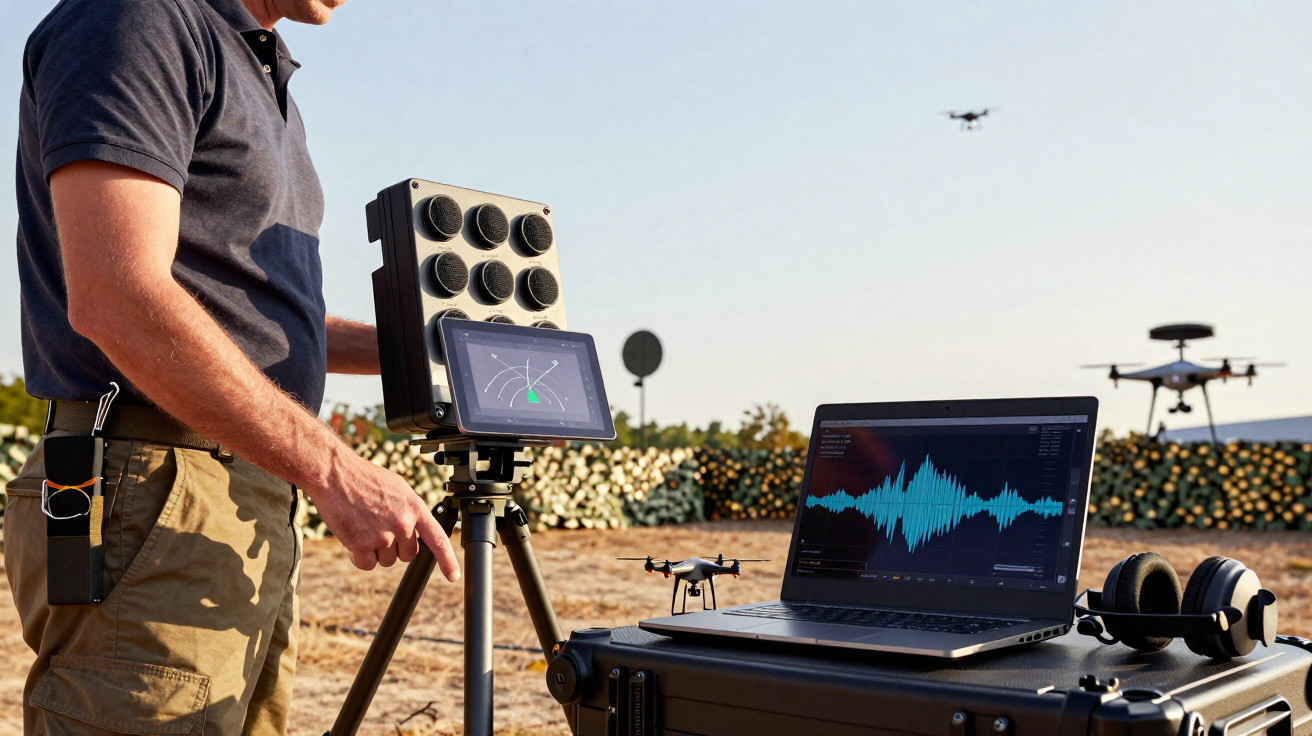
The rapid spread of drones across today’s battlefields is accelerating work on fresh ways to detect and defeat these systems. Against that backdrop, the Israeli firm NETLINE Communications Technologies used its presence at Eurosatory 2026 to showcase its Counter-UAS line-up, placing particular emphasis on SonicScan-a passive acoustic detection solution built to spot drones even in challenging surroundings.
Speaking with Zona Militar, NETLINE representatives said SonicScan was developed to address shortcomings seen in conventional radar-based detection, especially when facing small drones with a limited radar signature, or when operating in situations where electromagnetic transmissions could give away the position of friendly forces.
Passive acoustic detection with NETLINE SonicScan
“We call it an acoustic radar because it provides us with the direction of the threat without emitting any signal,” a NETLINE representative explained. Rather than broadcasting electromagnetic energy like traditional radar, the system relies on a set of acoustic sensors and artificial intelligence–based algorithms to recognise and categorise airborne threats by analysing their sound signature.
NETLINE stated that SonicScan uses an array of 128 microphones designed to capture the acoustic characteristics associated with different unmanned aircraft. The collected data is then processed by AI algorithms to separate drone noise from other ambient sounds, while also indicating the direction from which the drone is approaching.
The company stressed that the key benefit is the system’s passive operation. “Radar has its own limitations. It is an active system and, in combat, if it transmits, the enemy can locate you. With an acoustic sensor you are completely passive,” they said.
NETLINE argued that this advantage is becoming more important as conflicts shift towards environments packed with sensors and electronic surveillance. In that context, they noted rising interest in capabilities that preserve situational awareness without exposing friendly positions through electromagnetic emissions.
Designed to face the threats observed in Ukraine
During the briefing, NETLINE highlighted SonicScan’s ability to detect threats that have become prominent in the war in Ukraine-particularly FPV drones used for reconnaissance and strike missions. The company said the system can identify small FPV drones at ranges beyond 1 kilometre, offering valuable warning time to implement defensive actions. “We detect small FPV drones at more than one kilometer of distance,” the representative emphasised.
NETLINE also said SonicScan performs well against fibre-optic guided drones, which have attracted attention in recent years because they are not affected by traditional electronic jamming. As described by the company, these drones can produce an even clearer acoustic signature due to the extra weight of the fibre-optic spool. “Fiber-optic guided drones we detect at an even greater distance because they must also carry the cable and their engines work more,” they noted.
According to NETLINE, these features make SonicScan a strong complement to other surveillance assets, adding another detection layer for threats that can be difficult to pick up with standard sensors.
An integrated anti-drone defense architecture
In addition to SonicScan, NETLINE presented other Eurosatory offerings aimed at building an integral architecture of anti-drone defense. Notable systems included the Duo-Guard Manpack and Duo-Guard Vehicular solutions for neutralising threats through electronic warfare, alongside the portable C-Block Micro and the GeoDome command-and-control platform.
NETLINE explained that the direction of travel in the market is towards bringing sensors, effectors, and electromagnetic spectrum management into a single operational framework. “Everything is being combined into a single system. The aim is to integrate detection, protection, situational awareness and connectivity,” they said. This approach reflects a more complex operating environment, where countering drones increasingly demands early detection, identification, tracking, and neutralisation within very short timelines.
Within this setting, NETLINE expects passive technologies to keep gaining ground in the Counter-UAS sector. “There is growing interest in passive systems,” company representatives concluded, pointing to a trend shaped both by lessons from recent conflicts and by the need to operate in heavily contested electromagnetic environments.






Comments
No comments yet. Be the first to comment!
Leave a Comment