
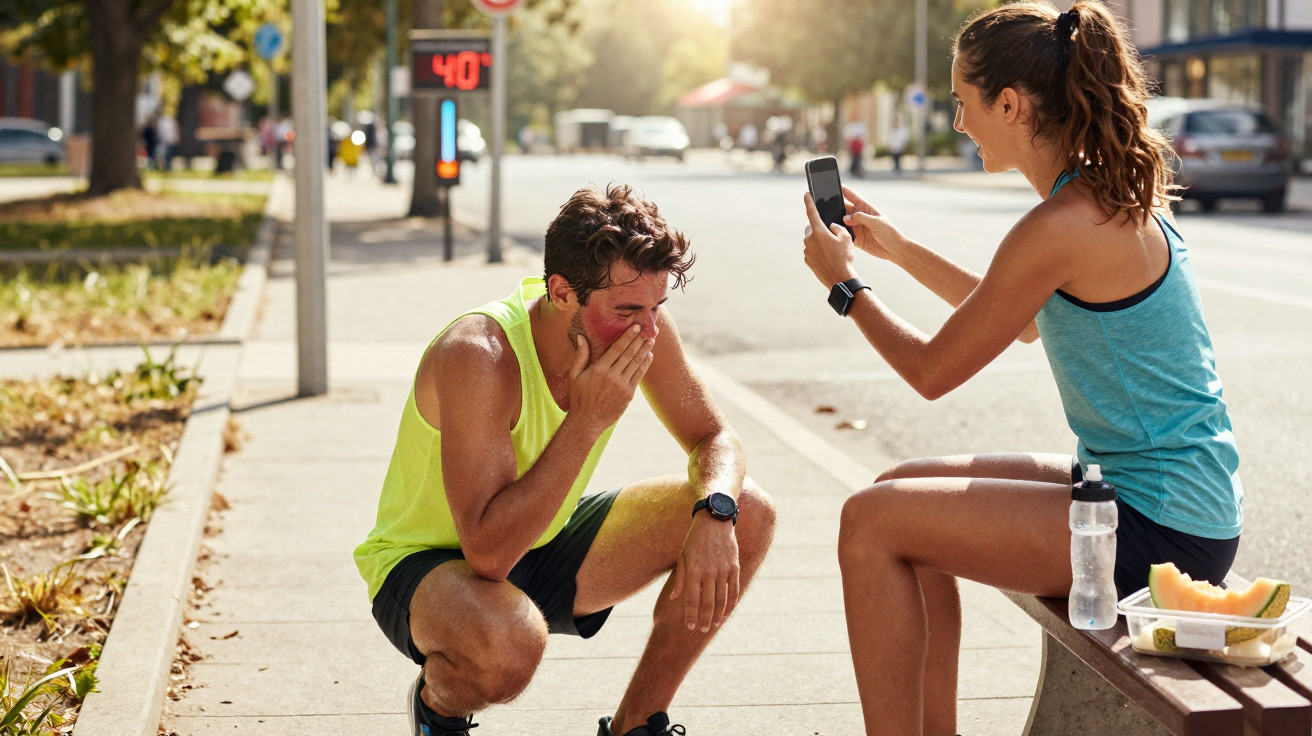
On Instagram, TikTok and YouTube, most running accounts are riding the heatwave for clicks, churning out tips for running in extreme heat. At the same time, people are dying while out running.
Thursday 18 June 2026, 11:00. Witnesses find a 30-year-old man unconscious on the athletics track at the Raoul-Dautry stadium in Ermont, Val-d’Oise. Six people begin CPR. A doctor and a nurse from the neighbouring clinic join them. The SMUR team arrives and confirms the death.
In recent weeks, reports of athletes losing their lives because of their sport have become more frequent. At the end of May, during the first heatwave spell of the year, a man in his fifties died during a 10 km race in Paris’s 20th arrondissement. In Chassieu (Rhône), a 28-year-old woman died from exertional hyperthermia. In Maisons-Alfort, sixteen runners were admitted to hospital as absolute emergencies.
“Practising sport in extreme heat requires absolute vigilance,” the Minister for Sport responded at the time. That was at the end of May.
Today, 49 départements are under a red heatwave warning. Météo-France refers to an “exceptional heatwave episode on a national scale, with a level of severity that could approach that of August 2003”. Back then, the government counted 15,000 deaths in France over three weeks.
Heatwaves as a content factory
On social media, there is little public grief for the lives lost. For influencers, the heatwave is mainly a trend. Unsurprisingly, running accounts (like other niches) have seized the moment to produce content aligned with the news.
It is not really fair to blame them for posting: a running influencer exists by publishing regularly about running. Their audience is built on that frequency, and the algorithm rewards it.
Nor is this impulse unique to influencers; news outlets rush in too. The difference is that informing the public is not something you improvise. Journalism is a profession learned (in training and on the job) and governed by rules-checking information, for instance, or bringing in specialists for specific topics.
Influencers are not held to the same ethical standards, which can open the door to excesses. During a heatwave, that means not all influencer advice carries the same weight.
The problem is simple: algorithms reward what triggers emotion, not what is factually precise. As a result, running-influencer posts offering “tips for running during a heatwave” are everywhere-even though scientists, official bodies and doctors all insist that, at the peak, sport should be avoided as much as possible.
What are running influencers saying?
Subscribe to Presse-citron
Safe Pace is an endurance-sports podcast presented by Hugo Clément, a journalist on France 5. He has 2 million followers on his main Instagram account and 108,000 on @safepacemedia. That level of visibility demands particular care when dealing with sensitive public-interest issues.
Even so, Safe Pace released an episode built around this central question: “Episodes of extreme heat are becoming more frequent. But is heat necessarily synonymous with underperformance? And can it ultimately become a tool for improving?”.
The programme discusses the topic with a scientist and a trail runner. For regular runners, the podcast content is fairly useful. Above all, it is framed around heat rather than a heatwave-a crucial distinction, because in the first case you can run if you adapt, whereas in the second this activity is off-limits.
Unfortunately, the podcast release and the heat-focused clips landed right in the middle of the heatwave episode. The boundary between “heat” and “heatwave” is also often unclear, which can lead the general public to the wrong takeaway. The title “Heat: the ultimate method to improve?” can itself be misleading.
View this post on Instagram
To illustrate the confusion: on 19 June 2026, as départements moved into an amber warning (before a red alert three days later), PurePeople published an article titled “Heatwave: it is possible to keep running”, relying on data from @safepacemedia and citing an Instagram post from the account. The data are accurate in themselves, but they still fail to separate extreme heat from a heatwave.
View this post on Instagram
Meanwhile, U-Trail, France’s leading trail-running reference site, published-during the red warning-a guide to the “best gadgets for running in very high heat”. RunMotion, Dans la Tête d’un Coureur, i-Run… all of them put out some form of “how to run during a heatwave” guide in the days before or after the red warning was announced.
All of this content starts from the assumption that the right question is “how do you run despite the heat?”, rather than “should you run at all?”. And that assumption is exactly where the problem lies.
What do the public health authorities say?
It is unusual enough to be worth noting: since heatwaves became a recurring phenomenon, the authorities have been consistent on this point-avoid sport during a heatwave.
Santé publique France recommends “limiting physical activity as much as possible, even when you are trained and in good health” and “prioritising gentle sporting activities”. The Ministry of Sport has formally urged event organisers, federations, clubs and supervisors to “show the greatest vigilance in order to guarantee the safety of participants”.
Because once temperatures go beyond 35–36°C, the surrounding air warms the body rather than cooling it. Any intense outdoor physical effort then becomes medically inadvisable. Under a red heatwave warning, all intense outdoor exertion should be avoided. As we write these lines, the thermometer reads 42°C. If you follow public health guidance, sport is therefore formally discouraged during a heatwave, at any time of day.
The only conditions under which sport is still possible during a heatwave
The general rule under a red warning is not to undertake physical exertion outdoors, whatever precautions you take.
The only workable way to keep running is therefore to do it on a treadmill in an air-conditioned gym, under certain conditions.
The Ministry of Sport and several prefectures explicitly mention “air-conditioned spaces” as a valid option. Those spaces need to meet several requirements:
- The venue must be genuinely air-conditioned (active air conditioning, ideally between 18 and 22°C); a fan is not enough.
- The intensity must remain moderate: yoga, Pilates, light strength work, an exercise bike, treadmill running at a moderate pace. So avoid HIIT and hybrid sessions (HYROX, CrossFit). Swimming is also encouraged, but still at a moderate intensity. In an outdoor pool, training is not recommended.
- Increase hydration before, during and after the session, even if you do not feel thirsty.
- Be careful on the way out: going from 20°C indoors to 42°C outside carries a risk of thermal shock. Choose shaded areas where possible.
What do doctors say?
Let’s assume, for the sake of argument, that the public health authorities are being overly cautious. They are not-given the deaths mentioned at the start of the article-but let’s accept the premise for this demonstration. What do doctors say?
Dr Jimmy Mohamed, a GP and health commentator on RTL and France 5, was unambiguous during a previous heatwave:
If you run when it’s 35 degrees outside, if you’re not used to prolonged effort, if you’re not used to being exposed to such intense heat, you’re simply risking heatstroke. Don’t go running when it’s very hot. All the more so because air quality is often degraded-there’s pollution, lots of allergens-and so you’ll feel unwell, and at worst end up in hospital with a massive heatstroke.
This month, he repeated his warnings, also reminding people that the human body needs one to two weeks to adapt to intense heat. It is therefore unable to cope with the sudden urgency of a heatwave episode.
Sports medicine backs this up: exertional heatstroke is an absolute medical emergency and can be fatal if not managed correctly. For some people, it can strike suddenly, with no warning signs.
Professor Pierre Asfar, an intensive care physician at CHU d’Angers, notes that heatstroke can occur from as low as 25°C when humidity is high and there is no wind. As we write these lines, the thermometer reads 42°C (yes, we’ve already said that?).
Melon: a summer fruit
View this post on Instagram
Of course, none of this expert guidance seems likely to reach our beloved running influencers, apparently forged from the same substance as Superman. As summer approaches, their heads seem to have turned into one of the seasonal fruits the French enjoy most: the melon.
To “do their bit” (though nobody asked), they claim that “if you’re trained, you can run if you adapt”. Then they present their own experience as proof. If they can run and still feel great, that must mean medical advice does not apply to their supposedly divine status.
Shame-like Hercules, running demigods are still mortal. And sports medicine flatly contradicts their claims. Worse, it explains that they may be among those most likely to meet a fatal outcome, because they are less cautious (or simply overconfident, depending on how you see it).
Dr Guillaume Gerbaud, a sports doctor at the Chénieux clinic in Limoges, told France 3 Régions that highly trained people are generally less at baseline risk thanks to acclimatisation. But “they are the ones who have the most heatstrokes because when you feel good, you can push further into the effort and not know where your limit is.”
The Haut Conseil de la Santé Publique confirms it: trained athletes “can be victims, because they may exceed their capacities, particularly during a competition.”
Training does not protect you from a heatwave; it can create the self-confidence that leads you to go too far.
The world is not made up of people who run 10 km in 30 minutes
View this post on Instagram
These influencers also tend to forget that most of their followers are not athletes at their level.
A running account with 200,000 followers is not followed by 200,000 marathon trainees. Most of the audience is made up of casual joggers, people returning after an injury, and occasional runners (for example, once a week). They watch these accounts “to get motivated”. That audience is therefore nothing like a well-trained runner with a structured programme who knows their body’s warning signs.
And for this public, not running for three or four heatwave days has no proven impact on fitness. In fact, runners preparing for an event can also tolerate a few days without running. According to sports doctors, a week of rest does not reduce VO2max or cardiovascular capacity in an amateur athlete (even if they are training for a competition).
By contrast, a single run at 42°C can kill. The benefit–risk calculation is obvious-though clearly not to everyone…
View this post on Instagram






Comments
No comments yet. Be the first to comment!
Leave a Comment