
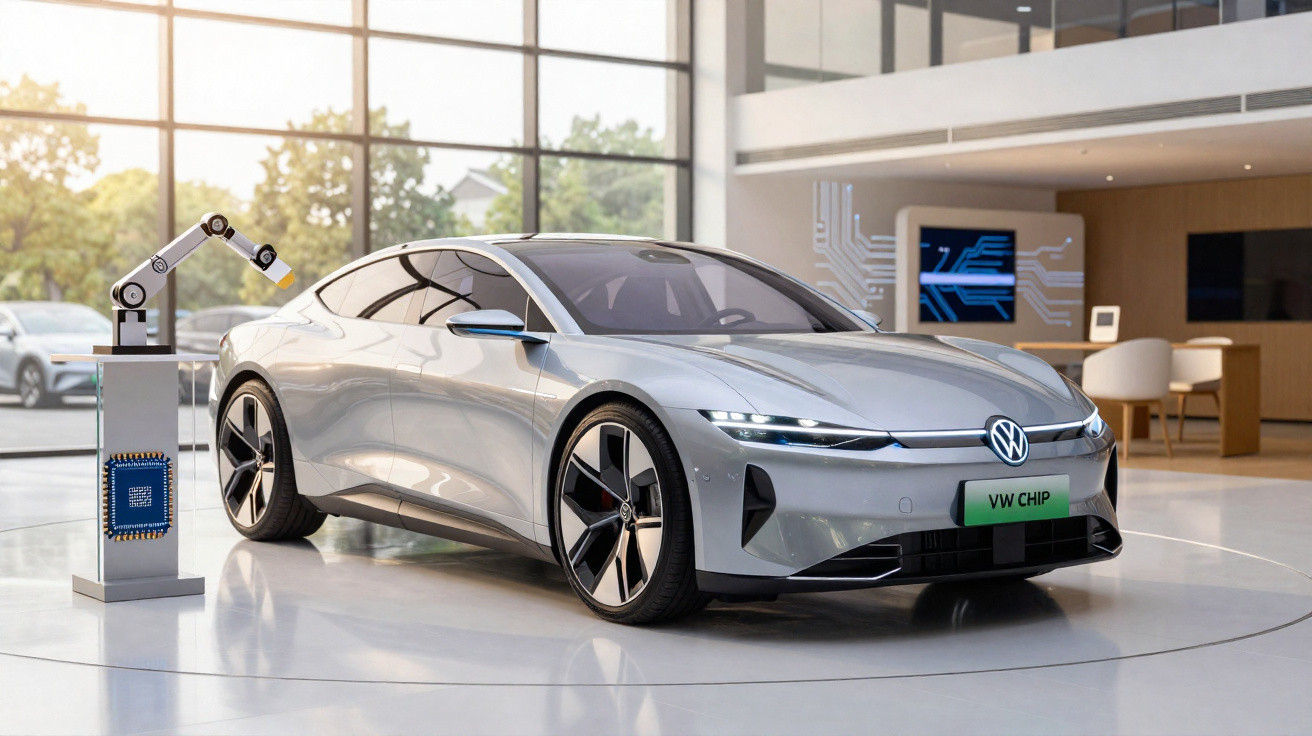
Carizon, the joint venture between Volkswagen and Horizon Robotics, is finally set to get up and running. Working with Horizon Robotics, Volkswagen wants to develop processors specifically for China-its most important market. The first chips are expected to reach vehicles within 3 to 5 years.
Back in 2022, Volkswagen put $2.3 billion into forming a joint venture with the Beijing-based startup Horizon Robotics, and afterwards the project largely disappeared from view. A brief update in April suggested the German manufacturer still intended to rely on its partner to build intelligent-driving functions, but there were few concrete details. On Wednesday, 5 November, Carizon confirmed chips are on the way for Volkswagen’s China-based production.
Carizon and Horizon Robotics: Volkswagen’s chip plan for China
This processor would be the company’s first to be developed in-house, even if it is easy to assume Volkswagen will have a limited hands-on role and that most of the engineering will sit with Horizon Robotics’ teams. At the end of September, Horizon Robotics raised $821 million on the Hong Kong stock market-funding presented as support for research and development of new autonomous-driving technologies.
What the Carizon chips will do
For Volkswagen, the chips are intended to handle the collection and processing of data coming from cameras and other sensors.
With computing performance quoted at 500 to 700 TOPS, Carizon’s chips are meant to sit at the heart of a new, centralised single-chip computer architecture. They are due within 3 to 5 years, although it is still unclear where the chips will be manufactured. For now, Volkswagen is only pointing to China-based production for vehicles sold in China, not in overseas markets.
China remains Volkswagen’s largest sales region, even if volumes are well below earlier highs: 2.75 million units in 2024 versus 4 million in 2018.
Volkswagen’s changes in China
Up to 2023, Volkswagen led the Chinese market in terms of sales. In that year, the company was symbolically overtaken by BYD. The following year, Volkswagen pulled out of talks with Renault on jointly developing its ID.1 (alongside the Twingo) for China, in order to streamline its roadmap and get on European roads sooner.
In early October 2025, Volkswagen revived its Cariad unit, which is responsible for developing the group’s in-house software, with a revised strategy built around external partners (Xpeng in China, Rivian in the United States).
Cariad’s teams are no longer tasked with designing the “2.0” software of the future; instead, they are focused on maintaining the current software and, going forward, ensuring proper integration of new software provided by foreign partners. With the trade war and supply difficulties involving Nexperia, could Volkswagen use Carizon to lock down its future chip supply?






Comments
No comments yet. Be the first to comment!
Leave a Comment