
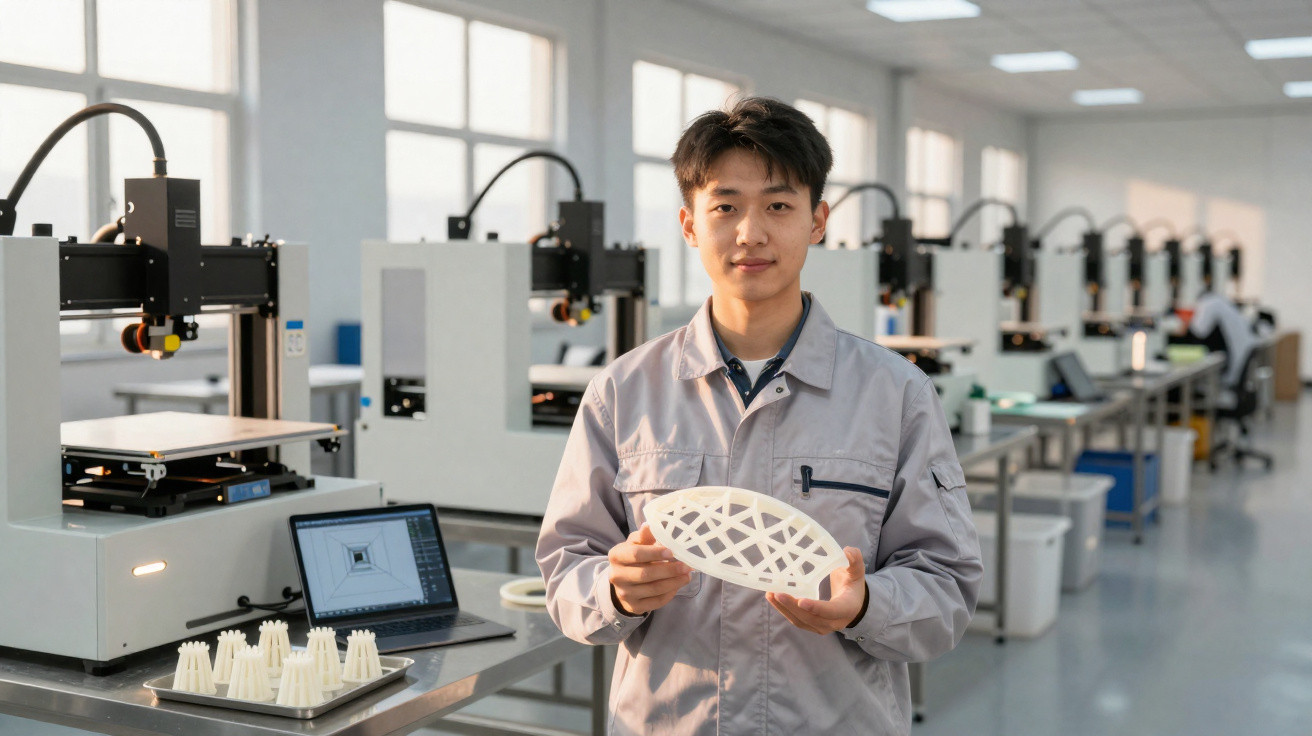
Quiet ranks of 3D printers are beginning to disrupt that long‑standing hierarchy.
From aircraft brackets to medical devices, additive manufacturing is moving into areas that used to belong almost exclusively to injection moulding and machining. A straightforward question is now troubling production managers: can serial 3D printing genuinely compete with established mass‑manufacturing approaches?
What serial 3D printing really means on a factory floor
Serial 3D printing is a world away from one‑off prototypes or attention‑grabbing concept pieces. It means producing the same part repeatedly (or producing parts with minor variations), in quantities that can run from a few dozen to tens of thousands.
Once components are intended for real‑world use, everything changes. Requirements become firm: dimensional stability, consistent mechanical behaviour, predictable costs and dependable lead times are no longer optional.
Serial 3D printing aims to behave less like a design studio and more like a production line-just without the moulds and tooling.
Several developments are coming together to make this feasible: fleets of industrial‑scale printers, greater automation for material handling and post‑processing, and a fast‑maturing selection of polymers and composites. Combined, these make it possible to run ongoing series without dedicated tooling-an important departure from conventional injection moulding or CNC machining.
Why industry is warming to additive production
Beyond the hype, there are solid, practical drivers behind why production engineers and operations teams are taking 3D printing seriously.
Flexibility that rigid tooling cannot match
Changing a mould or modifying a cutting tool can take weeks and run into thousands in cost. With 3D printing, the “tool” is simply a file: update the CAD model, check it, then dispatch the new revision to the printer fleet-often within the same week.
That speed reduces time‑to‑market and also supports regular design updates. In sectors like consumer electronics, sporting goods or mobility, this can translate directly into an edge over competitors.
Producing only what is needed
Serial 3D printing also supports on‑demand production. Rather than storing large inventories of spares or accessories, firms can manufacture in small, continuous batches.
- Lower warehouse and storage spend
- Less exposure to stock becoming obsolete
- Simpler handling of product variants
- Faster refresh cycles when designs improve
This approach aligns well with lean and just‑in‑time strategies, where money tied up in warehouses is treated as waste rather than protection.
Design freedom as a performance lever
The most disruptive advantage may be geometric freedom. Intricate internal channels, lattice structures for weight reduction, or turning multi‑part assemblies into a single component all become achievable.
Instead of designing parts for the machine, engineers begin to design parts for their function-and let the machine adapt.
For weight‑sensitive industries such as aerospace and high‑performance mobility, this can deliver lighter components, fewer fasteners and more straightforward assembly steps.
Main technologies used for industrial‑scale 3D printing
When the objective is continuous output, additive methods are not all equally suitable. In industrial serial production today, three technology families dominate: FDM, SLS and MJF.
FDM: workhorse for robust, functional parts
Fused Deposition Modelling (FDM) creates parts layer by layer by extruding molten thermoplastic. It is familiar from desktop machines, but industrial FDM systems are in a different class, with heated chambers, larger build envelopes and engineering materials such as ABS, PC, PEI or carbon‑filled blends.
In serial use, FDM is chosen for durability and controllable costs. It is frequently applied to functional parts, jigs and fixtures, assembly aids, and structural components in low‑to‑medium volumes.
The main drawbacks are surface finish and anisotropy between layers-factors that need to be considered during design. Even so, for many technical uses, the value for money remains compelling.
SLS: precision and repeatability in polymer powders
Selective Laser Sintering (SLS) uses a laser to fuse thin layers of polymer powder. Because the surrounding powder supports the part as it builds, dedicated support structures are not needed, which simplifies both design and finishing.
SLS delivers good dimensional accuracy, consistent mechanical performance and relatively uniform surfaces. It suits medium to large runs where dependability matters: housings, clips, connectors and small mechanical components.
For many engineers, SLS has become the reference point for industrial‑grade polymer 3D printing.
Its key trade‑offs include the complexity of powder handling, the finishing work required to remove and recycle unused powder, and the capital cost of the machines.
MJF: pushing toward higher volumes
Multi Jet Fusion (MJF), popularised by HP, also uses polymer powders, but replaces a single laser with arrays of inkjet heads and infrared energy. This enables rapid, full‑layer processing and typically reduces overall build times.
MJF is often seen as one of the best‑matched options for high‑volume serial printing of plastic parts. It combines consistent output, strong mechanical properties and the capacity to produce thousands of parts across repeated builds.
For OEMs making connectors, enclosures, brackets or intricate small parts in steady quantities, banks of MJF systems-sometimes arranged as “print farms”-are emerging as a credible alternative to small mould tools.
From design to finished part: an industrialised workflow
Industrial serial printing neither begins at the printer nor ends when a build finishes. It belongs within a broader production flow that runs from engineering through to finishing.
Design for additive manufacturing
Specialist engineering teams are increasingly helping firms adapt components to the constraints and benefits of additive production. This “design for additive manufacturing” (DfAM) work can include:
- Re‑orienting parts to reduce supports or limit warping
- Combining assemblies so fewer components are required
- Tuning wall thickness and lattice structures for strength and weight
- Allowing for post‑processing needs, such as inserts or threads
When a part is designed well, build time, material use and post‑processing effort can all fall-improving the economics of the entire run.
Print farms and automated flows
Rather than relying on a single large machine, many manufacturers now use groups of printers operating in parallel. These print farms expand throughput, add resilience if one unit fails, and make scheduling easier across materials or colours.
| Factor | Conventional line | 3D print farm |
|---|---|---|
| Scalability | Through larger tools and presses | By adding additional printers |
| Changeover | Hours to days | New file, new material batch |
| Redundancy | One point of failure | Spread across many machines |
Alongside this, more automation is appearing: robotic powder removal, automated build‑unit swaps, and software that controls job queues, traceability and quality documentation.
Post‑processing to meet industrial standards
Parts rarely come off the printer ready to ship. Post‑processing may involve depowdering, removing supports, tumbling, dyeing, surface blasting, painting, fitting threaded inserts or metal elements, and dimensional inspection.
The goal is not just a printed part, but a finished product meeting the same specifications as one from a traditional line.
This stage increases cost, but it is also where printed components are brought into line with established standards and expectations-particularly in areas such as automotive or medical devices.
Where serial 3D printing is gaining the most ground
In several sectors, serial 3D printing is already being used as a routine production route rather than merely a contingency.
Aerospace and defence
Weight reduction and complex shapes carry a premium here. Repeated series of 3D printed brackets, ducts, clips and cabin parts are now showing up in aircraft and satellites, beyond one‑off demonstration pieces.
Medical and healthcare
Customisation is effectively the norm in this space. Dental aligners, patient‑specific guides, hearing aids and orthotic devices are clear examples of serial production with high variation, well suited to additive methods.
Industrial equipment and robotics
Grippers, fixtures, covers and cable‑management components for robots and machinery are often produced in batches, with frequent iterations as production lines change. Without tooling, those updates become far easier to implement.
Spare parts and aftermarket services
Operators in rail, energy and heavy machinery are trialling or rolling out digital spare‑part catalogues: the part is stored as a file and printed on demand, sometimes near the point of use.
This model can keep equipment viable long after the original tooling has been discarded.
Where the limits still lie
Serial 3D printing is not a universal answer. For extremely high‑volume consumer products-millions of identical units per year-injection moulding still delivers the lowest unit cost once tooling is spread across the run.
Material options are also still more limited than with conventional processes. Metal additive manufacturing is available, but for large runs its throughput and economics are not yet broadly competitive outside specific, high‑value niches.
Skills can be a constraint too. Effective additive design, safe powder management and part qualification for regulated sectors all demand expertise that many factories are only just beginning to develop.
Helpful terms and scenarios for decision‑makers
Two ideas commonly come up when teams evaluate whether serial 3D printing makes sense for a given job.
Break‑even volume: the production quantity at which total 3D printing cost matches traditional manufacturing once tooling is included. Below that level, additive is often cheaper; above it, moulding or machining typically becomes more cost‑effective again. For some plastic components, the break‑even point is in the low thousands; for complex parts or those needing regular design updates, it can be much higher.
Mass customisation: producing large numbers of items where each one differs slightly. Examples include a sports brand offering helmets shaped to head scans, or automotive interiors with personalised elements for each order. In these cases, 3D printing does not merely compete with traditional methods-it supports a business model that tooling‑based manufacturing struggles to deliver.
For manufacturers, the most workable path is often a hybrid approach: using 3D printing for complex, lower‑volume or customised parts, while reserving conventional methods for simple, high‑volume components. As machine speeds increase and material prices drop, the dividing line is likely to move-gradually reshaping long‑held beliefs about how industrial production should operate.





Comments
No comments yet. Be the first to comment!
Leave a Comment